What are Gothic stories?
October 7, 2026
Now through October 31, we're waiving application fees for all freshman and transfer applicants!
*Common app code: Central27
Research project examines how free exchange of books fuels community
When Holly Hoffman, Tracy Donohue, Meghan Block, Kristina Rouech and JoDell Heroux started studying who used book exchange boxes in their neighborhoods, they hadn’t set out to answer any specific question. What they discovered was how the boxes help build a sense of community.
The two members of the Human Development and Family Studies faculty and three members of teacher and special education faculty are still sifting through the project, undertaken in collaboration with researchers at an institution in Georgia, but they’ve identified a few key themes that drive the use of the free book exchanges.
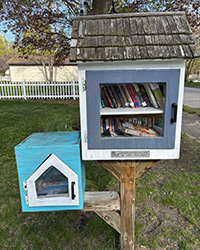
Informally, the book exchanges are called Little Free Libraries, after a Minnesota-based program that promotes their uses. Exchange boxes don’t require registration, but for a nominal fee, the organization will share the location of a box on an interactive map.
Registration appears correlated with higher rates of use, Hoffman said.
Little Free Libraries promote the sharing of books and other items by making them available to anyone who stops by to open one. The patron can take a book. They can also bring their own books to leave for other people.
Boxes that are visually appealing, easily accessible and encourage greater sharing through a larger selection of books saw more activity, the researchers concluded. Overall, they promote reading, accessibility and community connection.
Hoffman picked libraries around Mount Pleasant that were associated with notable landmarks: Pullen Elementary, the Discovery Museum and in a local neighborhood in the front yard of a local bookstore owner.
There were clear connections between the energy put into maintaining the boxes and the amount of use they got, she said.
Community connection was an important finding for the libraries Donohue studied in the Oakland County community of Milford, including one that had a butterfly garden built on top of it. But it was the human connection that stood out.
“All three of my libraries, I connected with people who live in those spaces,” she said.
Donohue built a running route around her libraries. It allowed her to inventory the books that were taken and the books that were left while getting exercise. The researchers also took photos of the library contents and left bookmarks that linked to surveys that patrons filled out anonymously.
They’ve developed some themes based on their observations, but they’re still working through the data to see what insights it offers.
They didn’t start the project with a specific inquiry in mind. They wanted to see where the data took them.
“We all agree that exploration is so important to us,” Hoffman said.
One question has emerged from Block’s ’s monitoring of libraries in East Lansing, where there is a robust library system. She said she’d like to learn about the relationship between a robust library system and patronage of Little Free Libraries.