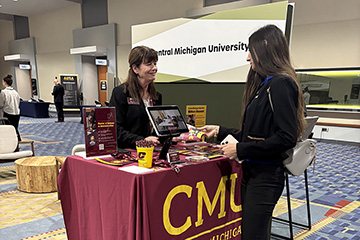
CMU hosting MI-ACE Women of Color Collaborative Annual Luncheon
October 22, 2026
Now through October 31, we're waiving application fees for all freshman and transfer applicants!
*Common app code: Central27
IPEP Director answers Q&A regarding how healthcare simulation has become a crucial component to health professions education
Healthcare Simulation Week highlights the impact of simulation-based education on healthcare workforce development. However, healthcare simulation is more than a week of highlights—it’s become a significant part of education within health care education. Central Michigan University's Interprofessional Education and Practice (IPEP) Center continues to provide hands-on learning experiences that prepare future healthcare professionals for real-world care delivery.
Amy Malheim, Director of the Interprofessional Education and Practice Center, answers intriguing questions to learn more about the center's growth, impact, and role in healthcare education.
Malheim: Simulation allows students to practice clinical skills, teamwork, communication, and decision-making in a safe environment before they work with patients. These experiences help learners build confidence and competence while strengthening interprofessional collaboration.
Malheim: It was an incredibly busy year. We are a small, but mighty team. As a team, the center facilitated 1,466 simulation sessions, recorded 537 hours of simulation activities, and supported 375 unique learners. Those experiences generated more than 1,500 student contact hours, and the center maintained an impressive 86% utilization rate. We are incredibly proud of the number of simulation sessions that we held this past year, and the impact this center has on the future of health care.
Malheim: It means hundreds of students had opportunities to engage in experiential learning that mirrors real clinical situations. Simulation provides a bridge between classroom knowledge and patient care, allowing students to refine their skills and learn from mistakes in a supportive environment.
Malheim: Since January 2019, the IPEP Center has hosted 7,507 simulation sessions, recorded 2,840 hours of simulation activity, and generated 3,719 student contact hours. Those numbers reflect years of collaboration among faculty, staff, and healthcare programs committed to innovative education.
Malheim: The center supports a wide range of health professions programs, including Audiology, Athletic Training, Nursing, Nutrition & Dietetics, Physician Assistant, Physical Therapy, Public Health, and Speech-Language Pathology. Bringing these disciplines together helps students learn how to function effectively as members of healthcare teams. We also have AHEC programs that utilize the space as well. We are always looking for different ways to explore and partner with other health focused departments to expand use.
Malheim: During a typical year, we run a variety of scenarios across all semesters. Recently, we facilitated 19 different scenarios in the fall, 37 in the spring, and 21 during the summer semester. This variety allows students to experience a broad range of clinical situations and patient populations.
Malheim: Creating a high-quality simulation requires significant planning. On average, it takes about 40 hours to develop a new scenario. Faculty and simulation specialists work together to create realistic patient cases, learning objectives, equipment needs, assessments, and debriefing activities that align with educational outcomes.
Malheim: It provides an opportunity to recognize the educators, technicians, standardized patients, and healthcare professionals who make simulation possible. Most importantly, it highlights the impact simulation has on preparing the next generation of healthcare providers to deliver safe, effective, and collaborative patient care.
As healthcare continues to evolve, simulation remains an essential component of training future professionals. Through thousands of learning experiences and collaborations across healthcare disciplines, CMU's IPEP Center is helping students develop the skills, confidence, and teamwork necessary to meet the needs of today's patients and communities.