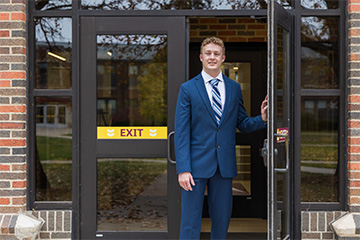
Austin Benchley turns CMU opportunities into a career with Celonis
November 19, 2026
As the longtime information systems professor prepares for retirement, he reflects on a career shaped by evolving technology and a commitment to student learning.
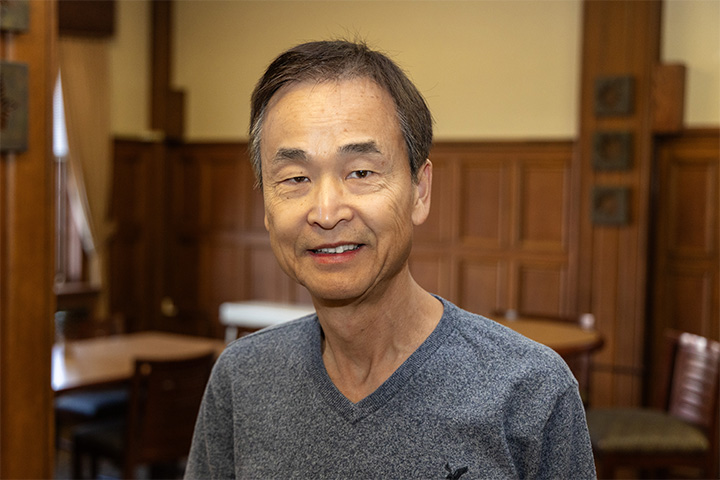
When Mark Hwang joined Central Michigan University's College of Business Administration in 1997, the technologies shaping the business world looked very different than they do today. Nearly three decades later, as he prepares to retire, the information systems faculty member is teaching the same subjects he taught during his first semester: database systems and application development. While the subjects remain familiar, the technologies and skills students need have changed dramatically.
"When I first came here, I was impressed by the emphasis placed on student learning," Hwang said. "CBA is student-centered and business-connected. We try to make student learning our number one priority. And we also try to teach relevant knowledge that students can apply in the business world."
Throughout his career, Hwang has continually adapted his courses to reflect changing industry needs. Early in his time at CMU, he transitioned his database courses to Oracle software, a decision that proved valuable when a former student credited the experience with helping him secure a job offer.
"I remember one time that a student actually emailed me saying that he just had an interview," Hwang said. "He got a job right away because they saw that he was taking a database class and learned Oracle, and they were using Oracle at their company. I was really happy about that, to be able to provide something that students can really benefit from in their career."
Application development is the first core course taken by IS majors. Hwang was instrumental in integrating different programming languages into this course including Visual Basic, COBOL, and Python. He has taught this course at both the undergraduate and graduate levels, and in both in-person and online formats.
Beyond these two courses, Hwang helped shape the college's information systems curriculum, developing courses in SAP Business Intelligence and SAP HANA, and contributing to graduate MBA and MSIS programs. As technologies evolved, he continued learning through professional development and collaboration with colleagues.
That willingness to adapt remains evident in his final semester, as Hwang encourages students in his Python application development course to use artificial intelligence to better understand programming concepts and troubleshoot problems.
"You can have a long conversation with AI to help you solve any problem step by step, but it's important that, at the end, you need to have learned the concept," Hwang said. "If you're called to explain your code, then you need to be able to do that. Otherwise, we know that AI can code, so that's not very useful to you. We need to know how you have learned coding with the help of AI."
The arrival of generative AI also raised new questions about how educators prepare students for careers and what graduates have to offer in a rapidly changing workplace.
"What can you bring to the company that AI cannot do? That's really a challenge for everyone, I think. We cannot do business as usual," Hwang said.
Hwang's academic journey began in Taiwan, where he studied international trade as an undergraduate. His interest in information systems emerged later, when he came to the United States for graduate school.
"I did not know that I wanted to get into information systems at first," Hwang said. "When I came to the U.S. to get my graduate degrees, I was introduced to the use of technology in business, so I decided to major in information systems. I really liked it after I had a chance to be exposed to using computers in business. I'm really glad that I made a switch."
That unexpected change in direction led to a distinguished research career exploring how people and organizations use technology. Hwang was named CMU's Research Professor in 2002 and recognized as the CBA's most-cited researcher in its 2020 AACSB accreditation report. Over his career, he published more than 40 peer-reviewed articles, made significant contributions to the development and launch of CMU’s online MSIS program, and became a certified SAP trainer for the ERPSim business simulation games. His influence also extends to generations of students who have gone on to careers at organizations including Google, Ford, Deloitte, IBM, and Dow.
“Mark has been a very productive researcher throughout his career, particularly in meta-analysis and related research methods. His publications have helped strengthen CMU’s reputation in the information systems research community,” said Zhenyu Huang, department chair.
Huang also highlighted Mark’s contributions to teaching and curriculum development.
“What I also appreciate about Mark is his willingness to take on new courses and bring emerging technologies into our curriculum. He was among our faculty who recognized early on the importance of SAP Business Intelligence and developed courses in that area,” Huang said. “At our October department meeting, Roberto Rando, one of our former graduate students who now works at SAP, spoke very highly of what he learned in Mark’s classes. It was wonderful to hear, so many years later, how much those learning experiences meant to him and his professional career.”
“As a colleague, Mark has always respected our departmental and university policies and procedures. I have appreciated his professionalism and his commitment to maintaining a collegial and productive working environment. We will miss him in BIS,” Huang said.
As he prepares for retirement, Hwang's advice to students reflects the same commitment to learning that has guided his career.
"Try to learn as much as you can about how AI can be used in your career," Hwang said. "No matter what your career is or what your goals are, what you're trying to accomplish, try to find out how AI can help you do that."
After the fall semester, Hwang plans to travel to Hong Kong and China, including a three-month stay on Hainan Island with a retired CMU colleague. It will be his first visit to the island and a welcome break from Michigan's winter after nearly three decades in the classroom.
While the technologies Hwang taught have changed dramatically since 1997, his commitment to helping students develop practical, relevant skills has remained constant. It is a philosophy that will continue to shape his legacy at CMU.