Now through October 31, we're waiving application fees for all freshman and transfer applicants!
*Common app code: Central27
PING students present cutting-edge research at national APS meeting
Three students from Central Michigan University’s PING (Physics Inspiring the Next Generation) program took their work to a national stage this year, presenting their research at the American Physical Society’s Division of Nuclear Physics (APS DNP) annual meeting. It was an impressive accomplishment for a cohort of just six PING participants.
For the students, high schoolers engaged in advanced research through PING, the conference offered a rare chance to share their findings at a major national scientific meeting. Their project focused on the neutron activation of chlorine isotopes and the analysis of those isotopes using gamma-ray spectroscopy, a level of research typically carried out by undergraduate or graduate students.
Preparing future physicists
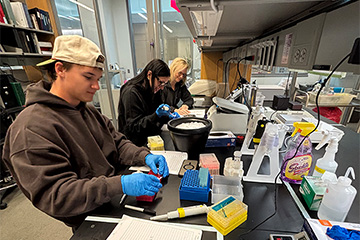
Preparing for the APS meeting was a months-long effort. The students began developing their presentation during the PING summer camp, where they practiced sharing their work during a workshop at the Facility for Rare Isotope Beams (FRIB). After the camp ended, the group continued meeting online to polish their results, refine their slides, and build confidence for a national audience.
“PING gives these students hands-on experience in a real university lab setting,” said Matthew Redshaw, chair of the CMU Department of Physics, who accompanied the students to the conference. “Attending APS helps them see what academic research looks like and what a career in physics could be.”
Professional growth at a national conference
The APS conference offered much more than presentation experience. Students attended scientific sessions, explored current research, and learned about degree programs and career paths in physics. Redshaw supported them throughout the process, from assisting with conference applications to organizing travel and helping them decide which scientific talks to attend.
“They got a sense of what research in a real physics university lab looks like,” Redshaw said. “This experience gives them a major advantage. Most high school students don’t have research or conference presentations on their résumé.”
Building connections and future collaborations
The conference fostered strong mentorship and networking opportunities as well. Current CMU undergraduate students who served as PING mentors helped younger students navigate the event. As PING continues to grow, these connections will form an expanding network of alumni and future collaborators.
What's next
Even though the high school students have wrapped up their conference presentations, their research is far from over. CMU graduate and undergraduate physics students are continuing to build on the chlorine isotope project, with plans to use the isotopes in an experiment at FRIB, further extending the impact of the PING students’ foundational work.
As PING continues to inspire young scientists, this year’s APS participation showcases the program’s expanding reach, its dedication to student development, and the bright futures ahead for its budding researchers.