
The week in photos: October 5-11
October 12, 2026
Now through October 31, we're waiving application fees for all freshman and transfer applicants!
*Common app code: Central27
CMU receives $30M investment from the state to strengthen STEM education
Brooks Hall is home to numerous foundational science programs at Central Michigan University. Each year, thousands of students spend time in classrooms and labs in Brooks Hall as they prepare for careers in high-demand fields, including environmental engineering, environmental science, biology, and healthcare. And now, with new support from the state of Michigan, Brooks Hall will receive a much-needed renovation that creates learning spaces that inspire entrepreneurial thinking and collaborative problem solving.
In July 2026, the Michigan legislature approved a $30 million investment in a total $45M capital outlay for the renovation of Brooks Hall, which was signed by Michigan Governor Gretchen Whitmer on July 21.
With the $30M commitment from the state, CMU will begin to move forward with the planning phase for renovations, said Mary Hill, vice president for finance and administrative services and CMU’s chief financial officer.
The construction phase will begin at a future date, after the university has shared and received state approval on the draft building plan, Hill said.
While innovation in STEM fields moves at a rapid pace, facilities and classrooms in Brooks Hall haven’t always been able to keep up, said CMU Provost Paula Lancaster.
Brooks Hall was constructed in 1964 and, since that time, has been the primary home for CMU’s science departments and programs. However, due to its age, Brooks Hall was no longer meeting modern requirements for teaching, learning and research in the sciences, Lancaster said.
“Brooks Hall was well built in the 1960s, but it needs significant renovations in order to provide the safest, most effective learning environment possible for students, and to support our faculty’s high-impact research,” Lancaster said. “In the decades since the construction of Brooks Hall, teaching practices have evolved, technological developments have altered the way research is conducted, and safety standards have changed. Renovating Brooks Hall will address each of these issues and advance our educational mission.”
Upgrading the building won’t simply improve the campus infrastructure, she said, it will also bolster student success. For example, the $30 million investment from the state of Michigan will support enhancements including:
“The sciences are at the heart of many of Michigan’s fastest growing career fields, and it is vital that we educate and prepare students for success in those areas,” said Michigan Senator Roger Hauck. “This investment in CMU is an investment in our young leaders, who will power the future of our state and our economy.”
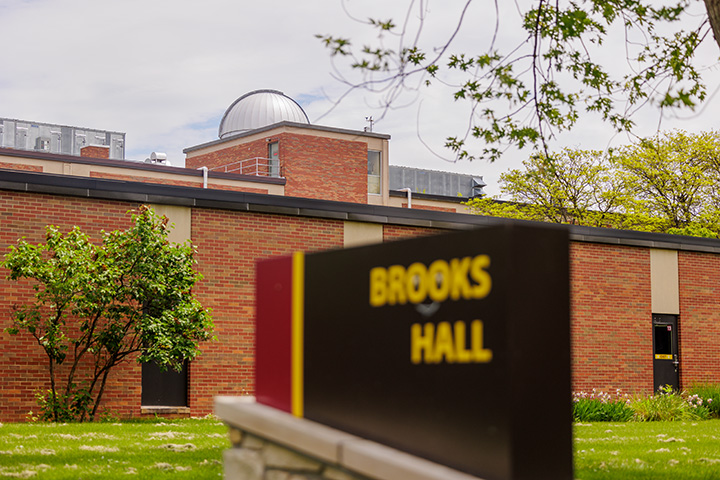
Brooks Hall will be home to the successful Integration of Science, Technology and Engineering, or InSciTE, program. The cohort-based interdisciplinary program engages undergraduate students in a team-based, research-forward approach to problem solving in STEM fields.
Wiline Pangle, director of the InSciTE program, said the Brooks Hall renovation will provide the program with spaces equipped for team-based, active-learning.
“Transferable skill-building and community are key components of the InSciTE program. We help students learn and practice teamwork and collaboration, communication, leadership, creativity and innovation, perspective-taking and problem solving,” said Wiline Pangle. “Now, for the first time, we will have a program home built specifically for that kind of collaboration and engagement. We will have spaces that do not feel sterile, that are instead intentionally designed to inspire teamwork and creativity in STEM disciplines.”
Beyond the classrooms, Pangle said the renovation plans will strengthen all student success initiatives.
“With this renovation, we will bring together all the student support services into a centralized place for students in our college,” Pangle said. “Bringing study and brainstorming spaces, academic support services, and classrooms together all in one place will help to foster a greater sense of community.”
And, finally, Pangle believes that the renovated building will reflect the passion and strength of students and faculty.
“We will have a space that feels modern and appropriate for their interests, and that really sends a message,” Pangle said. “Our spaces can do a great deal for our mental health and well-being. This investment shows that these programs and the people in them are valued.”
The state’s investment in Brooks Hall is a vote of confidence in the university’s academic mission and will strengthen more than just the Mount Pleasant campus, said State Representative Jerry Neyer.
“A stronger CMU means a stronger Isabella County,” Neyer said. “Projects like this support good-paying jobs during construction and help the university attract students and faculty who will spend their time and money here in our community — that’s the kind of long-term economic activity this investment supports.”
Hill said that most campus construction projects are completed by local and Michigan-based contractors. Once the university completes an initial project plan for the facility and has it approved by the state, CMU will issue a request for proposal for firms to support the renovations and next steps.
And, interest in STEM majors has grown in recent years, and CMU’s Strategic Enrollment Management plan includes emphasis on academic programs, including those in the sciences, with a high probability to engage prospective students.
“We’re thrilled to bring more students to campus to experience the high-quality, engaged instruction and research that our faculty provide,” Lancaster said. “They ensure that students leave our programs with deep knowledge about their subject matter and also having had critical experiences as researchers and problem solvers addressing the enduring questions and scientific issues of our time.