Now through October 31, we're waiving application fees for all freshman and transfer applicants!
*Common app code: Central27
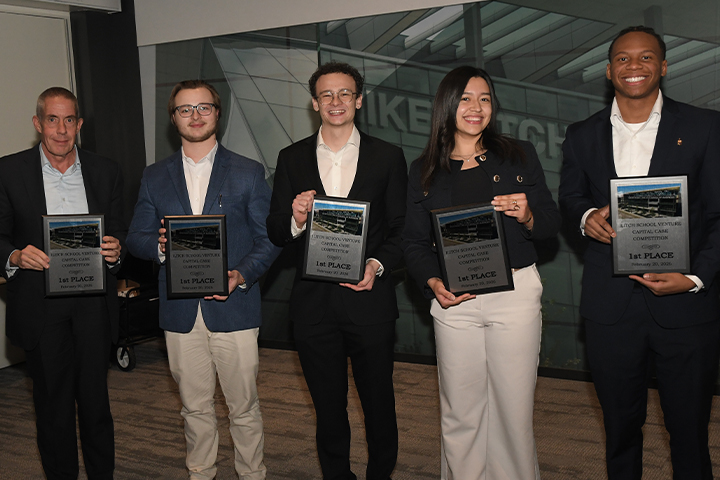
CMU finance students win inaugural venture capital competition
Students impressed judges with real-world diligence, disciplined analysis, and a partnership mindset
By the time the clock hit 3 a.m. in the Detroit hotel conference room, the work was just beginning to click.
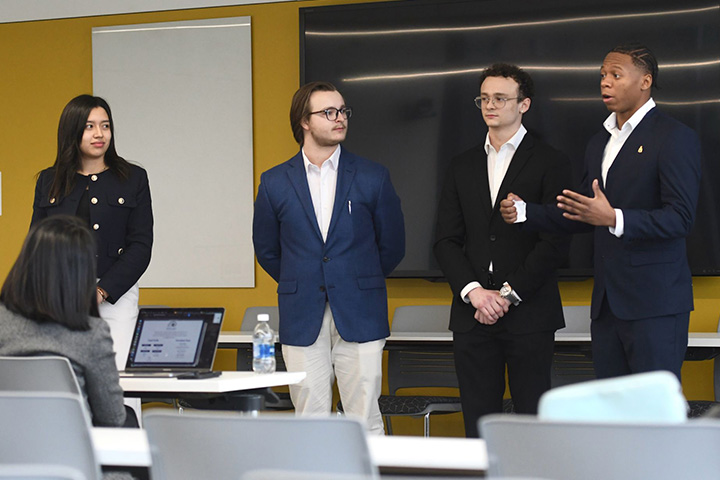
Four hours later, Central Michigan University finance students—Derek Ballas, Mark-Allen Gay, Carolina Hernandez Ruiz, Blake Jimenez—would present their final investment recommendation in a statewide venture capital competition. But in that quiet stretch of early morning, refining term sheets, stress-testing valuations, and aligning on conviction, something shifted.
“I sat in the judges' deliberations until the vote, and it was very clear that CMU had won the competition,” said finance faculty member Brad Taylor. “They outperformed after staying up to 3 a.m. to get a handle on the case study.
“This is as real as it gets. The judges loved the interaction between group members, their concise questions, and the fact that they introduced themselves and asked the founders what they wanted from their VC partner. Great job, hard work pays off!”
The case required students to examine three real startups, interview their founders, and present an investment recommendation, complete with valuation and term sheet, to venture capital professionals serving as judges.
For CMU, it marked the first venture capital competition in program history. For the students, it was a defining moment.
“This truly was a team effort.”
For Derek Ballas, a finance major from Allen Park, Mich., the 3 a.m. moment came after a whirlwind 48 hours.
The competition data room opened on Wednesday morning. Presentations began on Friday.
“This was a very quick turnaround for a competition and really tested our ability to meet a tight deadline,” Ballas said. “The specific 3 a.m. moment Brad Taylor was referencing was when we found a conference room at our hotel in Detroit and stayed up most of the night finishing our final deliverable for the competition in the morning.”
With a 7:30 a.m. departure looming, fatigue set in. But so did clarity.
“By 3 a.m., everyone is tired and ready to end the night,” he said. “But this really was when all the hard work went in, and everything started to come together. What kept us going was the fact that we knew we were doing good work and knew we had a great chance to win the competition the next day if we brought everything together.”
Mark-Allen Gay, a double major in finance and sales from Miami, Fla., described the same moment as intense and energizing.
“We were deep in refining our term sheet assumptions, stress-testing our exit analysis, and making sure every number we would put in front of the judges could withstand real scrutiny,” Gay said. “At that hour, the technical work almost became secondary to something more important: alignment.”
He added: “We were competing in the first VC competition in CMU's history, and that responsibility meant something. If you want a university to be taken seriously in the venture capital ecosystem, the standard has to be high from day one. Culture compounds just like capital does.”
Real founders. Real capital. Real stakes.
Unlike a traditional classroom case, the outcome wasn’t written in advance.
Founders sat across the table. Venture capital professionals evaluated every assumption. Students had to assess not only financials, but leadership, coachability, and long-term fit.
“This competition was as real as it gets,” Ballas said. “Real startups, their founders, VC professionals as judges, real valuations and term sheets, and last but not least, real conversations and connections.”
Students acted as venture capital analysts, performing due diligence, interviewing founders, forming an investment thesis, and defending it under pressure.
Gay said the human element made the difference.
“In a classroom case study, the outcome is already written. The information is curated. The stakes are a grade,” he said. “In this competition, the founders were sitting in front of us. Their stories, their pivots, their conviction made everything real.
“We were not just analyzing numbers. We were evaluating coachability, resilience, adaptability, and founder-market fit. That is real venture capital.”
Selling more than capital
Judges repeatedly praised CMU’s professionalism and presence, particularly the way the team asked founders what they wanted in a venture capital partner. That question was intentional.
“In VC, you are often trying to sell the founder on how you would be a great partner just as much as they are selling you their startup idea,” Ballas said. “Our team has been immersed in the VC space, which allowed for that to come through in how we showed up.”
Gay agreed.
“The best VCs are not just capital allocators. They are long-term partners,” he said. “Asking what they wanted in a VC partner was not soft. It was analytically useful. It shifts the dynamic from interrogation to alignment.”
That approach, balancing quantitative rigor with qualitative diligence, ultimately set CMU apart.
“We combined strong financial analysis with structured qualitative diligence,” Gay said. “Under pressure, we communicated clearly and avoided unnecessary complexity. Venture capital is ultimately about disciplined judgment, not flashy slides.
Built long before the competition
While the turnaround time was short, the preparation started years earlier.
Before the case was even released, the team met for a two-hour “VC 101 crash course” to ensure alignment. Once materials were available, responsibilities were divided based on strengths: financial modeling, market analysis, founder diligence, and narrative structure, with every major decision made collectively.
The foundation, both students said, was built at CMU.
“CMU and Brad Taylor are the reasons outcomes like this can even be possible,” Ballas said. “When I walked into CMU my freshman year, all I knew was that I did well in math class and finance seemed interesting. Over the next four years, Brad Taylor and the College of Business Administration equipped me and all of us with the abilities not only to compete but win a statewide venture capital competition and to pursue our passions.”
He pointed to hands-on experiences like working with the $4 million Student Managed Investment Funds and collaborating with alumni and university leadership as critical preparation.
Gay emphasized the same applied mindset.
“CMU prepared us by emphasizing applied learning over memorization,” he said. “Professor Brad pushed us to think like investors, not students. He challenged assumptions, made us defend every number, and reinforced that venture capital is about disciplined conviction.”
He added, “CMU does not just teach finance. It is starting to cultivate investment thinkers.”
Fired up for what’s next
For Professor Taylor, the win was about more than a trophy, it was proof that CMU students can operate at the highest levels of finance when given the opportunity and the expectation.
In a discipline where uncertainty is the norm and most investments fail, disciplined thinking, teamwork, and resilience matter. And for these students, it may have marked the beginning of something larger, not just a victory, but the foundation for a growing venture capital presence at CMU.
Related News


Kennedy Burns shares marketing lessons with CMU students
October 19, 2026
Kathy Litwiller keeps the details moving and the door open
October 16, 2026
CBA week in Pictures: October 12th - 16th, 2026
October 16, 2026
BELONG Peer Mentorship Program helps students find connection
October 15, 2026