Public invited to explore cybersecurity in practice
October 12, 2026
Now through October 31, we're waiving application fees for all freshman and transfer applicants!
*Common app code: Central27
In ENT 300, students from across campus build confidence and develop skills that reach far beyond starting a business
When faculty member Howard Haines asked a simple question in his ENT 300 Digital Entrepreneurship class—“Who isn’t an entrepreneurship major?”—about three-fourths of the room raised their hands. The response captured something bigger than a single class roster.
Entrepreneurship at Central Michigan University College of Business Administration is attracting students with a wide range of goals, backgrounds and majors who see value in learning how to build ideas, solve problems and create opportunities. Some students want to launch businesses. Others want to strengthen the skills they can carry into careers in music, marketing, management, creative industries, and beyond. Inside Haines’ classroom, those paths come together.
ENT 300 Digital Entrepreneurship leverages technologies, platforms, and the internet to lower the cost of starting a business, so students spend the semester working on launching their startup ideas. But they do not do it alone. The course is structured around peer-to-peer mastermind groups that meet weekly to solve problems, hold each other accountable, share advice, and connect to resources that can help each student founder move forward with their startup project. They also engage in multiple project reviews with mini-advisory boards that can help them figure out more strategic decisions. Along the way, they learn how to adapt when assumptions prove wrong or incomplete.
The course structure reflects Haines’ collaborative teaching style. Students regularly share progress, challenge ideas, ask questions, and help one another think through the next steps. The result is a classroom environment where participation feels natural, and students become invested in one another’s success.
“While the official learning objectives focus on leveraging technology, the meta-learning that happens involves students learning their own execution capacity and then finding ways to grow it by connecting and working with others.” Haines said.
With a smaller class size, students also receive close coaching and the opportunity to build meaningful relationships with classmates and faculty.
During final project reviews, students presented ventures that reflected a wide range of interests and industries. Some projects focused on digital services, ecommerce, or content creation, while others explored retail, hospitality, creative brands, and community-based business ideas.
One student shared how his original business concept was too broad and failed to gain traction, leading him to pivot toward a new market and outreach strategy. That process required rethinking his approach, learning from setbacks, and continuing to take action.
“It wasn’t as linear as I thought it was going to be,” said junior media arts major Jack Connors of leftlink.ai . “But that’s entrepreneurship.”
He also described learning to cold call potential clients, a challenge that pushed him to become more resilient and confident.
Another student explored the feasibility of a coffee shop concept in nearby Ithaca, connected to a larger family business vision. Through the project, she evaluated startup costs, local traffic and market demand, and multiple revenue models.
“You think going into it, this coffee shop is going to work by itself,” said junior entrepreneurship major Kaitlyn Klumpp. “Then you learn what has to change.”
Those lessons extend well beyond entrepreneurship. Students gain experience in navigating uncertainty, communication, research, decision-making, sales, financial thinking and problem-solving, all of which are valuable in nearly any profession.
Haines said many students enter the course with different ambitions and in different industries, but they often leave with a similar takeaway: knowing how to turn an idea into reality through their own actions. For some, that may mean launching a company. For others, it could mean leading projects inside an organization, improving a family business, or identifying new career opportunities. As workplaces continue to evolve and job markets become uncertain, entrepreneurial thinking has become increasingly relevant across industries.
That is one reason entrepreneurship can pair naturally with many majors. Students build adaptable skills that complement technical knowledge, creative talent, and professional interests.
The class also creates space for students to practice something just as valuable as business strategy: confidence. Students imagine where they want to go, undertake the planning and effort to make it happen, present ideas publicly, receive feedback, revise plans, and keep moving when things do not go as expected. They learn that progress is rarely perfect or linear, and that setbacks often lead to stronger ideas or better execution excellence.
In ENT 300, digital entrepreneurship is not limited to one major or one career path. It is for those who learn by doing and want space to build whatever future they choose.
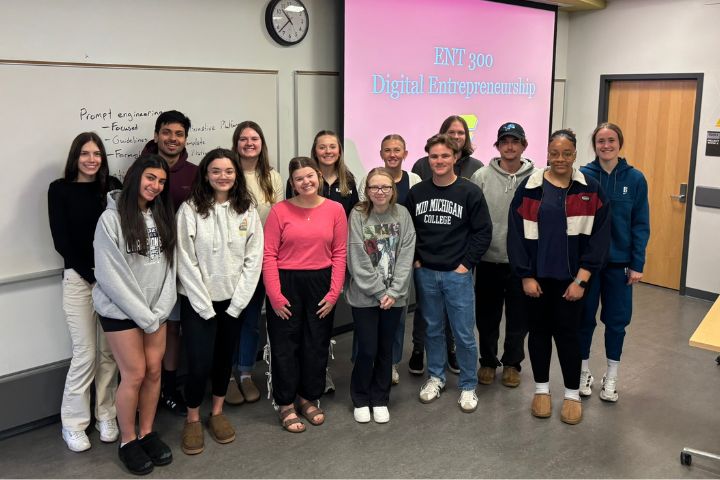
Students in ENT 300 Digital Entrepreneurship gather in the classroom, where collaboration, peer feedback and hands-on work help turn ideas into real-world ventures.