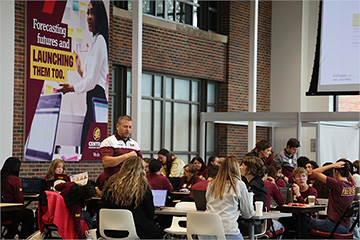
Tomas Thundiyil examines how language shapes leadership
September 28, 2026
Now through October 31, we're waiving application fees for all domestic freshman and transfer applicants!
*Common app code: Central27
Oct. 5 birthday celebration invites students to meet the man behind Grawn Hall
Students who pass through Grawn Hall every day will have a chance to get to know its namesake a little better Monday, Oct. 5, when the College of Business Administration celebrates the birthday of Charles T. Grawn.
Students can stop by the Grawn Hall atrium for saltwater taffy and limited-edition Charles T. Grawn trading cards featuring pieces of his life and advice. The celebration marks Grawn’s Oct. 4 birthday and grew out of a summer research project that started with a much simpler question: Who was the man in the portrait?
Alisha Draper had walked past Grawn’s portrait near the building’s south entrance countless times.
“I knew the basics. He was one of Central’s early presidents, and obviously he was important enough that we named a building after him,” Draper said. “But I started wondering, who was he beyond the biography? What did he value? What was he like? Did he deserve to be someone we still think about and admire?”
That question became a summer research project and, eventually, something of a rabbit hole.
Draper, director of marketing and communications for the College of Business Administration, began digging through materials from Central Michigan University’s Clarke Historical Library, including old university bulletins, yearbooks, commencement programs, newspapers and other contemporary accounts.
What she found was someone much more interesting than the stern administrator looking out from the portrait.
Charles T. Grawn was born Oct. 4, 1857, in Salem, Michigan, to Swedish immigrant parents. After beginning his career as an educator, he spent years leading schools in Plymouth and Traverse City before coming to Central Normal School in 1900.
He would lead the institution for the next 18 years, first as principal and later as president, overseeing a period of significant growth in Central’s campus, faculty and academic programs. But those accomplishments were only part of what Draper wanted to know.
“The biographies give you the highlights, but I wanted to know what this man was actually like,” Draper said. “And the more contemporary sources I found, the more personality started coming through. Students wrote limericks about him. They made jokes about him in the yearbook. People recorded stories about him. You start to realize that students had a relationship with him that was much more than, ‘That’s the man who runs the school.’”
Some of the details are surprisingly personal. Grawn entertained children with Swedish folk tales. He took pride in the trees planted across Central’s growing campus. He became a sought-after speaker. Accounts described him as hardworking, even-tempered, economical and attentive to detail. And apparently, he was a bit of a looker.
One history describes the tall, straight-backed Grawn as “the most handsome man on the faculty.” Another notes the “handsome, impressive presence” he brought to public speaking.
“That was part of the fun of this project,” Draper said. “You look at this very formal portrait with the big white mustache and think you know who you’re looking at. Then you start reading, and by all accounts, this man was delightful. He could absolutely be stern, but there’s a warmth in the way people wrote about him. He starts to feel like a person rather than a name on a building.”
Perhaps one of the strongest connections between Grawn’s world and the students who occupy his namesake building today comes from Grawn himself.
In a March 1917 edition of the Central Normal Bulletin, Grawn reflected on what he would do differently if he were beginning his professional career again.
His recommendations included taking care of his health, learning to think carefully, communicating well, developing character and good habits, choosing optimism, knowing what he believed, continuing to learn and getting to know people.
For Draper, the striking part wasn't simply the advice. It was how little of it sounded like it came from 1917.
“I kept reading it and thinking, we would tell our students these things today,” Draper said. “His voice doesn’t sound out of place in our contemporary Grawn Hall. He could walk into a Dialogue Days presentation here, give students much of the same advice he gave more than 100 years ago, and I think it would still resonate.”
For Draper, the advice reinforced something she had begun to see throughout the research: The distance between Grawn’s Central and today’s university sometimes feels surprisingly small.
“Once you start reading about Grawn, you start meeting all these other familiar names: Larzelere, Sloan, Warriner, Ronan and others whose names are still part of campus,” Draper said. “We walk through buildings with their names on them every day, but they were people who knew each other and worked together and had personalities and opinions and stories. You start getting this wonderful little glimpse of what CMU was like more than 100 years ago.”
Grawn Hall provides an especially tangible connection between those two versions of Central.
The building that now houses the College of Business Administration was constructed during Grawn’s presidency. More than a century later, students still study, meet and build their own careers inside a place Grawn himself knew.
“I think there’s something wonderful about that,” Draper said. “He was here. He knew this building. And now, more than 100 years later, students are walking past his portrait every day, probably without any idea who the guy with the giant white mustache was. I wanted to remedy that.”
Grawn was born Oct. 4, 1857. Because his birthday falls on a Sunday this year, the college will celebrate Grawn Day on Monday, Oct. 5.
Students can stop by the Grawn Hall atrium for saltwater taffy and limited-edition Charles T. Grawn trading cards featuring pieces of his life and advice.
The celebration is intentionally a little playful. So, for that matter, is the project that inspired it.
“I started out wanting to answer a pretty simple question: Who was Charles Grawn?” Draper said. “The more I learned about him, the more I liked him. He worked hard. He cared deeply about education. He thought people should keep learning, know what they believe and get to know other people. He planted trees. He told Swedish folk tales. Apparently, he was the most handsome man on the faculty. What’s not to like?”
And if the old president happens to still be keeping an eye on the building that bears his name, Draper wouldn't particularly mind.
“If Grawn Hall has to be haunted by somebody, I feel like we could do a lot worse than Charles Grawn,” she said.