Kennedy Burns shares marketing lessons with CMU students
October 19, 2026
Now through October 31, we're waiving application fees for all freshman and transfer applicants!
*Common app code: Central27
Cross-campus collaboration brings theater techniques into an advanced selling course
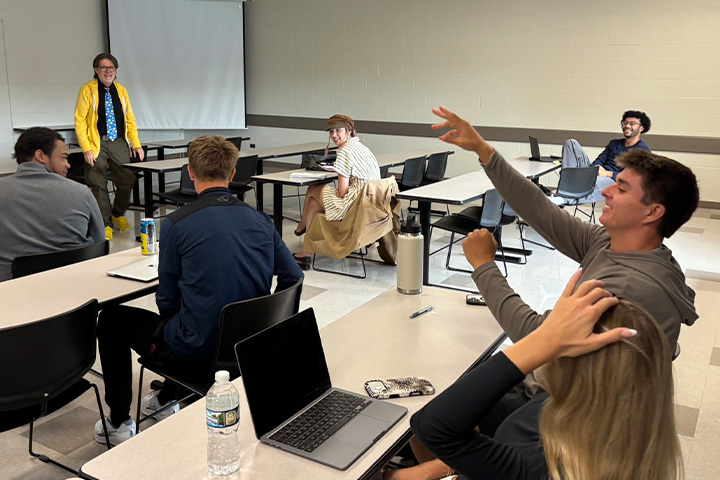
There wasn't actually a ball flying around Jeff Hoyle's MKT 420 classroom, but that didn't stop students from catching it.
As an imaginary ball moved around the room, students changed its size and weight, bounced it, dropped it and transformed it into a volleyball, a bowling ball and eventually a meatball. Whatever the student before them established, the next person had to accept, build upon and pass along.
The exercise wasn't preparation for a theater production. It was part of Advanced Selling and Negotiation.
Jody Price, a faculty member in Central Michigan University's Department of Theatre and Dance in the College of Arts and Media, visited Hoyle's class Sept. 17 and 22 to introduce students to improvisation and explore what its principles can teach them about sales.
At first, the disciplines might seem like an unlikely pairing. But both require people to enter situations they can't entirely predict, listen closely to the people around them and respond in the moment.
"You don't know what the situation is going to be like when you get there," Price told students. "And you are improvising when you get into those situations a lot of the time."
Price told students they might enter a sales interaction with some things planned, but they can't anticipate everything that will happen. He wanted them to experience some of the same uncertainty improvisers face when they step into a scene.
Price brought substantial experience to the classroom. Before earning his Master of Fine Arts in playwriting, he worked as an actor, writer, children's television host and stand-up comedian. He also spent about four years teaching improvisation at Stevie Ray's Comedy Theatre and Cabaret in Minneapolis.
But his lesson wasn't about teaching business students to become actors or even about teaching them to be funny. Instead, Price introduced principles of improvisation that translate beyond the stage: trust yourself, pay attention to what's happening, work with what you're given and support the people around you.
"The first rule of improvisation is trust," Price said.
That includes trusting fellow performers, but Price emphasized another kind of trust that matters when someone has to respond without a script.
"You've got to trust yourself," he said. Students put that idea into practice rather quickly.
The imaginary-ball exercise asked them to make eye contact, accept what another person had established and contribute something of their own. Students leaned into the exercise, setting and spiking the nonexistent volleyball and continuing the action when the ball was dropped and rolled across the classroom.
The willingness to be a little silly served a more serious purpose. Students had to pay attention to one another and react rather than retreat to a prepared response.
That attention to others became another connection between improvisation and sales. Price told students that improv isn't about competing to deliver the funniest line. It requires performers to work together and allow humor to emerge from what they're collectively creating.
He encouraged students to "stop, look and listen" before entering a situation, understanding what has already been established so they can contribute rather than disrupt it. The same principle can apply when working with a customer or colleague. Instead of concentrating exclusively on what they plan to say next, students have to listen and adjust to the person in front of them.
Price summed up that collaborative mindset with another principle: "The best way to do that is to make other people look good."
For students preparing for careers in professional sales, the lesson shifts the focus from delivering the perfect pitch to participating effectively in an interaction. That approach aligns closely with the goals of MKT 420, where students develop consultative selling and negotiation skills and learn to build value-based relationships with business-to-business customers. The course includes communication styles, collaborative problem-solving, negotiation and relationship development.
Finance and professional sales dual major Mark-Allen Gay Jr., of Miami, Fla., saw the same connection between the trust required in improv and the interactions he may encounter professionally.
“We had to trust ourselves enough to go with the first thought that came to mind and commit to it, while also trusting the other person to continue building the scene,” Gay said. “To me, that applies directly to sales, negotiation, leadership, and even everyday communication.”
Professional sales major Nicole Watts, of Novi, Mich., also saw applications beyond the classroom as she prepares to begin her career after graduation.
“Improv requires a lot of trust in yourself and those around you to carry out objectives in a short amount of time, and it’s nice to have that foundation set up for me as I enter a sales career next year post-grad,” Watts said. “It was a very insightful class period.”
Bringing Price into a business classroom also gave students an opportunity to approach familiar professional skills from an unfamiliar direction. Price described improvisation as learning to work with whatever you're given. For students, that meant temporarily trading sales presentations for imaginary objects, accepting someone else's idea and discovering what they could add next.
The result was an exercise in creativity, adaptability and collaboration, skills that don't belong exclusively to a stage, a sales classroom or any one academic discipline. They belong wherever the next response can't be scripted.