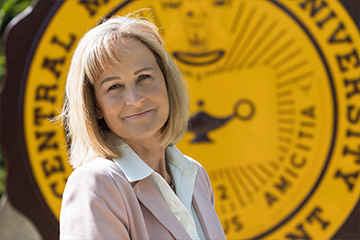
Kathy Litwiller keeps the details moving and the door open
October 16, 2026
Now through October 31, we're waiving application fees for all freshman and transfer applicants!
*Common app code: Central27
CBA Research Award highlights impact beyond academic journals
This spring, Keejae Hong was recognized with the College of Business Administration Research Award, honoring sustained scholarly excellence and meaningful contributions to the field of accounting. The award recognizes faculty whose work not only advances academic knowledge but also strengthens student learning and connects research to real-world challenges reflected throughout Hong’s career.
For Hong, the recognition represents both personal appreciation and institutional support for research at CMU.
“I am very glad to see that the College of Business Administration recognizes and values faculty research,” he said. “Awards like this are not only a personal honor; they are an institutional signal that scholarship matters at CMU.”
Hong’s research focuses on financial accounting, audit quality and international standards, but its impact extends well beyond academic audiences. He intentionally pursues questions that resonate outside the classroom, connecting accounting research to broader conversations in business and society.
“Whenever I can, I try to choose questions that also speak to people outside the academy, practitioners, regulators, journalists, and the broader public,” he said. “Accounting is the language businesses use to communicate with society.”
That approach gained national attention during the COVID-19 pandemic, when his earlier research on asset impairment became highly relevant. Reporters from The Wall Street Journal reached out after finding his work, leading to multiple interviews and features tied to corporate write-downs during the crisis.
“For me, those interviews were a confirmation that academic research can reach far beyond the journal page,” Hong said.
Hong views research as a core responsibility of higher education, alongside teaching.
“I think about higher education as having two responsibilities,” he said. “The first is teaching, but the second is generating new knowledge for society.”
That work, he noted, is often demanding and requires persistence.
“Long projects, rejected papers, revisions that take years, most of the day-to-day is grinding,” he said. “But every once in a while, you discover something genuinely new and those moments are what keep me going.”
In the classroom, Hong brings his research directly into student learning experiences, helping bridge theory and practice. He teaches financial accounting at multiple levels, with research grounded in the same subject areas, including financial reporting and international accounting standards.
“My research and my teaching feed each other in both directions,” he said.
That connection allows him to incorporate timely, real-world examples into coursework while encouraging students to think critically about the field.
“I try to pass that habit on to students, to teach them not just the rules but the reasoning behind those rules,” he said.
Among his recent work, Hong highlighted a study examining international trade pricing and tax policy. The research analyzed U.S.–Ireland trade data and found patterns suggesting profit shifting through pricing strategies, resulting in significant tax implications.
“We estimate this cost the U.S. roughly $94 billion in lost tax revenue,” he said.
The study also proposes a practical solution. Its “price filter” method can help regulators identify suspicious transactions in real time, an approach that has already drawn interest from policymakers and global organizations.
“I like this paper because it is not only intellectually interesting, but it also has real policy implications,” Hong said.
For Hong, the most rewarding part of research is not simply publishing findings or earning recognition. It is seeing ideas move beyond academia and helping students understand that the disciplines they study continue to evolve.
“Accounting is not a finished body of knowledge but a living, evolving discipline,” he said.
That perspective shapes both his scholarship and his teaching, creating opportunities for students to engage with questions that matter not only in the classroom, but also in business, public policy and society at large.