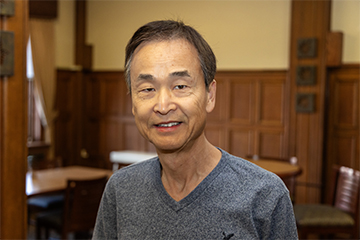
Mark Hwang reflects on 29 years of teaching, research and change
November 20, 2026
With plans to pursue family law, Amoo is using economics to better understand the systems that shape people's lives
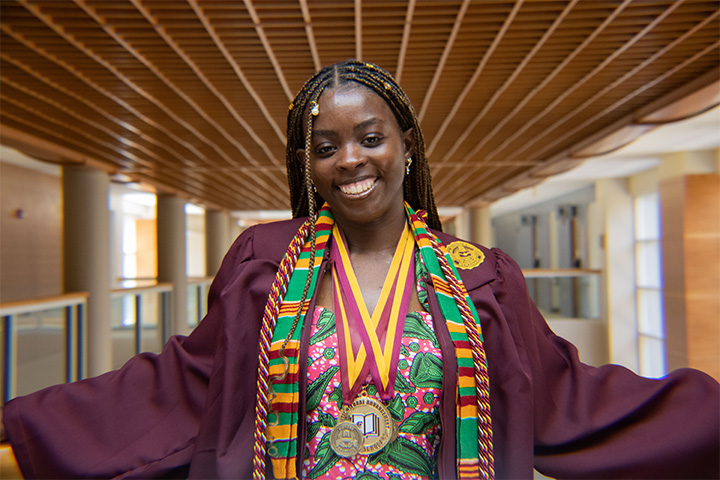
For Michelle Amoo, economics has always been about more than numbers. The Romeoville, Ill., native hopes to become an attorney specializing in adoption and foster care, helping children and families navigate systems that can shape their futures. Her interest in understanding those systems led her to Central Michigan University's law and economics program and, eventually, its accelerated Master of Arts in Economics.
"I have been very focused on helping children within the system and helping children in general," Amoo said. "I've always had the heart and want to adopt in the future."
At CMU, Amoo began exploring the broader social implications of economics, examining how economic decisions, policies and institutions influence everyday life. She sees those connections as particularly important for understanding the resources and opportunities available to children in foster care.
"I'm interested in learning more of the social aspects of economics," Amoo said, explaining that she wants to better understand how economic systems affect children and how those systems can be used to support them.
Amoo arrived at CMU with a clear plan. She would earn a bachelor's degree in law and economics, minor in Spanish and continue directly to law school. When her academic adviser first mentioned the accelerated master's program during her sophomore year, she wasn't interested.
"I actually was not interested at all," Amoo said. "I was like, no, I want to go to law school right after."
As graduation approached, however, Amoo began reconsidering her timeline. She was on track to complete her undergraduate degree early but wanted more time to prepare for law school and her future career. Rather than taking a gap year, she decided to pursue the accelerated master's program.
The decision allowed her to begin graduate coursework while completing her undergraduate degree. Although she entered the accelerated program later than some students, she completed two graduate courses before earning her bachelor's degree in May 2026. Now, during what would otherwise have been her senior year, she's completing her master's degree.
The transition hasn't been without challenges. Amoo found graduate coursework more demanding than she expected, particularly the quantitative requirements. She recommends that students considering the program strengthen their backgrounds in statistics and calculus before beginning graduate study. Still, she credits the support of her professors with helping her adjust to the expectations of graduate school.
"My professors have been so willing to work with me and so willing to help me catch up and help me feel part of the program," Amoo said. "It feels like a lot right now, but I'm getting through it and I have the support."
Beyond her academic work, Amoo has taken advantage of opportunities to explore new places and perspectives. Through CMU programs and experiences, she has traveled to Miami for a volunteer project, the Netherlands as a University Innovation Fellow and Boston through an alternative break. Those experiences have helped broaden her understanding of the world and the communities she hopes to serve.
As she prepares for law school, Amoo encourages students to explore accelerated programs early, even if they aren't certain a master's degree fits into their plans. Beginning graduate coursework during undergraduate study can offer financial advantages and provide additional flexibility as students consider their next steps.
Her biggest advice, however, is to invest in the experience rather than simply focusing on finishing quickly.
"Don't try to rush it," Amoo said. "The program takes time, and you're not going to enjoy it or you're not going to feel good about it if you're trying to rush through it."
She also encourages students to build relationships with faculty, attend office hours and ask questions, even when doing so feels intimidating.
"Once you do it, you can see that everyone's really rooting for you and everyone wants you to be great in it," Amoo said. "Take your time. But also ask the questions because if you don't ask, everyone else is going to be like, “I understand,” and they're going to move on."
For Amoo, the accelerated program has become more than an additional credential. It has given her an opportunity to deepen her understanding of economics, build confidence as a graduate student and continue preparing for a career focused on helping others.