Kathy Litwiller keeps the details moving and the door open
October 16, 2026
Now through October 31, we're waiving application fees for all freshman and transfer applicants!
*Common app code: Central27
Honor highlights management faculty member’s focus on societal impact and developing future leaders
When the Michigan Chronicle named Cleamon Moorer Jr. among its 2026 Men of Excellence honorees, the recognition placed him alongside leaders from across Metro Detroit whose work spans business, education, health care, public service and community development. Now in its 20th year, the program recognizes African American men whose professional accomplishments are matched by their commitment to serving others.
Moorer, a management faculty member in the Central Michigan University College of Business Administration, said the honor was meaningful because of the Michigan Chronicle's long history of recognizing Black leadership in Detroit and beyond. More importantly, he said, it reinforced the responsibility that comes with being seen as a role model.
“Our roles, of being whatever we are in our respective industries, span out into being role models for the culture or role models for communities,” he said. “So how do we continue to protect and to provide, and how do we serve as ambassadors?”
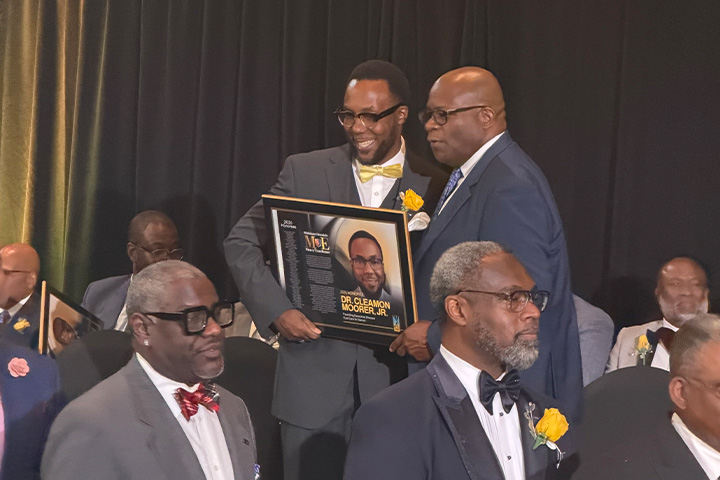
As Moorer approaches his 50th birthday, he is thinking about the next chapter of his work with a longer view. His career has included leadership in higher education, entrepreneurship, home health care, board service and community-based vision care. At this point in his life, however, Moorer said he is becoming more focused on how that work continues and who is prepared to carry it forward.
“I'm thinking ahead,” Moorer said. “More focus on communities, more focus on the vision, and making sure that there's accessible vision.”
As he considers the future, Moorer said he is thinking more intentionally about succession and how the organizations he has built will continue to serve others.
“I'm stepping back and looking at what succession looks like,” he said. “But I get a rush whenever I see people get their glasses or whenever folks get restored vision.”
Moorer, who was born with congenital cataracts and was legally blind by age 21, has spoken openly about the surgery that restored his vision and inspired his commitment to expanding access to eye care. Today, that work continues through Eye Care for Michigan, reflecting a broader mission to serve communities across the state.
“Access to vision is a rural challenge. It’s an urban challenge,” he said. “It’s not just, ‘Hey, Detroiters lack access to vision.’”
Moorer describes his current work as a series of “concentric circles,” with service extending through students, employees, corporations, community organizations and the people who turn to him for guidance.
That includes his service with Habitat for Humanity Detroit, speaking on panels, mentoring students and professionals, and responding to informal requests from people who want to understand how he built his career.
“Whether it's the students at Central or employees in one of my organizations, I'm always pulled into a mentor-mentee relationship,” Moorer said. “People like to shadow. ‘Hey, what does a typical day look like, Dr. Moorer?’ Even casually, at the barbershop, you're called upon to share what you believe and how you think things should move forward.”
Moorer said students do not need to know their full purpose at the beginning of their careers. Instead, he encourages them to start by identifying problems that matter to them. He said that sense of purpose may take time to understand, but students can begin by paying attention to the intersection of their experiences, skills and interests.
“Ultimately, your purpose will be unique to you,” Moorer said. “You may not know it on the front end, but find the passion, find the problem, find the purpose.”
Moorer is also quick to point to the people and organizations that make his work possible.
“People see the honoree, but they don’t see the village behind the honoree or the village behind the inductee,” he said.
For students, Moorer said that lesson matters. Internships, volunteer experiences and professional opportunities help students build the credibility and relationships that allow others to see what they can contribute.
“They give you access to a table that you probably wouldn’t normally sit at,” Moorer said. “That is critical. So if we take that back to students, it’s the internships, the opportunities that they have, even the volunteer opportunities that they have. It begins to give them leverage and a way to showcase their talent.”
That focus on service and access continues to resonate beyond Michigan. This summer, Moorer will receive Honorary Dimagu Citizenship, recognizing his commitment to community service and helping those in need.
Although Moorer has received numerous recognitions throughout his career, he said he is now thinking less about individual milestones and more about the deeper measures of a meaningful life. He has even identified a retirement goal: May 10, 2049, the date his mother would have turned 100. By then, Moorer will be 72, the same age his father retired.
“The challenge then is, what will I want the end game to look like?” Moorer said. “What would I want the legacy to have been? Who has been impacted the most?”
For Moorer, the answer still comes back to people.
“This will be my 25th year in higher ed,” he said. “So that’s a lot of students, a lot of lives impacted there. Lots of years in the entrepreneurship space, in the public community space.”
As he considers the years ahead, Moorer said he wants to continue serving as a mentor, advisor and teacher while helping others develop their own sense of direction.
“How do you continue to focus on mission? How do you continue to have a vision? How do you develop a Northern Star that continues to pull you?” he said. “I think my Northern Star has impacted the lives of others.”