Public invited to explore cybersecurity in practice
October 12, 2026
Now through October 31, we're waiving application fees for all freshman and transfer applicants!
*Common app code: Central27
How Frederick Lawrence is strengthening the logistics community from the inside out
Frederick Lawrence’s connection to Central Michigan University’s logistics program did not begin at the front of a classroom. It began in a student desk.
“I was a student in marketing and logistics. I was enrolled at CMU from 2006 to 2010 and signed the marketing and logistics double major at the time,” he said.
Many of the faculty who shaped his undergraduate experience are still part of the department today. Others, like longtime faculty member Bob Cook—who helped build the foundation of the logistics program during his more than three decades at CMU—remain influential through the culture they established.
“Any of our alum 2014 prior had Bob and it's kind of like a sticking point of a glue to many of our alumni,” Lawrence said.
That sense of continuity matters to him now in a different way. As a faculty member, he sees himself not simply as an instructor, but as part of a living network that connects past, present and future students.
Lawrence’s path to teaching was not linear. As an undergraduate, he drove flatbed trucks to help put himself through school. Logistics was not abstract; it was something he experienced firsthand. Through the department’s resume book and his involvement in the Supply Chain Management Association, he secured his first role with JB Hunt, managing freight for Home Depot across multiple states.
The job confirmed something important.
“I had a little bit of imposter syndrome. I can do school, but can I actually do this in the real world?” he said.
“And then I got into industry and realized, ‘Oh yeah, no problem. This is not an issue.’”
Even as his career progressed, he stayed connected to CMU. He returned to speak in classes and hosted students at industry sites. What began as a way to give back gradually revealed something deeper about his own interests and strengths.
“I didn't realize it at the time, but I really had a knack for and enjoyed coaching and working with students,” he said.
After earning his master’s degree and building leadership experience in management roles, a former professor encouraged him to consider a faculty position. Teaching had not been part of his original plan, but the more he examined the role, the more it aligned with what he already valued.
Nearly ten years later, he remains in the department—and deeply invested in its growth.
For Lawrence, the logistics program’s strength lies not only in curriculum or competition results, but in the intentional cultivation of community.
“It’s not easy and it shouldn't be taken for granted,” he said.
Faculty members devote significant time to advising student organizations, building corporate relationships and creating professional opportunities beyond required coursework. Many are alumni themselves. All understand the responsibility of sustaining what earlier faculty worked hard to build.
“We’re the beneficiaries of others who've cared about this as well,” he said.
That investment yields measurable results. CMU logistics students consistently earn top placements in national case competitions, competing against large and highly resourced programs across the country. The coursework is rigorous. Expectations are high. Yet Lawrence believes the most meaningful outcomes are often less visible.
In his Logistics Operations course, he structures rotating teams so that students collaborate with 15 to 20 different classmates during a single semester. SCMA provides professional networking events, industry travel and employer engagement that connect students directly to the field.
“We really want you to be plugged in, so we create opportunities that make it easy to say ‘yes,’” he said.
That intentional design supports more than technical learning. Research consistently shows that even one meaningful faculty relationship can positively influence student performance and persistence. At CMU, students are not anonymous faces in lecture halls of hundreds.
“We can provide really customized resources to our students if they need it or if they want it,” he said.
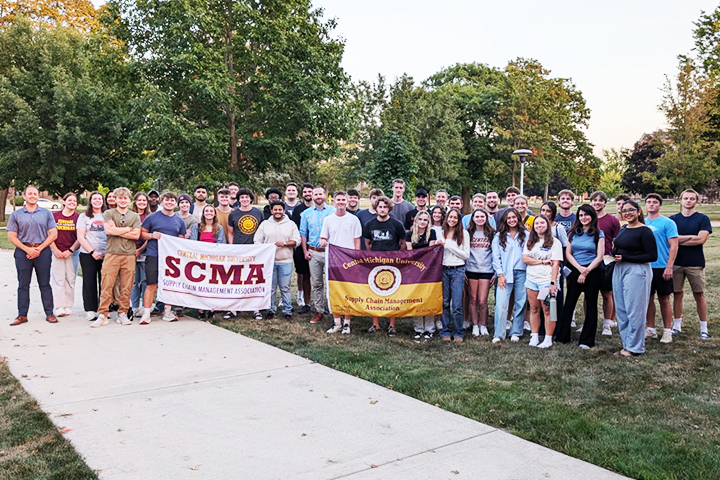
Now serving as director of corporate relations for the logistics program, Lawrence extends that same philosophy outward. He has been reconnecting with alumni across industries and continents, discovering former students in leadership roles many may not realize are tied back to Mount Pleasant.
“I've been linking up with alumni that nobody's linked to for years or maybe ever,” he said. “It's incredible the things that some of these former students are doing.”
He sees value in representing every stage of the professional journey. While seasoned executives offer perspective and validation, recent graduates offer immediacy and relatability.
“We love the 30-year veterans, don't get me wrong,” he said. “But sometimes their experiences are a bit removed, so students might see it and go, ‘I'm just trying to graduate.’”
That observation inspired “Fire Up the Future - My First Year,” an internal series highlighting recent alumni and their early career progress. By showcasing graduates at multiple stages, the department reinforces the idea that career development is a progression—not a single leap.
Lawrence chose CMU because it offered a strong business education and a clear pathway forward. The deeper connection came after he arrived.
“When I came, the program was a tight knit community,” he said. “It's kind of like your own secret club. You're an insider now. You get it. You're part of it.”
That sense of belonging is what he works to preserve for today’s students. The logistics program challenges students academically, connects them professionally and supports them personally. For Lawrence, success is not only measured by placement rates or competition wins, but by whether graduates feel prepared—and whether they choose to stay connected.
“I want students to have the same experience that I had,” he said. “When I left this program, not only was I really well prepared, I also knew that I could lean back into the program if I needed to.”
In that return—from student to professional to mentor—the full arc of the program becomes visible. It is not simply preparing graduates for jobs. It is building a community that sustains itself.