Business students can apply now for CBA scholarships
October 9, 2026
Now through October 31, we're waiving application fees for all freshman and transfer applicants!
*Common app code: Central27
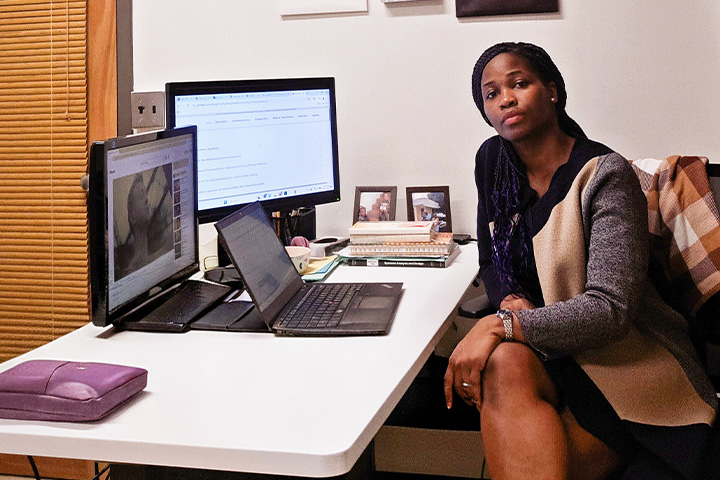
Ekhomen Ehimen-Ebitibituwa encourages curiosity, communication and confidence in every classroom
Professor Ekhomen Ehimen-Ebitibituwa didn’t expect to be in the classroom, at least not yet.
“I used to always tell my friends, even my husband when I got married that it was a retirement plan,” she said. “Maybe I would like to teach when I turn 50 or when I turn 60, but it wasn’t something I thought I was going to start now.”
Instead, her path into higher education came earlier than planned. With a background in mathematics, economics, and information systems, and industry experience as an analyst and project manager, she stepped into teaching ready to bring real-world perspective with her.
“It came earlier than I expected, but it was something I knew I was going to do, and I’m loving every bit of it right now,” she said.
That perspective now shapes how she teaches, mentors and challenges students in Business Information Systems at Central Michigan University.
For Ehimen-Ebitibituwa, teaching and research are deeply connected, and both start with curiosity.
“I like to write about things that answer pressing questions,” she said. “And I keep asking a lot of questions.”
Her work spans cybersecurity, project management, and artificial intelligence, with a growing focus on how emerging technologies shape business decisions. But her research doesn’t stay on paper, it shows up directly in the classroom. In one course, she transformed an exam into a high-stakes debate around a cybersecurity breach, asking students to take positions, defend decisions, and think like executives.
“They weren’t just thinking surface level because they always had to have a backup on whatever they said,” she said.
That approach reflects a broader goal: helping students move beyond memorization and into real-world thinking where answers aren’t always clear, but reasoning matters.
What stands out most to Ehimen-Ebitibituwa isn’t just what students learn, it’s what they discover about themselves. She sees her role as helping students find their voice, especially those who may hesitate to speak up.
“I’ve met some really creative people that don’t even know their power,” she said. “I’ve seen people who are so good, but they live in their shell, and they just need someone to hold their hands and guide them.”
That work goes both ways. In the process of teaching, she continues to learn from her students through their perspectives, habits, and ways of thinking.
“I feel CMU students actually have given me a wider space to be able to guide while learning from them as well,” she said. “There are so many gifted people that have something to share.”
Across every course she teaches, one skill remains constant: communication.
“Even if it’s a coding class, I would still push you to communicate,” she said. “Because someone who writes a code talks to their boss, [you should be able to explain] why you used this particular programming language.”
For Ehimen-Ebitibituwa, technical knowledge alone isn’t enough. Students must be able to explain, defend, and apply what they know. That belief connects to a larger mindset she encourages in every student: a refusal to limit themselves. She encourages students to keep growing step by step, and challenges herself to do the same.
“Don’t ever think you can’t do something if you haven’t even tried,” she said. “I want to take one step higher every day. I want to be a better version of myself every day.”
Long after students leave her class, Ehimen-Ebitibituwa hopes they leave with more than a single concept. She hopes they leave with a different way of thinking.
“Think of it that when you leave, it doesn’t necessarily mean you have to have an A, but your mindset should shift in a positive manner,” she said.
She emphasizes that while earning strong grades matters, it shouldn’t be the only goal. Growth, learning, and becoming a better version of yourself should be part of the motivation as well. Whether it’s time management, teamwork, or communication, the goal is growth. Above all, she wants students to keep asking questions and pushing themselves further.
“Always ask why,” she said. “Because that question changes your mindset to want to be better than you are.”
And if there’s one message that defines her approach, it’s simple: “Never say you can’t do something if you haven’t even tried.”