Business students can apply now for CBA scholarships
October 9, 2026
Now through October 31, we're waiving application fees for all freshman and transfer applicants!
*Common app code: Central27
Gustav Verhulsdonck shares practical strategies for human-centered AI adoption with SAP professionals in Ireland and Germany
Artificial intelligence can generate content in seconds. Determining how to use it effectively, responsibly and within real workplace systems is proving far more complex.
That challenge was at the center of a recent international presentation by Central Michigan University faculty member Gustav Verhulsdonck, who joined software company SAP’s product manager and AI specialist Marianne MacGregor to discuss how organizations can integrate AI while maintaining human expertise, trust and accountability. The session, moderated by SAP’s Futures Research lead Jody Byrne and delivered for SAP teams in Ireland and Germany, focused on the future of AI-enabled work and the evolving role of people within it. As AI changes work processes, people are sometimes relearning their own jobs, requiring new approaches to workflows.
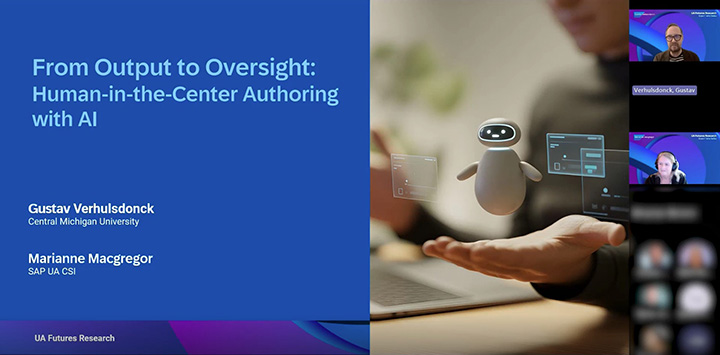
Verhulsdonck, a Business Information Systems Department faculty member, said many organizations are still in the early stages of understanding how AI should fit into daily workflows.
“We are in the naive phase of using AI,” Verhulsdonck said. “A lot of people think, ‘Do everything for me.’ But it should be, ‘Do this part for me.’”
That distinction became a central theme of the presentation. Rather than viewing AI as a replacement for human work, Verhulsdonck encouraged attendees to think more strategically about assigning tasks, defining oversight and preserving human judgment where it matters most.
“We need to become more literate in different interaction patterns with AI,” he said. “How do we integrate AI into workflow? How do we determine where humans still need authority and where AI can take initiative?”
The presentation, titled From Output to Oversight: Human-in-the-Center Authoring with AI, explored what Verhulsdonck describes as a shift from simply producing AI-generated content to actively managing its quality, relevance and trustworthiness.
As organizations adopt generative AI tools, the challenge is no longer whether content can be created quickly. Increasingly, the focus is on who reviews it, refines it and stands behind it.
“AI can generate output,” he said. “But people still need to evaluate it, shape it and take responsibility for it.”
As part of the discussion, the group introduced the HEAT framework, which emphasizes four key priorities in AI adoption: human experience, expertise, accuracy and trust.
The model is designed to help organizations think beyond efficiency alone and consider how AI affects communication, decision-making and professional standards from a human- and user perspective. MacGregor noted how better-quality output now requires grounding AI systems in curated data to reduce hallucinations and leveraging context engineering to create tailor-made output and structure. Those questions are becoming more relevant across industries as businesses explore how generative AI can support writing, research, analysis and customer communication while structuring it according to precise company formats and emerging needs.
The invitation to speak with SAP reflects the growing need for professionals who can bridge technology and human-centered strategy. It also highlights how CMU faculty are contributing to real-world conversations about one of the most significant workplace shifts in recent memory through support of the SAP university alliance.
Verhulsdonck brings that same perspective into the classroom, where students explore emerging technologies alongside the communication, analytical and leadership skills needed to use them well.
As organizations continue to adapt, he believes success will depend not only on adopting new tools, but on making thoughtful decisions about how people and technology work together.
For more on Verhulsdonck’s work exploring the human side of AI and responsible innovation, read “Exploring the human side of AI.”