Business students can apply now for CBA scholarships
October 9, 2026
Now through October 31, we're waiving application fees for all freshman and transfer applicants!
*Common app code: Central27
Finance students outworked national powerhouses on one of the country’s biggest stages
When four Central Michigan University finance students walked into the University of Florida Stock Pitch Competition, they knew they weren’t the biggest name in the room.
They didn’t need to be.
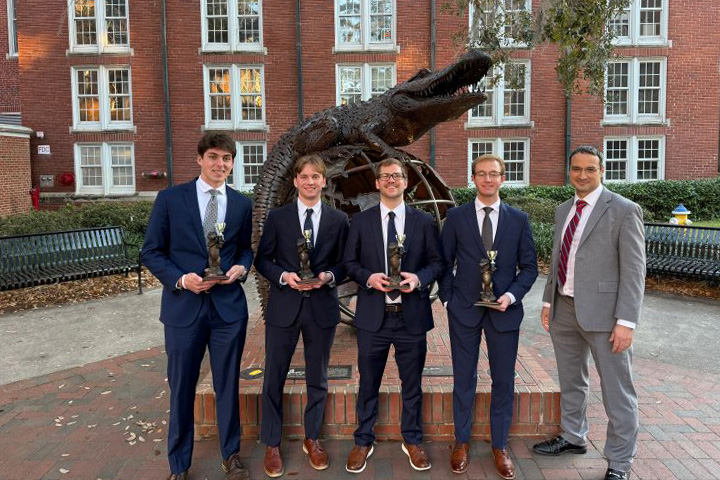
Ethan Schweitzer, a junior finance and logistics management double major from Traverse City, Mich., Trevor Carnovsky, a senior finance and accounting double major from Berkley, Mich., Wyatt Ross, a junior finance major from Mount Pleasant, Mich., and Adam Rose, a senior accounting major from Trenton, Mich., earned second place overall in one of the country's largest and best-known stock-pitch competitions. More than 60 universities submitted written equity research to qualify. Only 18 teams were invited to compete. Just four advanced to the final round.
CMU finished second, just behind the University of Notre Dame.
“This competition is one of the largest and best-known stock pitches in the country,” said finance faculty advisor Brad Taylor. “When you consider the relatively small size of CMU and the fact that we are not as recognized as others, the achievement of these students is amazing.”
For the team, the months leading up to the competition were filled with collaboration, conflict, and critical thinking. Each round tested not just their financial acumen, but also their communication, confidence, and commitment.
“Our preparation was very repetitive with phone calls and Teams meetings, especially since taking place over winter break,” Rose said. “We spent weeks refining our investment thesis, highlighting the most important topics, and anticipating counterarguments from judges. A big focus was making sure we could clearly defend not just our valuation, but why we had conviction relative to the broader market.”
For Ross, the intensity felt familiar.
“The preparation was intense but familiar,” he said. “CMU’s finance program has a culture of hands-on analysis, so the long nights in the Voigtman Bloomberg Lab felt like home. Our team spent countless hours in Excel refining our assumptions, stress-testing our model, and perfecting our pitch deck to ensure every conclusion was supported by extensive data.”
Once in Florida, the challenge intensified. Teams only 12 minutes to present a complex equity thesis and defend it against industry professionals.
“The most challenging part was narrowing a complex analysis into a concise, compelling pitch under time constraints,” Rose said. “The most rewarding part was seeing that process pay off when competing against top programs and realizing our work could stand on its own at that level.”
Carnovsky pointed to the unpredictability of the final round.
“The most challenging part the finalist process, which involved presenting to 80+ finance individuals with three judges immediately after having our group randomly selected from a cup,” he said.
Schweitzer still remembers walking out of the room.
“The most rewarding part was giving the first presentation and walking out of it feeling like we did the best we possibly could. It was amazing,” he said.
Facing off against nationally recognized business schools could have been intimidating. Instead, it fueled them.
“To me, it meant going into the competition with a chip on my shoulder and wanting to show the larger schools that we can compete with them and hold our own,” Schweitzer said. “I felt like Rocky; I just wanted to go the distance and prove that we belong there.”
“It was definitely intimidating to see names like Wharton and some of the most renowned business schools in the country,” Ross said. “But once the competition began, that intimidation faded, and the focus shifted entirely to the quality of analysis behind the pitch. The experience reinforced that strong ideas, rigorous preparation, and teamwork matter more than a school’s name.”
“It was exhilarating; the entire process was awesome!” Carnovsky added.
Taylor saw that same mindset from the start.
“The teams worked day and night and on weekends to get their presentation and pitch perfected,” he said. “Those students knew that they were not going into the competition with the upper hand. Thus, they worked twice as hard as anyone else to win.”
Beyond the trophy, the students walked away with sharpened skills that translate directly into finance careers.
“The competition reinforced the importance of clear communication under pressure and being able to explain complex financial ideas to different audiences,” Rose said. “It also emphasized how critical teamwork and preparation are in high-stakes environments.”
Carnovsky added, “Preparing and creating a comprehensive argument surrounding an individual company and presenting it in front of a large audience under significant pressure at a moment's notice.”
The students have a clear message for peers considering similar opportunities.
“Start early, challenge yourself often, and be detail-oriented, taking your time to understand important concepts,” Rose said. “For presentations, don’t underestimate the value of practicing your pitch out loud. Competitions like this reward both strong analysis and the ability to communicate your point clearly.”
“I’d tell students who are interested to go for it,” Schweitzer said. “You’ll learn a lot about yourself, you’ll learn a lot about the people you’re competing against when applying for jobs, and you’ll learn how to work as a team and achieve a goal together.”
Ross put it simply: “Don’t let perceived disadvantages intimidate you. Approach challenges with confidence, prepare relentlessly, and trust your process. Hard work compounds, and when preparation meets opportunity, the results can be disproportionately great in comparison to expectations.”
For Taylor, the broader lesson is clear.
“First, it should be a sign to all students that if you work hard, you can succeed,” he said. “Second, most employers, in such a tight labor market, will not consider a student for a position without showing that they take part in extracurricular activities. Students must not only take part but be extremely active and be in leadership positions.”
At CMU, that’s exactly what these four students did, turning preparation into performance, and performance into national recognition.