Now through October 31, we're waiving application fees for all freshman and transfer applicants!
*Common app code: Central27
From CMU classroom to the green screen: Alum returns to prepare the next generation of broadcast meteorologists
For Diane Phillips, returning to Central Michigan University to teach broadcast meteorology is an opportunity to give back to the program that helped launch her career.
Phillips, a CMU meteorology alum and working broadcast meteorologist on WNEM Channel 5, now teaches students how to take their knowledge of weather and turn it into forecasts that inform, engage and help keep the public safe. The course combines instruction on the broadcast industry with hands-on practice in front of a green screen, giving students an opportunity to develop the communication and presentation skills they will need in a newsroom.
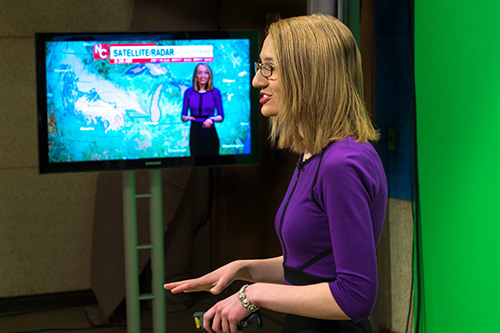
“I was excited and honored to be teaching the broadcast meteorology course at CMU,” Phillips said. “After years of polishing my craft, I felt ready to start giving back to the same cycle I came up through myself.”
Rather than mentoring one intern over the summer, Phillips is now working with 13 students as they prepare for careers communicating weather to the public.
According to Marty Baxter, a CMU faculty member in the Department of Earth and Atmospheric Sciences, the specialized training addresses a significant career path for the department’s graduates. Over the past decade, approximately 20% of CMU meteorology graduates have taken positions as broadcast meteorologists.
“Diane knows exactly the challenges students will face, because she is facing them and overcoming them every day,” Baxter said. “She is well informed on both the technical skills and soft skills students will need when they enter the workforce.”
Turning science into a story
Understanding meteorology is only part of being a successful broadcast meteorologist. Communicating that knowledge in a way that makes sense to viewers is just as important.
Phillips said the course is not designed to teach students how to forecast the weather. Instead, it focuses on communicating complex scientific information clearly and effectively.
“Though students understand the weather, the terminology used in the meteorology lab is not comprehensible to most people,” Phillips said. “Students are learning how to educate people and meet them where they are.”
A typical class includes lectures on the broadcast industry, the meteorologist’s role in a newsroom, communicating science, and launching a broadcasting career. Students then put those lessons into practice in the studio, working with a green screen and weather graphics.
Phillips emphasizes repetition, giving students as much time in front of the screen as possible. Practice helps them develop a natural presentation style, interact effectively with graphics and learn to deliver forecasts at a pace viewers can follow.
Beginners often speak too quickly because of nerves, she said. Others struggle with body language or fail to engage with the graphics behind them. Even small mistakes, such as using incorrect grammar or naming the wrong day of the week, can undermine an otherwise accurate forecast.
Communication, presentation and storytelling are fundamental to the profession, Phillips said. A meteorologist must be able to explain what the weather means for people's lives without overwhelming them with technical language or talking down to the audience.
Students also work with the Max Studio graphics system from The Weather Company, which Baxter said is an industry-standard platform used across the country. The experience gives students an opportunity to become familiar with technology they are likely to encounter in their first jobs.
The course builds on the scientific foundation students develop throughout CMU's meteorology curriculum, including opportunities to study weather forecasting at both the lower and upper levels.
“Diane helps students apply the knowledge they learn across all of their meteorology courses in the broadcast environment,” Baxter said. “In the broadcast meteorology course, students learn how to translate that scientific knowledge into an effective weathercast and communicate it clearly to a public audience.”
Learning from experience
Phillips understands the transition from the classroom to a professional newsroom because she has made that journey herself.
When she was a CMU student, she did not initially expect broadcasting to become her career. She remembers the challenges of the meteorology curriculum and the extensive studying required to earn her degree. Opportunities outside the classroom, however, helped her discover broadcasting and gain experience.
She auditioned for News Central 34, CMU's student-run newscast, where she practiced presenting weather in front of a green screen. She also completed an internship at WLNS in Lansing, gaining valuable experience before graduation.
By the time she finished at CMU, Phillips was interning and presenting live weather five days a week. When a weekend position opened at WLNS, she applied and got the job.
The station already knew her work and abilities, giving her an opportunity to move from intern to professional broadcaster. Phillips credits her first chief meteorologist, David Young, with providing the opportunity and coaching that helped her begin her career.
Her early years also taught her what it takes to succeed in the industry.
“I worked ‘doubles’ on weekends, meaning I slept very little between the morning and evening newscasts,” Phillips said. “It was exhausting, but I wanted to launch my career.”
Those demanding shifts helped her gain experience and improve her skills. Now, she sees teaching as another measure of professional success.
“My first thought is that I've made it!” she said. “Being able to teach the next group of broadcast meteorologists means those three-hour naps and brutal alarm times were worth it.”
Baxter said Phillips' return to CMU is especially valuable because she understands both the university's program and the expectations students will face after graduation. The department recognized her experience when she spoke at its annual Alumni Career Day event last fall. As faculty prepared to find a new instructor for the broadcast meteorology course, Phillips emerged as a natural fit.
As an alum, she can help students connect what they learn in their meteorology classes with the realities of working in television and other forms of broadcast media.
Preparing for a changing industry
The skills required of broadcast meteorologists continue to evolve. Television remains part of the profession, but streaming, social media and other digital platforms have expanded the ways audiences receive weather information.
“When I started, streaming was not much of a thing,” Phillips said. “Now, it is the future of media.”
Meteorologists increasingly need to deliver forecasts across multiple platforms, reaching people wherever and whenever they consume news. Phillips said broadcasters may distribute content through more than 20 different outlets, making it important to understand how to communicate effectively beyond a traditional television newscast.
Baxter sees those changes creating new opportunities as well as new expectations for graduates. Social media and live streaming can help meteorologists build audiences beyond traditional television stations, while artificial intelligence tools can speed up routine tasks and allow more time for forecasting and communication.
Students must also learn to write concisely, presenting essential information in a format that viewers can quickly understand.
For Phillips, adapting to those changes means recognizing that learning does not end when students land their first job.
“My best advice for students landing that first job in television is to continue to practice and work hard,” she said. “You landed the job, but so much growth happens in that first year, so keep working on your craft and skill set.”
She also cautions students against pursuing broadcasting simply for the chance to appear on television. The job can require working weekends, holidays and unconventional hours, particularly when severe weather demands extended coverage.
The most rewarding part, she said, is helping people. Weather affects nearly every aspect of daily life, and communicating accurate, useful information can help audiences make safer and better-informed decisions.
That responsibility is also at the heart of the training students receive at CMU.
Building on a CMU foundation
Although broadcast meteorology is one possible destination, CMU's meteorology graduates pursue a variety of careers. Baxter said alumni work as National Weather Service forecasters, research scientists, Air Force officers and meteorological specialists for private companies that rely on weather guidance to protect their businesses.
Broadcasting remains a significant pathway, with CMU alumni working in major markets such as Detroit and Chicago and at national outlets including CNN, The Weather Channel and Fox Weather.
Phillips hopes the students she teaches will look back on the course as an important part of their professional preparation.
She remembers the value of learning from experienced meteorologists during CMU's meteorology career day, as well as the practical lessons she gained from launching weather balloons, presenting live weather and completing internships. Those experiences helped her understand the possibilities within the profession and prepare for the demands of a first job.
Now, she hopes to provide similar guidance to the next generation.
“I benefited from people before me helping with feedback and advice, and I'm glad to be able to return the favor,” Phillips said.
Her goal is straightforward: to help students leave CMU ready to put their knowledge to work, communicate with confidence and continue growing throughout their careers.