Now through October 31, we're waiving application fees for all freshman and transfer applicants!
*Common app code: Central27
CMU doctoral student receives prestigious Dalai Lama Graduate Scholarship for environmental research
Tenzin Pema's research focuses on developing materials that could help remove emerging contaminants from wastewater
A Central Michigan University doctoral student has received a prestigious scholarship recognizing her academic achievements and potential to contribute to the Tibetan community and the broader world through scientific research.

Tenzin Pema, who is pursuing a Ph.D. in Science of Advanced Materials at CMU, received the Dalai Lama Graduate Scholarship, administered by the Gaden Phodrang Foundation of the Dalai Lama. The scholarship supports outstanding Tibetan students pursuing graduate education internationally.
For Pema, the award represents more than financial assistance. It also recognizes her academic journey and reinforces her commitment to using science to address real-world challenges.
“It's not only financial support but also recognition of my hard work and a responsibility to use my education in a way that benefits others,” Pema said.
The selection process is highly competitive, with an independent committee evaluating applicants based on their academic achievements, potential and commitment to contributing to their communities.
Pema said the scholarship will help ease the financial challenges of pursuing a doctorate in the United States while allowing her to focus on her research and long-term career goals.
Her work at CMU centers on developing specialized materials called molecularly imprinted polymers that can detect and remove emerging contaminants from wastewater. Her research focuses on compounds including gemfibrozil, a pharmaceutical, and perfluorobutanoic acid, or PFBA, a member of the group of chemicals commonly known as PFAS.
These substances present challenges for water treatment, and researchers are investigating more effective ways to detect and remove them from the environment.
Pema describes her approach as developing materials with tiny recognition sites designed to capture particular pollutants, much like a lock designed to fit a specific key. The goal is to create materials that can selectively target unwanted chemicals in water.
“My long-term goal is to contribute to the development of more effective materials for water treatment,” Pema said. “Access to clean water is an important global challenge, and I am motivated by the possibility that scientific research can help address it.”
Addressing an environmental challenge
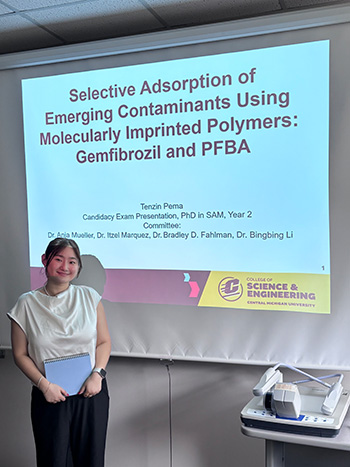
Pema's research is part of a collaborative project involving CMU faculty members Dr. Itzel Marquez, Dr. Anja Mueller and Dr. Bradley Fahlman.
Marquez said the research group's work addresses a significant environmental concern: the presence of PFAS in the environment and the potential risks these chemicals pose to human health and ecosystems.
“PFAS analysis is not simple, and their removal and degradation is one of the biggest challenges currently in the environmental field,” Marquez said.
She said Pema approaches the challenge with persistence, curiosity and a genuine interest in finding solutions.
Beyond her laboratory work, Pema contributes to the scientific community through newsletter collaborations and volunteering at science communication events. Marquez also praised her work as a mentor to younger students.
The scholarship, Marquez said, provides valuable recognition of Pema's achievements and potential.
“This external recognition validates Tenzin's achievements, research potential, and professional promise,” Marquez said. She added that the award offers more than financial support, providing professional recognition and opportunities to connect with other graduate students and researchers.
Pema said her interest in water treatment began during her master's degree in India, where she worked on treating dye-contaminated wastewater using different techniques. That experience sparked her interest in developing materials and methods that could make wastewater treatment more effective.
Since joining CMU, she has gained experience in materials synthesis, contaminant removal and analytical techniques, while learning to approach unexpected experimental results with patience and critical thinking.
A connection to her community
Pema's academic journey has also involved personal challenges. Pursuing a Ph.D. abroad has required independence and persistence, while living far from family has meant missing festivals and other important occasions at home.
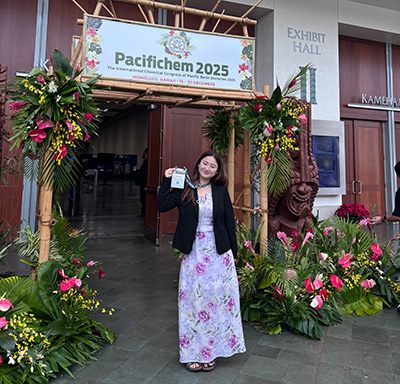
As the only Tibetan student currently at CMU, she said receiving the scholarship carries particular cultural and personal significance.
“Being far from my community and family can sometimes feel lonely, so receiving this scholarship reminds me that I am supported and connected to a larger Tibetan community,” Pema said. “It makes me proud to represent my community through my education, and I hope to use what I learn to give back in the future.”
After completing her doctorate, Pema hopes to continue her work in research, potentially through a postdoctoral position or a research and development role. She plans to focus on materials and technologies that address environmental challenges, particularly water pollution, and hopes to encourage other Tibetan students interested in pursuing careers in science.
Her advice to students considering education abroad is straightforward: believe in yourself, ask for help when needed and persevere through difficult moments.
Pema expressed gratitude to the Gaden Phodrang Foundation of the Dalai Lama, her family, mentors and others who have supported her education.
The scholarship, she said, motivates her to continue developing as a researcher and make the most of the opportunities available to her at CMU.
Through her research and commitment to her community, Pema is working toward a future in which advances in materials science can help address environmental challenges while creating opportunities to give back to others.