Now through October 31, we're waiving application fees for all freshman and transfer applicants!
*Common app code: Central27
Real-world experience that builds confident business leaders
How Jeffrey Hoyle brings industry insight into the classroom to help students grow
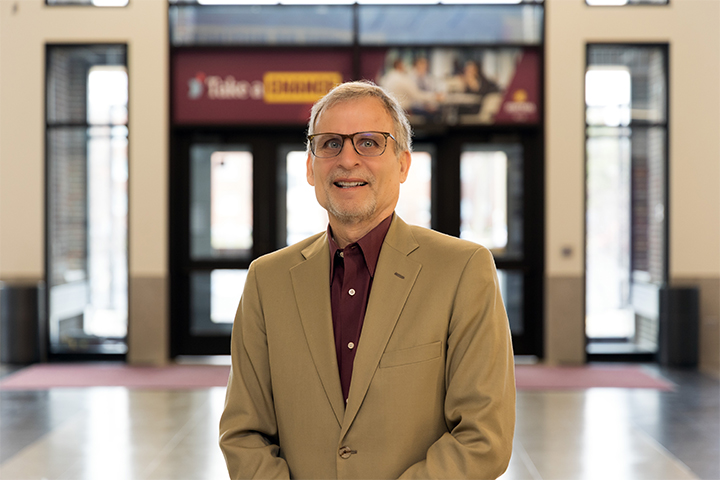
Jeffrey Hoyle didn’t originally see himself in the classroom, but he found his way there through experience.
“When I came out as an undergrad, I was just adamant,” he said. “I said, I am never going to be one of those people.” Those people, he added with a laugh, “are what I am now as the professor.”
Today, Hoyle serves as marketing and professional sales faculty member in the marketing, hospitality, and logistics department at Central Michigan University. He is in his 25th year at CMU, teaching courses including MKT 420: Advanced Selling and Negotiation, MKT-SL 460: Organizational Selling, MKT 490: Marketing Internship, MBA 650: Marketing-Based Management and BUS 619: Voice of the Customer.
His path to higher education was anything but direct—and that is exactly what shapes how he teaches.
From B2B sales to the classroom
Before joining academia full time, Hoyle spent more than 20 years in the B2B sales and marketing space. He worked in custom manufactured stainless steel and refrigerated food-service equipment, health care and forest products industries, collaborating with companies such as Boeing, General Motors, General Electric, PepsiCo, Mead Corp., International Paper Co., and Alcoa.
He was also involved with a health care company start-up. When the company was approached by a potential buyer and they began considering selling the business, he found himself at a crossroads.
“It was a perfect segue,” he said. “We ended up selling the company in the health care field and then I landed here.”
At the time, he was teaching part time. What started as an opportunity became a calling.
“At that moment, it kind of clicked,” he said. “I said, boy, I wish I would have found this profession sooner than later. But life has an interesting way of taking twists and turns. I’m glad I’m here now.”
His earlier skepticism about professors changed once he gained experience of his own.
“I realized how much value, how much knowledge they had,” he said. “It’s kind of like when you look to your parents, you realize, hey, they really did know what they were talking about after the fact.”
That industry perspective still defines his classroom. He believes students benefit from learning alongside someone who has navigated real negotiations, client relationships and organizational challenges.
“I love the experience of being with a student body that challenges me as well as me challenging them,” he said.
Research that informs practice
Hoyle earned his Ed.D. from Central Michigan University in higher education, global studies and assessment, following an MBA in marketing from CMU and a bachelor’s degree in natural resources from The Ohio State University. He also studied engineering at the United States Military Academy at West Point.
His research often explores the intersection of organizational support, sales performance and stakeholder relationships. Recent publications include work in Education + Training, the Journal of Selling, the Journal of Market Analytics and Business Horizons, examining topics such as intern commitment, person-environment fit among Gen Z sales talent, and sales forecasting perspectives.
But for Hoyle, research is not about prestige. It is about impact.
“I like my research to inform the body of experiences I’m trying to share,” he said. “I want it to be that combination of scholarly yet practical.”
He remembers the excitement of completing his dissertation.
“I was just so excited, man, this is going to change the world,” he said. “When in reality, it can help to inform a small slice of my world.”
And that small slice matters.
“If I can share a little bit of that with students, those students go on to inform their space around the world,” he said.
His work has also been recognized nationally, including the Best Teaching Innovation in Sales Education Award at the National Conference in Sales Management and a Best Technical Presentation award from the Society of Plastic Engineers.
Still, he keeps focus on students.
“You have a chance. You can change the world,” he tells them. “If you can influence one small factor, you really don’t know how that will carry through society.”
Reaching into your toolkit
In courses like Advanced Selling and Negotiation and Organizational Selling, Hoyle integrates experiential learning through live projects, internships and service-learning partnerships.
“Now students have learned some skills, they’ve got some concepts, some things in their toolkit,” he said. “Now they get to maybe go out and do a project and that requires them to reach into that toolkit.”
He has seen students grow dramatically when given that opportunity.
“They might be that average student,” he said. “But when you put them in that setting of an internship that average student becomes stellar.”
Part of that growth comes from reframing failure.
“I use a phrase in most of my classes by Nelson Mandela,” he said. “He said, I never lose. I either win or learn.”
Failure, he reminds students, is not something to avoid at all costs.
“Failure is only a real failure if you don’t explore it,” he said.
Creating confidence in the classroom
Hoyle works intentionally to create what he describes as a safe place for ideas.
“I want that to be a safe place to share your perspective, your ideas,” he said. “There’s no such thing as a crazy idea.”
Students in his classes often collaborate with community organizations and business partners. He wants them to see themselves not just as students, but as contributors.
“I want them to gain confidence,” he said. “Confidence that their ideas are sought after. Their ideas are valued.”
He also emphasizes authenticity. When asked what he hopes students remember long after graduation, his answer is simple: “That I was genuine,” he said. “Hopefully I was authentic. Hopefully I was transparent.”
He does not claim to have all the answers, and he does not expect students to either.
“We don’t have all the answers,” he said. “But we can certainly find people that can help inform that, or I can go search for answers.”
Advice for students still finding their path
For students questioning whether they belong in business, Hoyle returns to one theme again and again.
“Always be curious,” he said. If uncertainty lingers, he encourages conversation and engagement.
“Have some conversations,” he said. “Have some conversations with your faculty, with your peers, attend some events that the university offers.”
At the same time, he encourages commitment once a decision is made.
“Once you’ve made a commitment, you go on and get that degree,” he said.
His own journey—from engineering and natural resources to an MBA in marketing to a doctorate in higher education—proves that career paths evolve.
“There’s really a lot of overlap in any discipline,” he said. “You just have to be savvy enough to be able to look through.”
After 25 years at CMU, Hoyle remains energized by the same thing that first drew him to teaching: students.
“As long as I can connect with the students,” he said, “I’ll be excited to continue on.”
Related News

Kristin Schooley helps students see what comes next
October 5, 2026
CMU students test logistics skills with new industry software
October 2, 2026

From CMU to Wall Street
September 30, 2026
Improv gives sales students practice thinking on their feet
September 29, 2026