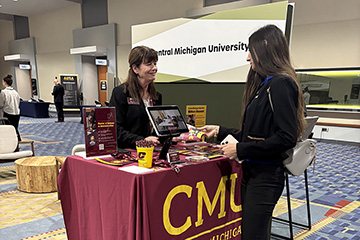
CMU hosting MI-ACE Women of Color Collaborative Annual Luncheon
October 22, 2026
Now through October 31, we're waiving application fees for all freshman and transfer applicants!
*Common app code: Central27
Change Roadmap and Governance Council to drive institutional progress
In this story:
In September 2025, the Central Michigan University Board of Trustees gave President Neil MacKinnon a directive: Develop a plan to help the university more easily adapt to and embrace change.
Since that September date, members of the Change Champions Network and the University Transformation Office have been working to develop a roadmap for change at CMU. After dozens of data-gathering listening sessions, the team identified numerous challenges and opportunities and began to synthesize a first draft of the roadmap.
And this week, MacKinnon and Chief Transformation Officer Darcie Wilson launched the roadmap and introduced the Council that will drive its implementation.
“Without a clear destination in mind, a map to get there, and someone to help us stay on the path, we won’t achieve our goals for transformational change,” MacKinnon said. “By adopting this Change Roadmap and empowering the Change Roadmap Governance Council to lead our way, we are setting CMU up for long-term success.”
“The Change Roadmap is a three-year plan for developing an institutional culture that is flexible, adaptable and open to change,” said Chief Transformation Officer Darcie Wilson.
“During our listening sessions with the university community, we identified several persistent patterns and challenges that make it difficult for people to innovate and take risks. These challenges included complex processes for achieving multi-office tasks, technology issues, questions about decision-making authority and responsibility, policies that were difficult to interpret, and more. If we want to be nimble and responsive to the changing higher education environment, we have to address the practices that slow us down.”
To set the foundation for change, the Roadmap establishes five themes for creating change:
“These are the foundations required to move CMU in the right direction, and they will require understanding, buy-in and support from every unit on campus,” Wilson said. “These were themes that came up in nearly every conversation we had with teams across the university, so we know these are vital to our success.”
To achieve the five foundations, the Roadmap assigns specific tasks by focus area in three phases.
“In the first phase, we are working toward clarifying and enabling decision-making. Next, we will begin to redesign and standardize workflows, and in the third phase, we will focus on implantation and optimization for sustainable change,” Wilson said.
There are steps for each phase broken down by category:
Among the tasks included in the Roadmap are the adoption of a new Enterprise Resource Planning software, which supports the university’s administrative functions in areas including personnel management and payroll, student and employee records, financial planning and budgets, and more.
While every individual and unit at CMU will have a role in change management, the university also needed a governance and accountability structure to build and maintain momentum for change.
“I have formally established and charged a Change Roadmap Governance Council to ensure that we are implementing the roadmap strategically and effectively,” MacKinnon said. “The group will play an important role in prioritizing and sequencing initiatives, resolving cross-unit challenges and ensuring sustained progress.”
MacKinnon and CMU Board of Trustees chair Denise Williams-Mallett met with the newly appointed group on June 2, 2026, to review the Council’s charge and the Board’s expectations.
Members of the founding CRGC are:
“As they make decisions, the Council will model the behaviors we encourage in the Change Roadmap: thinking with a university-first mindset, focusing on long-term sustainability over short-term convenience, demonstrating a willingness to confront difficult topics and to consider new ideas, and to engage in constructive, solutions-oriented conversations,” MacKinnon said.
MacKinnon said the Council would operate through at least the three-year period outlined in the Change Roadmap. Members of the Council will serve a minimum of two years and a maximum of four years, with the understanding that any vacancies that arise may be filled via presidential appointment.