Now through October 31, we're waiving application fees for all freshman and transfer applicants!
*Common app code: Central27
The Change Roadmap
In September 2025, the Central Michigan University Board of Trustees gave President Neil MacKinnon a directive: Develop a plan to help the university more easily adapt to and embrace change.
Since that September date, members of the Change Champions Network and the University Transformation Office have been working to develop a roadmap for change at CMU. After dozens of data-gathering listening sessions, the team identified numerous challenges and opportunities and began to synthesize a first draft of the roadmap.
The charge
Embracing change was a prominent theme in the September 2025 Board of Trustees’ formal session. President MacKinnon noted that significant change would be required across the university as a result of the university’s adoption of the new strategic enrollment management plan, changes to CMU Online, and ongoing implementation of the CMU 2023-2028 Strategic Plan, among many other efforts and initiatives. Trustees also weighed in on the challenges of change management and highlighted the need for a framework to implement organizational change. As a result, the Board of Trustees charged the President and the University Transformation Office with the development of a change management plan.
The process
The CMU Change Roadmap is the result of broad engagement across the institution. From October 2025 to January 2026, the University Transformation Office facilitated numerous Change Roadmap sessions with senior leaders, faculty, staff, and key stakeholder groups, complemented by university-wide participation via an anonymous form to facilitate candid input. The themes, priorities, and recommendations reflected in this summary are a synthesis of those collective perspectives, validated through repeated examples. These documents were then reviewed and modified by the Change Champion Network and a representative cross-section of senior leaders who bring diverse, forward-looking perspectives and a strong understanding of institutional priorities.
The themes
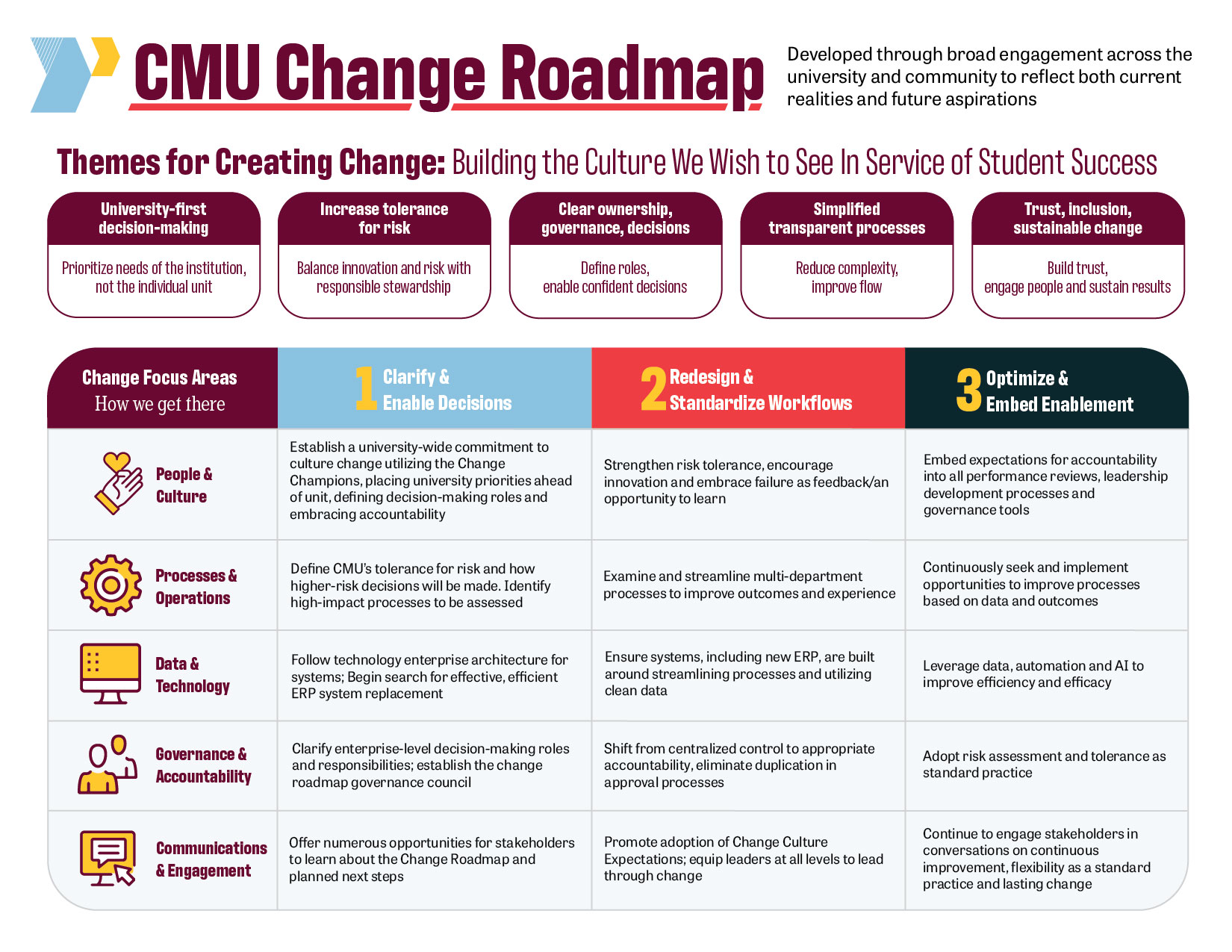
The Change Roadmap is intended to provide a shared foundation for how we prioritize, manage, and implement institutional change in a more coordinated and sustainable way. It aligns major initiatives, improves institutional processes, and builds the leadership and cultural practices needed to move forward. The roadmap ensures that change across the university is purposeful, coordinated, and lasting. This represents a meaningful strategic and cultural shift, with measurable progress over the next three to five years. It is informed by university-wide input and designed to:
- Create clarity, trust, and decision discipline so the institution can move faster
- Identify and reimagine university value streams, which include processes, systems, and data, with a focus on the intended outcome
- Embed enterprise thinking, continuous improvement, and change capability into our culture
The goal of the Change Roadmap is to build a university that makes clear, university-first decisions, adapts with confidence, and consistently delivers on outcomes, ensuring long-term sustainability and student success.
To set the foundation for change, the Roadmap establishes five themes for creating change:
- Adopting a university-first and mission-first mindset, which asks individuals to prioritize the needs of CMU as an institution over the needs or wants of a single unit.
- Increasing the university’s tolerance for risk, which invites people to see failure as an opportunity to learn and not something to be feared.
- Establishing clear ownership and decision-making roles, which should make it easier to identify who is accountable for making and implementing changes.
- Simplifying processes, which involves assessing how tasks move through and across offices university-wide and removing duplication and barriers.
- Building trust and sustaining change, which will require engaging people in the changes that affect their work.
Change culture expectations
The Change Culture Expectations describe how each Leadership Standard is demonstrated during periods of change, by defining the shared behaviors and expectations that enable CMU to successfully deliver the Change Roadmap through consistent execution.
Governance and accountability
Creation of the Change Roadmap Governance Council will enable effective prioritization and implementation of CMU’s Change Roadmap by establishing a governance and accountability structure to build and maintain momentum for change. The Council will model the behaviors we encourage in the Change Roadmap: thinking with a university-first mindset, focusing on long-term sustainability over short-term convenience, demonstrating a willingness to confront difficult topics and to consider new ideas, and to engage in constructive, solutions-oriented conversations.
The Council will operate through at least the three-year period outlined in the Change Roadmap. Members of the Council will serve a minimum of two years and a maximum of four years, with the understanding that any vacancies that arise may be filled via presidential appointment.
Assessing impact
Progress will be assessed by how effectively we improve decision clarity, reduce rework and reexamination, and deliver redesigned, efficient processes that are adopted, sustained, and aligned to a university-first approach.
Informed by stakeholder input and achieved through the Change Roadmap, CMU should expect to:
- Deliver complex initiatives with greater predictability and confidence
- Define clear decision rights and accountability, ensuring decisions are made efficiently and followed through to results
- Reduce friction, rework, and hidden costs driven by unclear processes
- Strengthen trust through transparency and consistent engagement and delivery
- Shift institutional culture toward balanced risk-taking, accountability, and innovation
- Protect strategic investments by ensuring adoption and sustainability
Questions and answers
What is the Change Roadmap?
The Change Roadmap is intended to provide a shared foundation for how we prioritize, manage, and implement institutional change in a more coordinated and sustainable way. The goal of the Change Roadmap is to build a culture that makes clear, university-first decisions, adapts with confidence, and consistently delivers on measurable outcomes, ensuring long-term sustainability and student success.
Why is CMU creating a Change Roadmap now?
In September 2025, the Central Michigan University Board of Trustees gave President Neil MacKinnon a directive: Develop a plan to help the university more easily adapt to and embrace change. With several major initiatives that require significant change currently underway, such as the Strategic Enrollment Management plan and the 2023-2028 Strategic Plan, this is the ideal time to establish a framework for more effectively accepting and adapting to change.
What will CMU look like if we have successfully implemented the Change Roadmap?
CMU will be a sustainable, high-performing university that can adapt, decide, and execute. Specifically:
Decisions
- Decisions are made once, at the appropriate level
- Decision rights are understood and respected
- Escalations are rare and follow a clear process
Accountability
- Leaders own implementation and outcomes
- Expectations are clear
- Performance and results are transparent
Operations
- Core processes are streamlined and consistently followed
- Administrative burden is reduced
- Technology supports standardized work
Culture
- University-first thinking outweighs unit-first thinking
- Balanced risk-taking is encouraged
- Collaboration replaces silos
Resources
- People, funding, and space are aligned with institutional priorities
- Investments are intentional and measurable
How was the Roadmap created?
The Change Roadmap was developed using a structured, process-focused methodology designed to identify recurring themes, root causes, and systemic barriers rather than individual concerns or isolated requests. The Roadmap is the result of broad engagement across the institution. From October 2025 through January 2026, the University Transformation Office facilitated numerous Change Roadmap sessions with senior leaders, faculty, staff, and key stakeholder groups, engaging more than 350 employees. This effort was complemented by a university-wide anonymous feedback process to encourage candid input and ensure diverse perspectives were captured. The themes, priorities, and recommendations reflected in this Roadmap consistently emerged across stakeholder groups, aligned with institutional priorities, and demonstrated the potential to improve effectiveness, accountability, sustainability, and student success.
Is this ‘just another initiative?’
No. The Roadmap should help CMU manage current initiatives, not add more work to them. It is designed to reduce “initiative overload” by creating clearer prioritization, sequencing, governance, and accountability around institutional work already underway. It will also support future initiatives and those currently in the planning phase by improving how change is managed and implemented. When adopted, the Roadmap will help CMU reduce duplication of efforts and minimize the number of concurrent and/or overlapping initiatives.
Does this mean more work for employees?
The council is intentionally pacing this work over multiple years to avoid overwhelming faculty and staff. In the short term, the Roadmap may introduce changes to processes and ways of working, and, at first, this may increase workloads for some individuals. However, the long-term goal is to simplify processes, reduce inefficiencies, improve coordination, and create more clarity around priorities and responsibilities — which will reduce workload.
How will the university address change fatigue?
The Roadmap itself is intended to help manage institutional capacity for change more intentionally. This includes:
- Spacing initiatives over time
- Identifying dependencies and overlaps
- Prioritizing highest-value efforts
- Improving communication and transparency
- Providing implementation support and change management resources
The goal is sustainable transformation, not constant disruption.
What is the purpose of the Governance Council?
The Governance Council exists to help ensure the Change Roadmap is implemented with institutional goal/priority alignment, transparency, and accountability. The council will:
- Make recommendations to the President for areas/policies/processes that need to change, aligned to the Roadmap themes
- Validate priorities and sequencing
- Help resolve cross-unit conflicts
- Support university-first decision-making
- Reinforce accountability for implementation
- Reduce reexamination of decisions after direction has been established
The goal is to create a clearer and more sustainable approach to institutional change.
Does the Change Roadmap Governance structure replace shared governance?
No. Shared governance remains critically important and will continue to play a role in institutional decision-making. The Governance Council exists to improve coordination, prioritization, execution, and accountability for enterprise-level transformation work that crosses organizational boundaries.
Who selected the Governance Council members?
Members were appointed by President MacKinnon after reviewing recommendations from the University Transformation Office. Recommendations were based on input through a collaborative process involving input from institutional leadership, a subset of the Change Champions Network, and internal stakeholders familiar with the type of leadership needed to support enterprise-level transformation.
Why doesn’t every division, college, or employee group have a seat on the council?
The council was intentionally designed to remain small enough to function effectively and make timely decisions. Council members were selected based on their ability to think institutionally, not representationally, and to make decisions in the interests of CMU and its many constituents. In addition, engagement and input opportunities will continue through existing leadership structures, stakeholder engagement, Change Champions, project teams, and communication efforts.
How will faculty and staff provide input?
The Roadmap was created based on faculty and staff input through the change workshops conducted in fall and winter 2025. Input and engagement remain critical to the Roadmap’s success. Faculty and staff will continue to have opportunities to provide feedback through:
- Existing governance and committee structures
- Listening sessions and workshops
- The Change Champions Network
- Project engagement efforts
- Surveys and other feedback mechanisms
- Leadership and departmental discussions
The Roadmap will continue evolving as implementation progresses.
How will decisions be made and communicated?
The Governance Council will make recommendations through structured discussion using a university-first lens focused on institutional priorities, student success, sustainability, and capacity. The council will strive for consensus whenever possible; however, when consensus cannot be reached, established decision-making processes, defined accountability expectations, and clear escalation paths will be used to support timely progress. Final authority rests with the university president. Decisions, priorities, and implementation progress will be communicated through leadership updates, university communications, project updates, and engagement sessions to ensure transparency and understanding.
What happens if leaders or units disagree with a decision?
Healthy disagreement is expected and encouraged during the discussion process. However, once decisions are finalized through the governance process, leaders and units are expected to support the change implementation. The goal is to create greater institutional consistency and follow-through.
What is expected of leaders during implementation?
Leaders are expected to:
- Support university-first decision-making
- Engage constructively in implementation efforts
- Communicate changes clearly and consistently
- Reinforce accountability and follow-through
- Help model the change culture expectations the university is working to build
How will success be measured?
Success will not be measured solely by whether projects are completed on time or on budget, though those are important measures. The university will evaluate whether the Roadmap leads to:
- Improved clarity in decision-making
- More transparent and streamlined processes
- Reduced duplication and reexamination
- Better alignment of institutional resources
- Stronger implementation outcomes
- Increased organizational capacity to achieve change sustainably
What happens next?
Now that the Roadmap has been approved by the university president and Board of Trustees, next steps include:
- Finalizing governance structures and operating expectations
- Prioritizing implementation efforts
- Developing implementation plans for Roadmap initiatives
- Continuing communication and engagement efforts across campus
- Beginning phased implementation of priority initiatives over time
The Roadmap is intended to guide long-term institutional improvement, not create immediate large-scale disruption overnight.