CMU's Amy McGinnis earns Alma College’s highest alumni honor
October 8, 2026
Now through October 31, we're waiving application fees for all freshman and transfer applicants!
*Common app code: Central27
Department Chair Ed Chou focuses on belonging, mentorship, and professional development to help students thrive
When you talk with Edward Chou, chair of the Department of Management at Central Michigan University, one theme keeps coming up: students thrive when they feel connected to their department, to each other, and to opportunities beyond the classroom.
That belief shapes everything from how he leads the department to how he advises Alpha Iota Delta, the international honor society where he also serves as president.
For Chou, the Management Department isn’t just an academic unit—it’s a community hub.
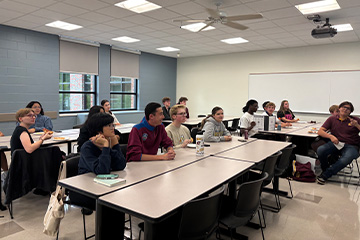
“Tuesday, usually we have lunch together in the Department of Management,” he said. “Students will get together, and sometimes even if we don't have anything, in between classes, they still go to my office. They just hang out in there, and it feels very good.”
He sees firsthand how simple, consistent connection points give students confidence, motivation, and a sense of stability.
“We always have a bunch of students in the office just hanging around, talking to each other and sharing experiences like what classes they are taking, how to do the homework, things like that.”
That environment, he emphasized, helps students succeed both academically and socially.
Chou is passionate about helping students connect their coursework to real business experiences. Whether students are in class, visiting employers, or participating in honor society activities, he wants them to see how learning becomes career readiness.
“This is something we would like to showcase to the world,” he said. “You come into here, you're not just learning theory. We combine theory with business practice, and we do have actual business partners providing you with internship opportunities.”
Chou’s commitment to student development also shows in his leadership of Alpha Iota Delta, the international honor society for decision sciences—a field that includes analytics, operations management, supply chain, and information systems. Historically, AID has been oriented toward graduate students and faculty scholars through its long-standing connection to the Decision Sciences Institute.
“When you look at our 9,000 members, most of them are PhDs,” Chou said. “It’s essentially an honor society for professors.”
Bringing AID to CMU changed that. The Sigma Mu chapter became, in his words, “a guinea pig—the first modern chapter with the most flexible chapter bylaws.” Chou argued successfully that undergraduate business students who apply analytical tools to make decisions should be included. “I said, ‘Let’s try it and see how it goes.’ They agreed, so we moved forward—and so far, so good.”
That pilot model didn’t stay local for long.
“The board intends to expand AID so we can reach even more people,” he said. “Right now, we’re starting to do something different. We’re also expanding our model to other universities.”
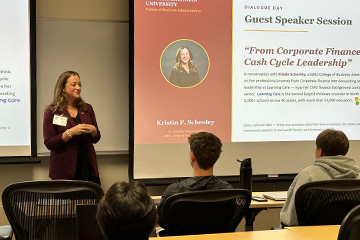
CMU students now benefit from a chapter designed to blend academic excellence with hands-on learning, employer engagement, mentorship, and leadership development. Through AID, students participate in speaker sessions with industry professionals, skill-building workshops, networking opportunities, and collaborative events that help them connect classroom learning to real-world decision-making.
Chou is also adapting ideas from peer honor societies to make AID more accessible. Inspired by Beta Alpha Psi—an international honor society for accounting, finance, and information systems known for its strong professional development programming—Sigma Mu is exploring an “associate member” option.
“They have something called an associate member,” he said. “You’re not officially recognized as an honor member, but you can join the activities.”
Across the department and through AID, Chou’s priority is clear: helping students find belonging and confidence as they discover their future.
His approach is rooted in a simple idea—students flourish when they know they’re part of a community that sees them, supports them, and believes in their potential.
If you’re interested in getting connected in the department, stop by his office or reach out by email at chou1c@cmich.edu.