Kathy Litwiller keeps the details moving and the door open
October 16, 2026
Now through October 31, we're waiving application fees for all freshman and transfer applicants!
*Common app code: Central27
From classroom concepts to real-world decisions, CMU students take on healthcare’s toughest challenges
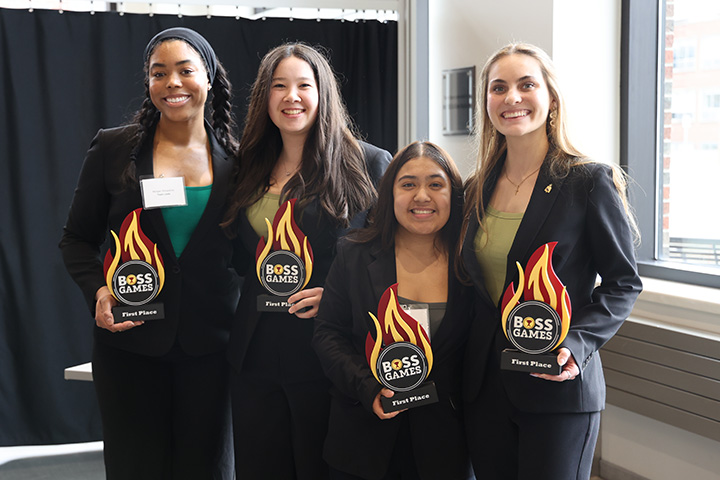
For the first time this spring, Central Michigan University College of Business Administration students stepped beyond the classroom and into the boardroom. The inaugural Boss Games, developed by faculty members Shilpa Alamuri and Jarvis Smallfield, challenged students to think like consultants advising a healthcare system under pressure—balancing workforce shortages, financial constraints and access to care.
“This was a demanding, integrated experience,” Alamuri said. “Students had to bring together what they’ve learned across different areas and apply it over several weeks as they worked through the case, and then build on that during the competition day with new challenges and time-bound decisions. What stood out was how many of them rose to that, thinking through tradeoffs, making decisions, and explaining their reasoning clearly. I’m proud that this event served as a showcase for our students’ abilities. It also did not go unnoticed by our industry partners. Several left wanting to find ways to work with them.”
The event was designed and launched entirely by Alamuri and Smallfield, who saw an opportunity to create something that pushed students beyond traditional coursework.
“Building this from the ground up gave us the opportunity to be intentional about every part of the experience,” Smallfield said. “We wanted students to move beyond theory and really wrestle with the kind of complex, high-stakes decisions they’ll face in their careers. Our industry sponsors repeatedly told us how impressed they were with how well the teams navigated that. Seeing how valuable this experience was for our students is immensely rewarding.”
The competition unfolded across three stages:
In the final round, students acted as consultants advising a nonprofit health system navigating real-world pressures—from staffing shortages to long-term financial sustainability. Their recommendations had to be financially grounded, operationally realistic and defensible under questioning.
In recognition of their performance, a total of $1,750 in scholarships were awarded to the top-performing teams.
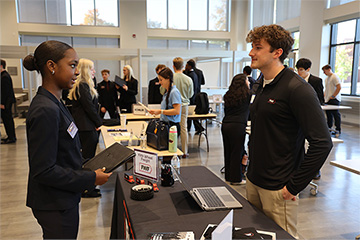
In addition to the competition rounds, the event included an employer showcase open to all students, featuring organizations such as MyMichigan Health, Enterprise Mobility, Munson Healthcare and HealthWest.
The showcase created space for students to connect directly with employers, explore career paths and gain insight into opportunities within the healthcare and business sectors.
Dana Thering, System Vice President of Business Development at MyMichigan Health, said the experience stood out for both students and industry partners.
“The Boss Games was a fantastic day, and the students’ performance was nothing short of remarkable. Their ability to think strategically and adapt in real time was impressive, and the enthusiasm from judges and mentors—many of whom are eager to return—highlights just how meaningful the experience was.”
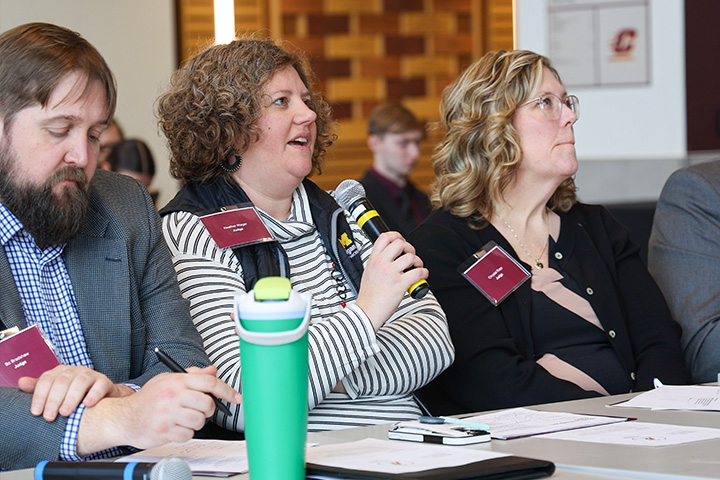
A key part of the experience came through direct engagement with healthcare professionals. Students visited MyMichigan Health, where they toured facilities, explored operational systems and engaged with senior leadership on the realities behind the case they were solving. That experience carried directly into competition day, where industry leaders returned as judges.
“I thoroughly enjoyed engaging in conversations with the students and was very impressed with their presentations,” said Bo Bradshaw, MyHR Service Center Manager at MyMichigan Health. “If I had been in their shoes as an undergraduate—or even in high school—I would have been very anxious to openly discuss a case study with several professionals observing, let alone present to a board of individuals I had never met before.”
Bradshaw said he is already looking ahead to next time.
“I would love to participate again,” he said. “It was a great exercise in critical thinking and presenting for the students, and I’m excited to see how the event continues to grow.”
That level of engagement made an impression beyond the classroom. Leaders from MyMichigan Health were so impressed with student performance that they are currently working to identify at least one participant for a future internship opportunity, with a decision expected in the coming weeks.
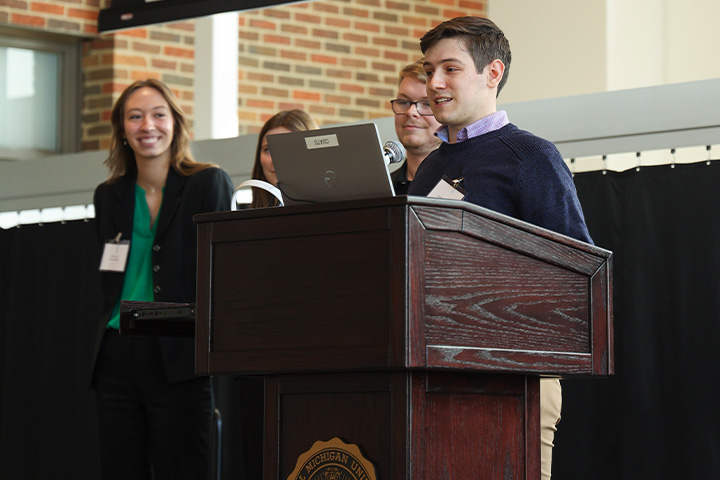
For students, the experience went beyond competition—it was a chance to apply what they’ve learned in a high-pressure, high-visibility setting.
“After weeks of preparation and an intense final day, my team and I secured first place overall,” said logistics management, marketing, and purchasing and supply management major Lauren Bonomo, a member of the first-place Team Jade. “For the final case, we acted as consultants for a nonprofit health system serving over one million residents. I focused on financial analysis, including ROI and payback periods, and making sure our recommendation stayed within budget."
Health administration major Elizabeth Hoff, also a member of Team Jade, said the experience reshaped how she approaches complex decisions.
“One of the things she taught me is the importance of asking, ‘What is the greatest risk of not implementing?’ Not only did this question challenge my approach, but it has restructured my thinking and will continue to shape how I approach future endeavors.”
Human resource management major Terri Gullatt, a member of the second-place Team Azure, said the experience connected directly to her coursework.
“As an HR major, I especially valued the opportunity to focus on the workforce dimension of the problem,” she said. “We analyzed staffing models, retention strategies and how human resources decisions directly impact organizational performance and patient outcomes.”
Teams also navigated unexpected challenges along the way.
“After losing and gaining team members, my team faced a little adversity,” said marketing major Jenna Carpenter-Ferguson of Team Ruby, which placed third. “But we overcame it and gave an amazing performance. I was absolutely shocked and excited.”
The competition also extended beyond CMU students. Through outreach efforts led by Anthony Niemiec, assistant director of student services and external relations in the HUB, high school students were invited to participate as part of select teams.
“Providing high school students with an experiential learning opportunity to team-up with college-level students and faculty, while also competing for cash prizes, will help tremendously in their post-high school pathway,” Niemiec said. “Nothing can replace first-hand college experiences like this. I absolutely loved seeing the We Do mindset in action, and I can’t wait to see how Boss Games helps these students now and into the future.” Interest extended beyond the region, with inquiries from as far as Chicago. For this first year, participation focused primarily on local and regional students, with future expansion a possibility.
While the first Boss Games delivered strong results, organizers are already looking ahead. Faculty are exploring ways to refine the experience, expand support and build on what worked—all while maintaining the momentum created in year one. For now, the focus is on growth, iteration and continuing to create opportunities that connect classroom learning with real-world impact. Additional details about future Boss Games opportunities are expected to be shared this fall.