Director of the Clarke Historical Library announces retirement
October 9, 2026
Now through October 31, we're waiving application fees for all freshman and transfer applicants!
*Common app code: Central27
CMU is home to one of Michigan’s best fishing book collections
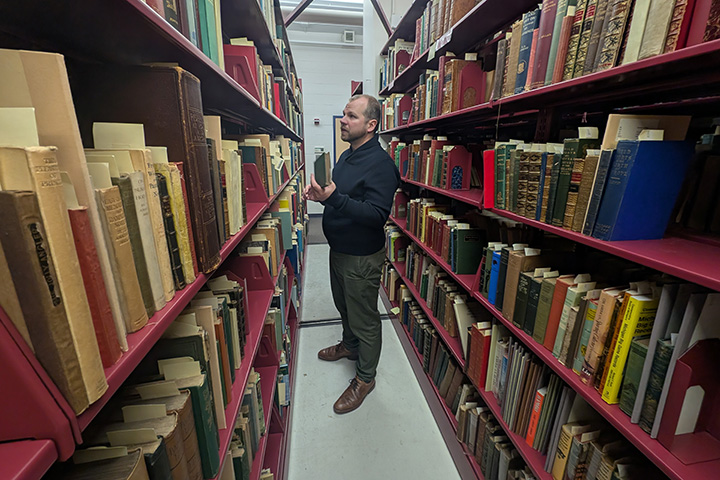
Robert Kohrman’s obsession with books about fishing was sparked by a question of geography: where did the city of Grayling get its name?
The question came to him while driving through the city in the early 1970s. He did some research, which led him to a second question: why are there no grayling—a brightly colored fish once native to northern Michigan—near Grayling?
His pursuit of the answer also introduced him to one of Michigan’s iconic sporting fish, the coaster brook trout.
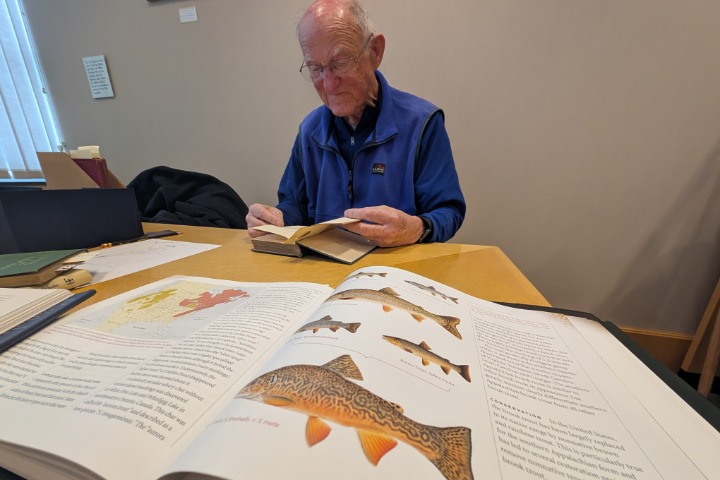
The question of why there were no grayling in Grayling started him on a journey that ended with him donating more than 900 books and large collections of more than 100 magazines to one of the Midwest’s best collections of angling books at Central Michigan University’s Clarke Historical Library.
“The Clarke unambiguously has one of the biggest collections of angling books in the Midwest,” Kohrman said. Kohrman has visited libraries across Michigan and the United States in his pursuit of books about fishing.
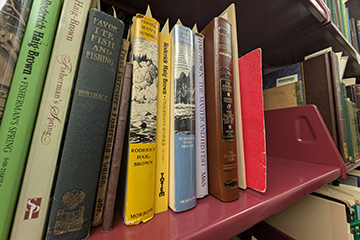
Over his active years of collecting, Kohrman amassed a library of approximately 900 titles, said Bryan Whitledge, the Clarke’s public services librarian. Kohrman, a former CMU administrator and member of the chemistry faculty, is in the process of donating his library to the Clarke.
It wasn’t just books, Whitledge said. Kohrman’s library included important historical full runs of magazines. For some, the Clarke is the only place you can find them.
It’s in those books and magazines that Kohrman said you can find clues about what happened to the grayling, which gave the city its name. The grayling was also the focus of Kohrman’s passion for angling books.
The grayling is legendary in Michigan conservation circles. It was eagerly sought by the state’s first sportsman, plentiful in the cold rivers of the northern Lower Peninsula, easy to catch in large numbers and delicious out of the frying pan.
Its rapid disappearance from the Lower Peninsula is also a cautionary tale about abundance.
There are likely two human-driven factors in the fish’s disappearance, Kohrman said. Overfishing and damage to spawning beds from logs during Michigan’s timber heyday are two commonly mentioned causes.
A third possible cause was competition from the brook trout, Kohrman said. Brook trout typically live in the cold-water streams and rivers of northern Michigan. Populations that live in the big waters of the Great Lakes get much bigger and are called coasters.
Coasters are genetically identical to their smaller river-living cousins, said Kevin Pangle, a faculty member in CMU’s biology department. One of Pangle’s graduate students hopes to find a way to study coaster aging in a way that won’t kill them.
Coasters are legendary in Michigan’s sporting community. As brook trout, they are culturally significant to the state because they were officially designated the state fish in 1988.
They also didn’t originally live in the Lower Peninsula, Kohrman said. They lived in the Upper Peninsula, but are hypothesized to have migrated through Lake Michigan to the northern Lower Peninsula and into the smaller streams.
There, it’s believed you can track the discovery of the grayling and its replacement by brook trout in Michigan’s northern streams through the books and magazines in the Clarke’s fishing collection. It boasts just over 2,000 books and magazine titles.
The Clarke’s fishing collection was already unique before Kohrman started donating his holdings. What put CMU on the map was the donation in the early 2000s of the 1,200-title Reed Draper collection, Whitledge said.
Reed Draper owned auto dealers in the Bay City area and was a keen collector of angling books, he said.
Former Clarke director John Cummings helped Draper acquire books in an even larger collection held by someone in Cleveland, Kohrman said. Over the years, Draper curated an angling collection with a focus on Michigan.
“The Reed Draper collection is a really fine collection,” he said.
It also helped the Clarke build a reputation within circles of people interested in angling literature or the history of places where fishing was prominent. Books about fishing can provide insights into how people made economic development decisions years ago.
“Why does US-131 follow the route it follows?” Whitledge said. It follows the old route of the Grand Rapids-Indiana railroad, used to shuttle vacationers from Chicago to northern Michigan.
A supportive CMU community was a key element to the Clarke’s collection, Kohrman said. Faculty members from the biology department frequently used library resources to satisfy professional and personal questions.
Only a few years ago, an author who earned his doctorate at CMU wrote a book about the role salmon fishing played in the growth and decline of the economy of a northern Michigan fishing boom town.
The Clarke is still taking in Kohrman’s full angling collection, Whitledge said. They could just receive boxes of materials, but library staff want to properly catalogue each piece.
Careful, thorough cataloguing helps connect people to resources that can satisfy their questions, he said. It also helps the Clarke get the word out that one of Michigan’s premier collections of angling books is at Central Michigan University.