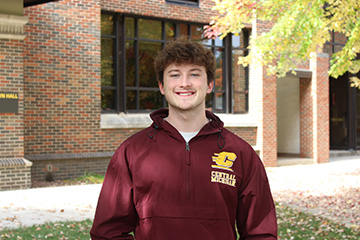
CMU student's initiative helps create new recruiting role
October 26, 2026
Now through October 31, we're waiving application fees for all freshman and transfer applicants!
*Common app code: Central27
How Zane Iqbal found direction, support and a sense of home
For Zauraiz “Zane” Iqbal, an MBA student with an emphasis in logistics from Pakistan, choosing where to pursue his graduate degree was less about rankings or checklists and more about how a place made him feel.
“CMU just felt right. I looked at a lot of schools, but people here actually respond and help guide and make space for you. I didn’t want a place where I’d just be another student’s ID number, and CMU didn’t feel like that. The small town makes me feel at home.”
Iqbal didn’t arrive at CMU with his academic direction completely locked in—and he’s open about that. His journey into the supply chain began with exploration and reflection.
“So, I first chose the emphasis, I first chose project management, but after considering and thinking about it, I chose supply chain and logistics because I was attracted to the technical nature and the involvement in the process.”
What ultimately pulled him in was curiosity—and how clearly the field connected to real-world leadership and careers.
“I was more curious about it than anything, and I see how it ties into real-life careers and leadership. And it motivates me even more.”
When asked about his favorite course so far, Iqbal doesn’t hesitate—not just because of the subject, but because of how it’s taught.
“My favorite classes are Managing and Leading Individuals and Organizations. The professor, Alexandra McDougall, makes you so involved in class. The course and the subject are so interesting, and the professor makes it more interesting.”
As a graduate student adjusting to a new academic environment—and a new country—Iqbal said the level of support he’s experienced at CMU has been one of the most meaningful parts of his journey.
“So honestly, I’ve been overwhelmed by the support. It feels so natural and not forced. If I have a question, there’s always someone who answers it. And if I’m confused, there’s tutoring office hours, and everyone is just so supportive. I’ve never felt judged for asking for help, which is huge.”
That sense of support extends beyond the classroom, especially through collaborative learning.
“Group projects changed how I work. You meet so many different personalities, and you learn when to step up, when to step back, and when to just breathe through deadlines. It’s kind of the real-world version of patience.”
Rather than focusing on titles or formal roles, Iqbal has taken a more organic approach to getting involved on campus.
“I’m involved informally more than officially, I show up to events, meet people, join conversations, but I’m not chasing titles or positions right now.”
Over time, that approach helped him find his people.
“Just by showing up, you slowly find the people you click with, and international students, especially, get it. We all know what it’s like to start from scratch.”
For students who feel pressure to have everything planned early, Iqbal offers reassurance rooted in experience.
“What I would say is don’t stress yourself into a major. Start with what interests you, even if you’re not 100% certain. Because no one has it figured out at 18.”
There’s also one mindset shift he wishes he had embraced sooner.
“It’s okay to not adjust instantly. You don’t need to be perfectly settled on day one. Some things take time, and that’s normal.”
After graduation, Iqbal hopes to work in supply chain management, particularly in roles centered on logistics, operations and planning.
“I like the idea of being the person who connects all the moving pieces, vendors, inventory, shipping, data, timing, that makes sure everything actually arrives where it’s supposed to, when it’s supposed to.”
As his understanding of the field has grown, so has his perspective on its impact.
“Once I started learning how supply chain impacts everything—everything we buy, eat, wear, or use—I stop seeing it as just trucks and warehouses. It’s actually strategy, timing, forecasting, problem-solving, and people management all at once. It feels like a field that keeps you thinking rather than repeating the same work every day.”
When Iqbal looks back on his time at CMU, it’s not just the coursework or credentials that stand out—it’s the transition itself.
“It’s the people that I met here, my friends, the weird mix of being lost and finding my footing. The moments where everything felt new but slowly became familiar, how CMU became my home, our home. That transition itself is what changed me.”