ENT 301 students discover the value of a rough prototype
With cardboard, tape and 30 minutes, teams built working models for a real problem, then put them in front of children ages 10 to 12
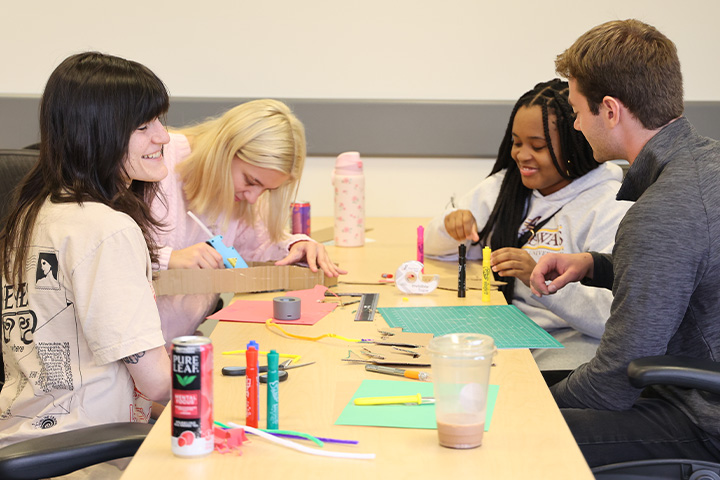
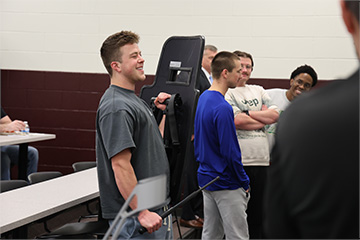
Cardboard scraps, hot glue guns and rolls of tape covered the tables in Grawn 150G on Nov. 11, and the clock was running. Students in entrepreneurship faculty member Lauren Zettel's ENT 301 Innovation and Entrepreneurship had 30 minutes to build a working model of a product that could help kids take a daily vitamin on their own.
The challenge was aimed at children ages 10 to 12 and their parents. Zettel said studies have found that many children are low in vitamin D, and parents want kids to take their vitamins independently and safely. Every team got the same materials, and Zettel reminded students that prototyping comes after they have researched a problem and weighed several solutions.
When time ran out, the tables held a gumball machine on a 24-hour timer, a claw machine that hands out vitamins as prizes, a dispenser that tracks how many days in a row a child takes a vitamin, and a rocket and a rose that launch or bloom as a reward.
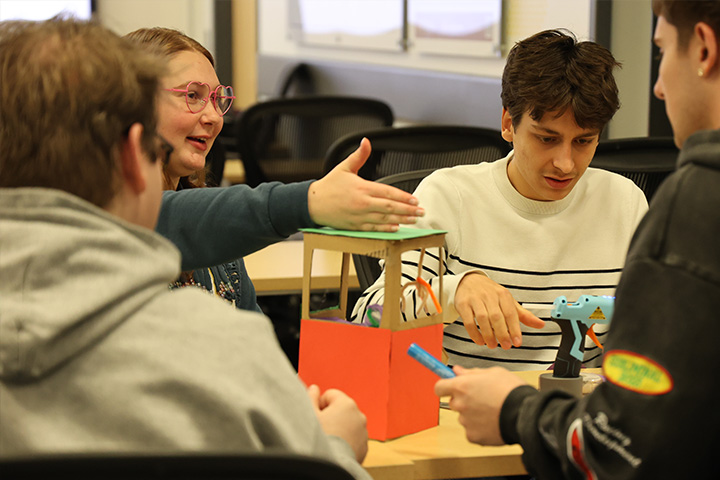
Drake Evans, a junior entrepreneurship major from Lansing, Mich., whose team built the gumball machine, said the goal was simple.
“Kids are more incentivized to take their vitamins because it’s a gumball machine," he said, "but also keeps them from taking 12 gummies in a day.”
Building it taught his team something no brainstorm could.
“We learned that it’s really hard to make a sphere out of cardboard and paper,” Evans said. “It’s also a lot harder to build a decent prototype in 30 minutes. But I think we did a great job.”
With more time, he said, “I think we would try and make a sphere for the top part of it and make a working flap that opens and closes. It does work right now, but it’s not very smooth.”
Zettel said that kind of roughness is the point.
“Initially a lot of students are embarrassed to create a prototype and show it because they think it’s too rough,” she said. “But really, all a prototype has to do is to communicate your idea and how it would work. And so something very basic and very rough can do just that.”
Then the models met their audience. A panel of children ages 10 to 12 reviewed each one and gave direct feedback. They liked designing their own vitamin and favored ideas that fit their age. That kind of response is why Zettel has students build prototypes at all.
“If customers can sort of interact with the product or the idea, then they can get more valuable and honest feedback from them,” she said.
Back at their tables, students turned the experience into takeaways. Several said a rough model lets a team find out what works for a fraction of what a finished product would cost, and others described the next step as taking a first version to potential customers, testing it and revising it based on what they hear.
That cycle carries into the final project in ENT 301, where students research a consumer problem, build a prototype, test it with potential customers and decide what to change next. Zettel’s message to the class was that the barrier is low.
“You don’t need a ton of fancy tools or experience to build a prototype,” she said. “It only took you 30 minutes, but look what you were able to accomplish in 30 minutes.”
Related News

Mark Hwang reflects on 29 years of teaching, research and change
CBA Weekly Pics: November 20th, 2026
Austin Benchley turns CMU opportunities into a career with Celonis