He never planned to teach—but is still going strong after 45 years
For Thomas H. Anthony, law, learning and respect have always gone hand in hand
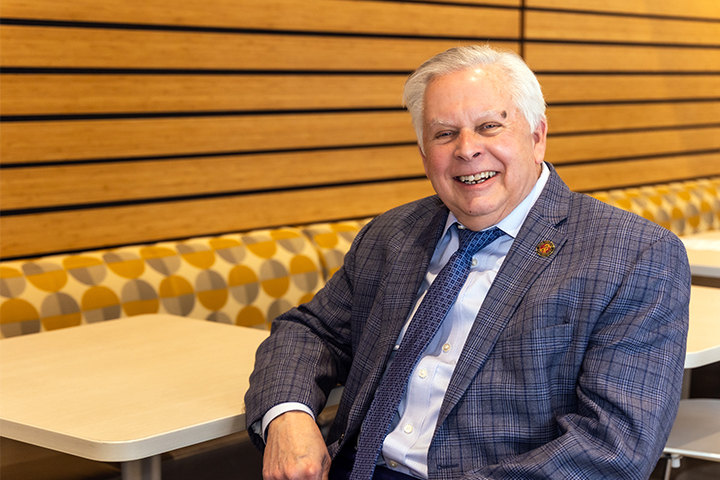
Thomas H. Anthony never imagined a career in higher education. More than four decades later, he is one of Central Michigan University’s longest-serving faculty members—and someone who still measures his success by how well he connects with students.
Anthony, who holds a doctorate in law, joined CMU in 1981 after working full-time at a law firm. Two senior attorneys encouraged him to try teaching, and he began as a part-time instructor while continuing his legal work. Later, when CMU asked him to teach while he was also at Alma College, he split time between both campuses.
When a tenure-track position opened at CMU, Anthony hesitated.
“One of the senior attorneys told me to take it, because you couldn’t replace the benefits,” he said. “So, I’ve been here ever since.”
He earned tenure in 1986 and has spent 45 years teaching courses including business law, commercial paper, estate planning, finance, and management. He also helped create CMU’s entrepreneurship program and taught its capstone course, holding a split appointment between entrepreneurship and management law.
Research with real-world impact
Anthony’s scholarship reflects the same practical lens he brings to the classroom—focused on how law affects people, business, and society.
“One of my more recent articles was in the State Bar Journal and talked about dower, which is a legal term affecting real property rights of spouses,” he said.
That work extended beyond publication. The Michigan state committee reviewing dower used his article to update the law. Another major publication in the Federal Law Journal focused on the legal rights of Native Americans, reflecting his interest in how legal systems shape lived experience.
In the classroom, Anthony is clear about expectations.
“Some people take the class expecting it to be a substitute for a law class in law school, and it’s not,” he said. “It’s just designed to give business majors an introduction to legal concepts and really say, ‘OK, this is when I need to call an attorney.’”
A classroom that evolves
Anthony’s teaching philosophy is grounded in change. “I hope it’s never the same twice,” he said. “Every year I change things.”
He adapts his approach to each class, blending lecture, discussion, and unconventional tools such as film. Current events are central, with topics like immigration or the federal budget deficit prompting student responses.
“[Students] start to realize there’s a world outside that’s huge,” he said. “What happens here is just a small, microscopic part of life. You really have to be aware of what’s going on in the world.”
At the heart of his classroom is respect.
“I think you treat [students] with respect,” Anthony said. “What most people forget is as instructors in the classroom, we’re supposed to be substitute parents. So, I try to treat them as I would treat my own children.”
Preparing students for the real world
Anthony is quick to say that teaching isn’t a one-way street. His students challenge him—and he welcomes it.
“They keep me young,” he said. “They make me think about things.”
That exchange is part of what keeps him engaged in the classroom, but he’s also clear about expectations. College, he tells students, is not an extension of high school—it’s preparation for what comes next.
For Anthony, success in college comes down to effort and engagement. Students who show up, stay curious, and take ownership of their learning tend to get the most out of the experience.
“College is—you get out of it what you put into it,” he said. “The more you’re engaged, the better you’ll do.”
For students still figuring out their direction, his advice is practical and honest: focus on finding work that feels meaningful.
“Find something you like,” he said. “If you are working for a job for the money, the money doesn’t matter. If you find a job you love, the money doesn’t matter, because if you enjoy going to work, you’re going to enjoy life.”
Internships, he believes, are a critical part of that discovery process. They offer students a chance to test-drive a career path before committing to it long term.
“It’s a 90-day job interview,” he said. “You find out if you like it. If you don’t, you move on and find something else you do like.”
Skills that never stop mattering
No matter where students land professionally, Anthony emphasizes that certain skills remain essential throughout a career—especially reading and writing.
“The two most important skills are reading and learning to write effectively so you can communicate your thoughts, regardless of your major.” he said. “The law changes every year. In some fields, it changes daily. If you can’t study and read, how are you going to learn new products?”
These skills, he explains, are not tied to a single discipline or job title. They’re foundational tools that allow graduates to adapt, grow, and keep learning long after they leave the classroom.
A lesson beyond business
After decades of teaching, Anthony hopes students walk away with more than legal knowledge. But his most important lesson reaches beyond coursework and careers. It’s about how students move through the world and interact with others.
“Respect other people and treat them as you would treat yourself,” he said. “We all come from different cultures. We may have different ways of doing things, but that doesn’t make it right or wrong.”
He believes curiosity and conversation are essential—especially when perspectives differ.
“When you sit down and have a meal with somebody, you’d be surprised how much more you agree than disagree,” he said. “We should be able to agree to disagree without rancor.”
After 45 years at CMU, that philosophy continues to guide his work—anchored in respect, perspective, and a belief that learning begins with listening.