Public invited to explore cybersecurity in practice
October 12, 2026
Now through October 31, we're waiving application fees for all freshman and transfer applicants!
*Common app code: Central27
In BIS 636, students analyzed everyday challenges and built technology concepts with real business value
What if ordering lunch on campus was smarter, faster and better tailored to dietary needs? What if local transit riders could track buses in real time and pay digitally? What if mechanics could receive vehicle diagnostic data before a car ever arrived for service?
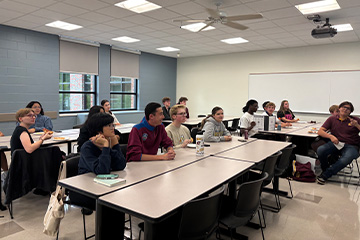
Those were the kinds of questions students tackled in BIS 636, Systems Analysis and Design, a graduate-level course in the Central Michigan University College of Business Administration where students learn how to evaluate existing systems, identify inefficiencies and propose technology-driven improvements. Rather than focusing only on theory, the course challenged students to think like analysts, designers and consultants—studying how organizations operate, where friction exists and how better systems can improve experiences for users and businesses alike.
“The Systems Analysis and Design class teaches students how to think before they build,” said BIS faculty member Ekhomen Ehimen-Ebitibituwa. “Students learn to slow down, ask better questions, define the current state, envision a stronger future state and make sure technology solutions truly fit business needs.”
She said the course helps students understand that systems are more than software alone. “A system includes people, processes, data, policies, workflows, controls, risks and outcomes working together,” Ehimen-Ebitibituwa said. “That perspective helps students connect business needs with technology decisions no matter where their careers take them.”
Students worked in teams across several industries, developing proposals supported by research, documentation, feasibility planning and prototype concepts.
One student team focused on improving dining operations in the Bovee University Center Central Eats food court. Their proposal included an AI-powered kiosk chatbot that could help users navigate dietary restrictions and estimated preparation times for meals.
Sadiksha Giri, an MSIS student from Kathmandu, Nepal, said the idea grew from firsthand experience working in the food court. “Right now, most students have two ways to order food—at the kiosk or face-to-face,” Giri said. “Some people have dietary restrictions, and since staff are so busy, they don’t always have time to answer those questions.”
The team also saw another issue: students ordering food between classes without knowing how long the wait would be. “Most of the time people are already late for class,” Giri said. “They just leave [the food they ordered]. So, it’s a waste of food.”
The proposed system would provide wait-time estimates and recommend faster options during peak lunch hours. Yogesh Kumar, from Hyderabad, India, said the concept could scale far beyond campus dining.
“This could actually be even bigger than this,” Yogesh said. “If you go to McDonald’s or somewhere else like Dunkin’, they have kiosks too. If you’re able to integrate a chatbot into that, it could be a big business.”
Other student teams explored improvements in transportation, vehicle service systems, entertainment platforms and healthcare. One project proposed modernizing the local iRide transit system with digital payment options, bus tracking and more accurate arrival estimates. Another team developed a pre-arrival vehicle diagnostic system that could send car data to service centers in advance, helping shops prepare technicians and parts before customers arrived.
Cade Sowinski, an undergraduate student from Bay City, Mich., in CMU’s accelerated MSIS program, said his team wanted to solve a common frustration in today’s entertainment landscape. “The streaming industry is very fragmented,” Sowinski said. “You want to find a show that you like, and you don’t know where it is.” Their proposed system would recommend the most valuable package of streaming services based on user preferences and budget.
Together, the projects reflected the wide range of ways business information systems can improve organizations, customer experiences and decision-making. Projects included:
Teams were also recognized for standout work in creativity, research and analysis, business strategy, communication and industry impact, highlighting the professional skills developed throughout the course.
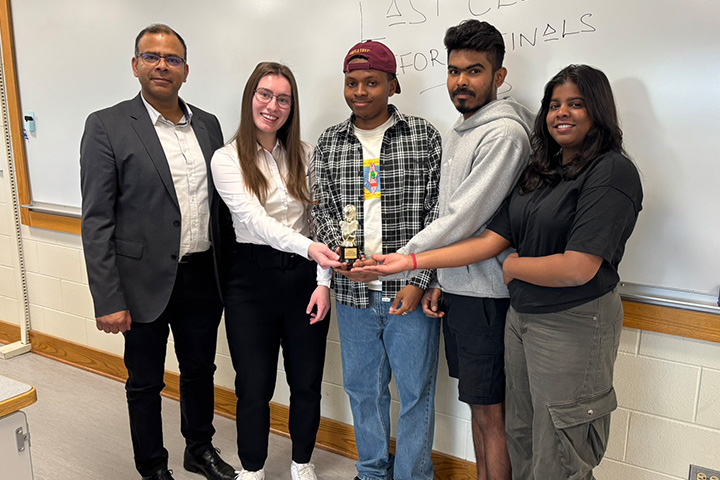
Associate Dean Sanjay Kumar told students the value of the project extended well beyond the classroom. “These projects are essential for developing your thinking style, sharpening your analytical skills, and learning how to present yourself effectively,” Kumar said. “In every class, make it a habit to keep a record of your projects—this will give you concrete examples to draw upon during job interviews.”
That connection to real-world application was reinforced by alumnus Faris Abdelrahim Ahmat, MSIS ’14, who joined the class earlier in the week to share how he applies similar concepts in his work, using data-driven insights to build stronger client relationships and navigate competitive markets.
That career relevance is central to the BIS experience at CMU, where students gain technical knowledge while learning to communicate ideas, solve business problems and create solutions organizations can actually use.
By the end of the semester, students were not only presenting projects. They were practicing the kind of work many will do in their careers: identifying needs, collaborating in teams, analyzing tradeoffs and building solutions with impact. In BIS 636, systems analysis is more than a course topic. It is a mindset—one that helps students turn ideas into outcomes.