Engineering innovation meets industry need
June 16, 2026
For Geologist Rickey Bartlett, geology has always been about asking questions that rocks have been quietly holding onto for millions of years.
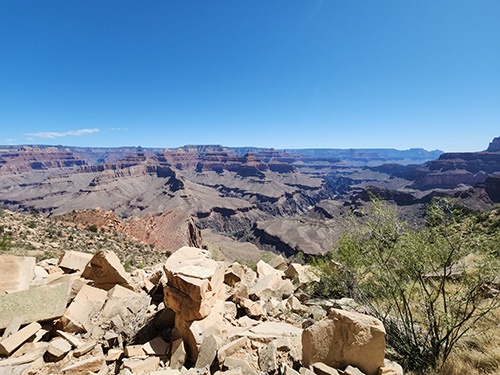
Now, as a new faculty member in Central Michigan University's Department of Earth and Atmospheric Sciences, Bartlett is leading research that could reshape scientists' understanding of one of the most famous rock formations in North America while providing undergraduate students with hands-on research experiences rarely available at the undergraduate level.
This summer, Bartlett and undergraduate researcher Cierra Robinson returned from a field expedition to Grand Canyon National Park, where they continued investigating a remarkable fossil site within the Coconino Sandstone, a 280-million-year-old rock formation that stretches across much of the American Southwest.
Funded through a Faculty Research and Creative Endeavors (FRCE) grant, the trip allowed Bartlett and Robinson to collect new data from what may be the richest concentration of trace fossils ever discovered in the Coconino Sandstone.
"The Grand Canyon is impossible to explain or describe in words," Bartlett said. "One has to experience it. It's an extremely challenging but rewarding place to work."
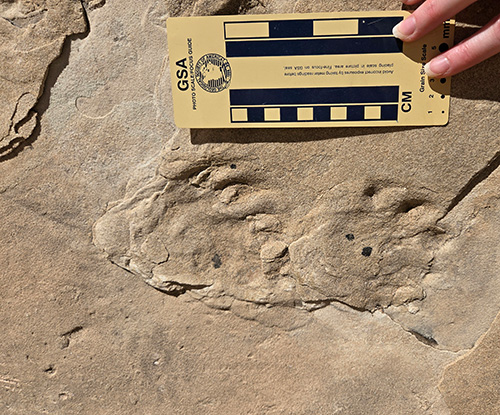
The Coconino Sandstone preserves evidence of an ancient desert ecosystem that existed during the Permian Period, a critical chapter in Earth's evolutionary history. During this time, some of the earliest fully terrestrial vertebrates were diversifying into lineages that would eventually give rise to modern mammals, dinosaurs, and reptiles.
Unlike many fossil sites, however, the Coconino contains no preserved bones or body fossils.
Instead, researchers must piece together the story of life from traces left behind in the sand millions of years ago: footprints, trackways, burrows, mud cracks, and even raindrop impressions.
"We are trying to get an idea of what an ancient desert sand dune ecosystem looked like through only preserved footprints and environmental traces," Robinson explained. "It helps us better understand a critical period in time for the evolution of modern mammals and reptiles."
The challenge is that many of these traces are incredibly delicate.
Some fossilized scorpion tail drags, for example, are only a few grains of sand high yet extend for several feet. Understanding how such fragile structures survived and were preserved in a landscape of shifting sand dunes remains one of the central questions driving Bartlett's research.
Bartlett first became interested in the site years ago while conducting undergraduate research with his own advisor. Together, they identified a previously undocumented locality in the Grand Canyon containing an unusually dense concentration of trace fossils.
This spring's expedition provided an opportunity to revisit the site and gather data needed for a formal scientific publication.
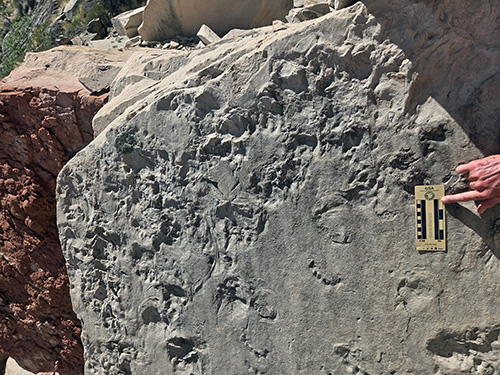
The team's findings suggest the locality may represent an ancient hotspot of biological activity in what was otherwise an extremely harsh desert environment.
"Traces in the Coconino are generally sparse," Bartlett said. "But there are a few locations where life seems to be concentrated, and those concentrations offer clues about how these ecosystems functioned."
The leading hypothesis? Water.
Researchers believe the site may have contained a source of surface or near-surface water that attracted animals and concentrated biological activity in one area.
During the recent expedition, Bartlett and Robinson documented several previously unrecorded trace fossils and discovered a large bioturbated surface that suggests unusual animal behavior.
"In all my years working in the Coconino Sandstone, I've only encountered one other surface like it," Bartlett said.
The discoveries have positioned the team to prepare a formal paleontological description of the site later this year.
For Bartlett, the project is about more than scientific discovery.
A former community college faculty member who came to CMU from Ohio's Lakeland Community College, Bartlett chose Central Michigan University in part because of its commitment to undergraduate research.
"I was very fortunate in my own education to have excellent mentors and teachers," he said. "What I would like to accomplish is to do the same thing for my students."
Robinson has become an integral member of the research team, participating in nearly every aspect of the project.
Her work includes conducting field research in the Grand Canyon, preparing rock samples, performing microscopy analyses, reviewing scientific literature, and helping interpret data.
She will also present research from the newly documented locality at the annual meeting of the Geological Society of America this fall in Denver.
Through CMU's Summer Program for Undergraduate Research (SPAR), Robinson is able to remain on campus throughout the summer and continue working on the project.
"Within the scope of this project, she is performing many of the duties of a graduate student," Bartlett said.
Back on campus, the project highlights the collaborative nature of research at CMU.
Bartlett and his students are utilizing laboratories within the Department of Earth and Atmospheric Sciences, as well as scanning electron microscopy facilities in the Department of Biology.
The team has also partnered with CMU's Fashion Design Program to use advanced 3D scanning technology. Every fossil specimen collected during the expedition is digitally archived before testing, creating permanent 3D models and printable replicas that preserve the specimens for future study.
The process was required under the team's National Park Service collection permit, but it also provides valuable opportunities for interdisciplinary collaboration.
Throughout the summer, Bartlett and his students will continue analyzing samples collected from the Grand Canyon and northern Arizona.
The team hopes to identify the mechanisms responsible for preserving delicate fossil traces and ultimately reconstruct the food web of a desert ecosystem that existed nearly 280 million years ago.
Long-term goals include securing funding from the National Science Foundation and conducting a broader survey of the Coconino Sandstone and related rock formations across the Southwest.
For Bartlett, the work offers a chance to answer fundamental questions about life on Earth while helping students discover the excitement of scientific exploration.
His favorite moment from the recent expedition had little to do with fossils.
"Watching my student develop the same love and appreciation for the canyon and the work that I did as an undergraduate," he said. "That was the most exciting part of the trip."