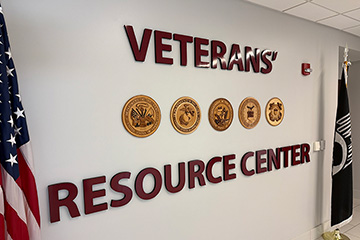
CMU named Gold-Level Veteran-Friendly School
October 15, 2026
Now through October 31, we're waiving application fees for all freshman and transfer applicants!
*Common app code: Central27
Students get experience, support while assisting local schools
Jaime Modrzynski started making a difference in the lives of Midland County school children in her first semester of graduate school.
Modrzynski was providing extra math assistance to a student, who struck her as frustrated about something beyond their schoolwork.
Modrzynski, who is in her second year of studying to be a school psychologist at Central Michigan University, spoke to school officials, who provided additional support to the child.
Graduate students in CMU’s school psychology program can participate in a one-year partnership, called the School Psychologist Apprentice Program, with local schools, which is funded through a state grant.
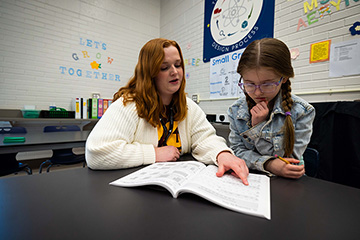
Students like Modrzynski are increasingly exposed to the demanding field of school psychology each year. School districts get desperately needed help from graduate students who have experience working with school students and teachers.
“My current practicum student has knowledge and confidence working in the school setting that I have not witnessed in previous practicum students,” said Danielle Pellegrino, a school psychologist who works for Midland Public Schools. “Because she had a year of direct work with students and teachers under her belt, and significant experience with interventions and (student case files), she has been able to hit the ground running.
“I am so thankful that the SPA Program prepared her so well and I wish that I could hire her now.”
The program’s chief architect is Megan Thompson, who works in Midland County’s Sanford-Meridian School District. Thompson said she was originally contacted by Daniel Drevon, a faculty member in CMU’s psychology department, to provide CMU students with valuable hands-on experience in the field.
Thompson’s program helps transition CMU students into field work by creating a bridge year. Rather than immediately start offering supervised psychological services in their second year in the program, they now get a year of working with students and teachers in an academic-support role.
“We know there’s a critical shortage of school psychologists in the state, but how do we meet that need at the local level?” Drevon said. “This is one way to do that.”
The partnership is already making a difference in mid-Michigan.
“I believe a long-term partnership could be incredibly valuable for our region,” Thompson said. “School Psychologists are in critical shortage within the State of Michigan. Within the region, there have been unfilled school psychology positions for many years. I believe the SPA program is helping to attract school psychologists to our region and will hopefully allow for a more balanced and diversified role for school psychologists over time.”
Just as importantly, students are also taught to take care of themselves. School psychology specialists are in high demand, and high turnover makes a difficult situation even thornier.
The program is structured to provide CMU’s grad students with an experience that becomes more immersive the more experience they acquire.
In the first year, they support teachers primarily by offering academic assistance. In the second, they start to offer psychology services. By the third year, they serve in full-time internships.
Thompson structured the program to give graduate students an incremental exposure to the work, which can be stressful.
Hannah Conner, another second-year student, said that she’s found tremendous value in that structure beyond developing skills critical to the job.
“A lot of what I learned last year built my confidence for this year,” she said. The program is designed to holistically build the confidence of people entering the field. They get experience on the job, but they’re also taught to advocate for themselves to avoid burnout.
Conner said that’s made her feel more supported and confident. The confidence, in turn, makes her excited to pursue her passion of making a difference and helping teachers.
That sense of confidence has trickled down to students in their first year in the program. Lauren VanHouten originally passed on it, but after hearing about the experiences it offered signed up. Now she’s ready to learn new skills and take on new challenges.
“I feel excited at just the idea that I get to help with the shortage,” she said. “We get to be part of the change.”