Now through October 31, we're waiving application fees for all freshman and transfer applicants!
*Common app code: Central27
CMU biology professor receives grant to study proteins linked to cancer
One CMU biology professor is looking at one of the smallest components of our bodies for clues to one of medicine’s biggest challenges: understanding how cancer cells grow and spread.
Dr. Cynthia Damer, in collaboration with Dr. Eric Petersen, has received a three-year grant from the National Institute of General Medical Sciences to investigate how a group of proteins called copines help regulate calcium inside cells.
Calcium is essential to healthy cells, but keeping the right amount in the right place is critical. Damer compares the process to a thermostat maintaining the temperature in a house.
“Cells need to carefully control calcium levels to function properly, much like a thermostat controls temperature in a house,” Damer said. “We are studying proteins that may help maintain that balance, and understanding how they work could provide clues about why cancer cells grow and spread.”
The research will focus on a protein called CpnA and its potential interaction with a calcium pump known as PatA. Damer wants to determine whether CpnA helps control calcium levels by interacting with and activating PatA.
The answer could help scientists better understand how cells function, and potentially provide new insight into cancer.
Copine proteins are highly expressed in many cancers and have been associated with tumor growth and metastasis. However, scientists still do not fully understand what these proteins do or how they contribute to disease.
“The most exciting aspect is the opportunity to uncover a previously unknown function of copine proteins,” Damer said. “Discovering how these proteins regulate calcium could have broad implications for understanding both normal cell biology and cancer.”
Research that puts students in the lab
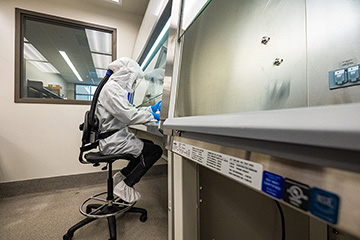
The grant will support a range of experiments, including protein interaction studies, the creation of mutant cell lines, calcium measurements and genetic rescue analyses. With the expert help of Dr. Petersen and his research team, Damer and her research team will also use advanced techniques such as Split NanoLuc complementation and bioluminescence resonance energy transfer, or BRET, assays.
Just as important, the grant will provide opportunities for CMU undergraduate and graduate students to take part in the research.
Students will work directly on experiments under Petersen’s and Damer’s supervision, gaining experience with techniques including cell culture, cloning, biochemistry and microscopy. They also will learn how to design experiments, analyze results and communicate their findings.
“Students contribute valuable time, ideas, and effort and their participation also helps build the next generation of researchers,” Damer said.
Students involved in the project could also have opportunities to co-author scientific publications and present their work at international conferences.
For Damer, that student experience is an important measure of the project’s success.
“Success would mean clearly demonstrating how CpnA and PatA interact and defining their roles in calcium homeostasis,” she said. “In addition, success would be students being co-authors on papers and presenting at conferences, and being prepared for future careers in science.”
Looking for an answer at the cellular level
At the heart of the project is a straightforward question with potentially far-reaching implications: Do copine proteins directly control calcium levels inside cells by activating calcium pumps?
Answering that question could give researchers a better understanding of why copines are associated with cancer and other diseases.
The three-year project will give Damer and her students the resources to investigate that question in living cells and establish a foundation for future research into copine proteins and their role in human health.
The project also highlights the value of collaboration across CMU's colleges. By bringing together faculty expertise and student researchers from the College of Science and Engineering and the College of Medicine, the research creates opportunities for students to work across disciplines, gain hands-on experience and contribute to discoveries that could advance our understanding of human health.