Now through October 31, we're waiving application fees for all freshman and transfer applicants!
*Common app code: Central27
CMU faculty awarded National Science Foundation grant to expand STORM field research program
Faculty members in the Department of Earth and Atmospheric Sciences at Central Michigan University have secured new funding from the National Science Foundation (NSF) to expand the Student Training for Observational Research in Meteorology (STORM) program, an immersive field research experience designed for rising sophomore meteorology majors.
Jason Keeler, PhD, and Daria Kluver, PhD, received the NSF award to broaden the reach of STORM and expand early-career experiential learning opportunities in meteorology. Collaborators include Matt Johnson, PhD, and Collin DeYoung of Central Michigan University, along with Wendi Flynn, PhD, of the University of Northern Colorado.
What is STORM?
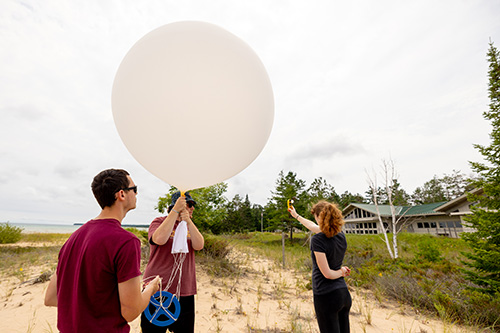
STORM is a one-and-a-half-week field research experience held each August at CMU’s Biological Station on Beaver Island. The program provides students with hands-on training using professional meteorological equipment, including mobile mesonets (instrumented weather research vehicles), radiosondes (weather balloons), drones, and surface weather stations.
Unlike many atmospheric field research opportunities that are typically reserved for juniors, seniors, or graduate students, STORM is designed specifically for students who have completed their first year and are entering their sophomore year.
Since its launch in 2019, the program has expanded and now supports 18 students annually. Thirteen participants are from CMU, and five are from the University of Northern Colorado, accompanied by one faculty member.
The Beaver Island location provides a natural laboratory for studying boundary layer and mesoscale phenomena, including lake breezes and island-induced weather modification. Students observe atmospheric processes in real time and later analyze those processes in upper-level coursework.
A student-centered approach
The program is structured to reduce financial and academic barriers to participation. Selection is not based on grade point average. All student expenses are covered, and participants receive a stipend, reducing potential conflicts between academic enrichment and summer employment.
During the program, students:
- Design experiments to investigate how Lake Michigan and Beaver Island influence local weather patterns.
- Collect and analyze atmospheric data.
- Meet daily to discuss findings and reinforce learning.
- Adapt research plans in response to evolving weather conditions.
- Participate in structured social activities to foster peer and faculty connections.
Following the field experience, students continue engagement through online communication platforms that support ongoing academic collaboration.
Measurable impact on student success
The program’s impact extends beyond technical skill development. Students report stronger connections to peers and faculty, factors associated with student retention and academic success.
Keeler noted, “One of the primary reasons students leave college is that they do not feel they belong. STORM directly addresses that challenge while providing meaningful, hands-on learning.”
Participants begin their sophomore year with:
- Increased confidence in applying classroom concepts to real-world atmospheric processes.
- An established academic and professional support network.
- Enhanced competitiveness for internships, Research Experiences for Undergraduates (REUs), and graduate study.
- Early development of professional skills associated with long-term career readiness.
The experience also supports continued academic engagement during the sophomore year by reinforcing disciplinary identity and purpose within the meteorology major.
A nationally distinctive program
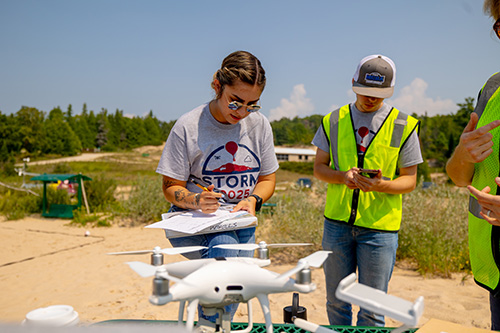
At many institutions, immersive field research is introduced later in a student’s academic trajectory. STORM accelerates that timeline by providing a paid, grade-independent, rising-sophomore field experience in which students design and implement atmospheric research projects.
Looking ahead
With NSF funding secured for 2025 and 2026, the STORM leadership team is planning for continued program development and long-term sustainability. Keeler and Kluver welcome collaboration with external partners interested in supporting early-career research opportunities in meteorology.
As the program expands, STORM continues to model an approach to immersive, community-based learning designed to strengthen both scientific training and academic community development.