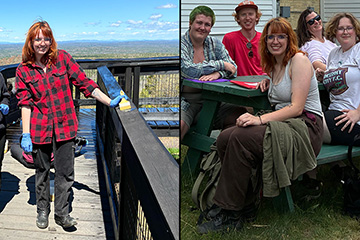
CMU summer trips teach the value of reflection
October 5, 2026
Now through October 31, we're waiving application fees for all freshman and transfer applicants!
*Common app code: Central27
When he arrived at Central Michigan University, Wyatt Cook knew one thing for certain: He loved physics. What he didn't know was where that interest would take him.
Today, the CMU physics graduate is putting the research skills he developed as an undergraduate to work at Argonne National Laboratory, where he is part of the low-energy nuclear physics group.
Cook's path to the national laboratory began at Montcalm Community College.
"I knew I wanted a greater education but wasn't quite sure what I wanted to study," Cook said.
He pursued a general liberal arts and sciences associate degree at MCC, choosing a path that would make transferring to a university relatively straightforward. Along the way, a few physics courses helped point him toward his next step.
"I really enjoyed the few physics courses I took during community college and knew that I wanted to pursue the subject further," he said.
When Cook began looking at universities, he prioritized schools with physics programs. He was particularly interested to discover that CMU offered an astrophysics program close to home.
At first, Cook wasn't sure what he would ultimately do with a physics degree. He simply knew he enjoyed the subject and trusted that his career direction would become clearer with time.
That direction began to take shape during his first semester at CMU, when he took a modern physics laboratory course with Alfredo Estrade, a faculty member in the Department of Physics.
Later that year, Estrade invited Cook to join his research group for the summer. Cook accepted.
Cook's research centered on data from an international nuclear physics experiment conducted in Finland in 2024.
The experiment sought to produce rare and unstable forms of elements such as sulfur and phosphorus. Because different versions of those elements have different masses, researchers can analyze the resulting data to determine what was produced and in what quantities.
Cook's role was to analyze the data and identify the elements created during the experiment.
The work presented a steep learning curve. Cook had no previous experience in nuclear physics when he joined the research group.
"The most challenging part was definitely working in a new subject area," he said.
For the first several weeks, Cook focused on understanding the fundamentals of the field and the significance of the research. Conversations with Estrade and other members of the research group helped him gradually build the knowledge he needed.
The experience also gave him a lesson that isn't easily replicated in a classroom: real research is messy.
"Many of the lab courses I took doing my undergraduate studies had simple methods with predictable 'yes or no' outcomes," Cook said. "Real physics research is in stark contrast to that where nothing seems to work quite right on the first try and many questions are answered with an un-assuring 'maybe.'"
For Cook, learning how to work through that uncertainty became one of the most valuable parts of his undergraduate experience.
"There are hundreds of factors influencing the results, and half the job is just figuring out what you can and can't ignore," he said.
Rather than discouraging him, the complexity made the work more rewarding.
"Getting to tackle a seemingly insurmountable problem and breaking it apart into more digestible pieces was incredibly rewarding," Cook said.
Cook continued working on the project throughout his time at CMU, beginning in 2024 and eventually using the research as the basis for his senior capstone.
The capstone became more than a final academic requirement. It gave Cook an opportunity to look back at how far he had come.
"Summarizing the project as my senior capstone was like summarizing my growth as a scientist, which meant a lot to me," he said. "Seeing how my research evolved with time was both satisfying and reassuring."
Although he wasn't physically in Finland when the experiment took place, Cook said working with data from an experiment where researchers didn't already know the outcome gave him a sense that his work was contributing to something larger.
"For lack of a better word, it felt pretty cool," he said. "Getting to work with a proper experiment where the outcome was unknown made me feel like I was making a real contribution to science."
The experience also helped confirm that research was something he wanted to pursue after graduation.
That interest has now taken Cook to Argonne National Laboratory, where he is working with the low-energy nuclear physics group.
At Argonne, Cook expects to contribute to a variety of projects. His current work involves programming and wiring touchscreen interfaces that allow researchers to communicate quickly with laboratory hardware and identify where problems are occurring.
The opportunity appealed to Cook because it offered another chance to learn through research.
"I quite enjoyed my time doing research as an undergraduate and was excited to apply my skills in new research areas," he said.
His time at CMU, he said, prepared him for the transition, particularly the experience of working through problems without always knowing the answer.
His undergraduate research taught him the importance of asking questions, reaching out for help, and learning how to approach unfamiliar projects.
Those lessons have carried directly into his work at Argonne.
"Seeing how messy experimental physics can be prepared me for the sorts of struggles that I have encountered here at Argonne," Cook said.
For Cook, the opportunity to work at a national laboratory so soon after graduating represents both the culmination of his undergraduate experience and the beginning of something new.
"Using all of the knowledge and skills I obtained at CMU to conduct research at a national laboratory and furthering my contribution towards science has been incredibly fulfilling," he said.
And while he remains focused on learning and building his research experience, he admits there is some satisfaction in being able to tell people where his CMU degree has taken him.
"I would be lying if I said I didn't carry a hint of pride when telling people about my new position."