Now through October 31, we're waiving application fees for all freshman and transfer applicants!
*Common app code: Central27
The biology of "Blondie"
If you’ve spent much time on campus, you may have seen one of our local celebrities: Blondie, the blond squirrel.
There are rumors there may be more than one Blondie. If that is true, they must have a pact never to travel together.
Most of our campus squirrels are reddish-brown or black, which makes Blondie stand out. But to a biologist, coat color is more than fashion. It is a phenotype, an observable trait produced through the interaction of genes, development, and the environment.
Squirrel fur gets its color largely from pigments called melanins. Eumelanin produces darker brown and black colors, while pheomelanin contributes lighter reddish and yellowish colors. Different combinations and distributions of these pigments can produce a beautiful diversity of coat colors. Changes in genes controlling the production, distribution, or type of melanin can therefore produce dramatically different-looking animals.
So how did Blondie get her blond coat?
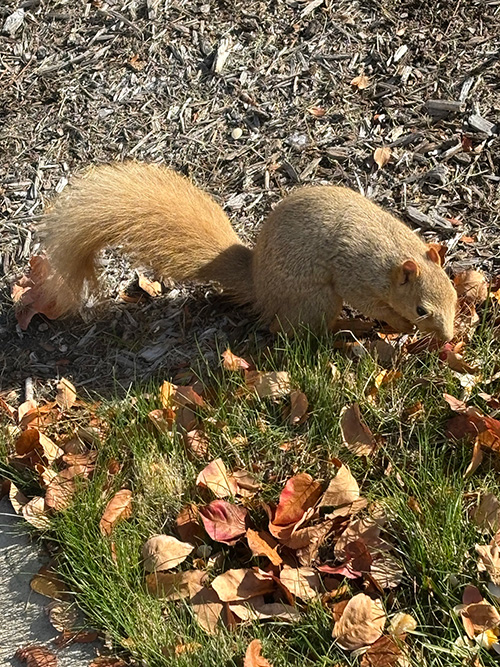
Blondie appears to be an Eastern Gray Squirrel with reduced pigmentation. One possible explanation is leucism, a condition in which genetic changes interfere with the normal production or distribution of pigment. Depending on the particular genetic cause, Blondie could have inherited pigment variants from parents who look like typical red or gray squirrels. Her brothers and sisters might also be red or gray. Or, dare I say, there could be another blond sibling running around campus.
But leucism is only one possible explanation for an unusually light coat. Without knowing Blondie’s genetics, we can’t know exactly what produced her coloration.
Genetics is fascinating
And that brings us to evolution. Being blond could have advantages, but also disadvantages.
In some environments, coat color can provide camouflage from predators. Darker fur may also absorb more solar radiation, potentially affecting heat balance. An unusual color, on the other hand, could make an animal more noticeable and perhaps more exposed to danger.
Or maybe being more noticeable makes humans more likely to find you, protect you, or give you food. On a college campus, perhaps celebrity has its advantages.
Whether a color is “good” or “bad” therefore depends on the environment in which the animal lives.
Cities and campuses complicate things even further. Predators, vegetation, pavement, buildings, traffic, food availability, and temperature are all different from those in a forest. Research on Eastern Gray Squirrels has found that the frequencies of different coat colors can change between urban and rural populations.
That means the squirrels running around campus aren’t just part of the scenery.
They are populations containing biological variation. If some of that variation is heritable and affects survival or reproduction, natural selection can change how common those traits become over generations. Other evolutionary forces, including genetic drift, gene flow, and new mutations, can change populations too.
So, what happens to blond squirrels at CMU?
Only time will tell whether campus is eventually flooded with blond squirrels or Blondie remains an unusual member of our squirrel population. A famous one at that.
Help us investigate
Where do you see Blondie? Do you think there is more than one, even if admitting it destroys the Blondie mythology? Are blond squirrels more common in particular parts of campus? What advantages or disadvantages might blond fur have here? Does Blondie have an increased or decreased chance of passing on her genes?
And, most importantly, share your favorite Blondie picture or story.