Candidates for medical dean to visit CMU
March 12, 2026
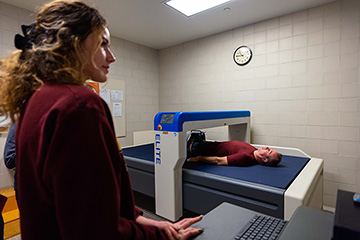
CMU faculty answer Q&A regarding the expanding role of DEXA scans in monitoring bone health and lean mass preservation
DEXA scans are widely recognized as the gold standard for assessing bone health, helping to identify risks for osteoporosis and other conditions. The scan delivers detailed body composition analysis, so individuals can use the results as a tool for focusing on fitness, weight management, and/or athletic performance.
Drs. Paul O'Connor and Rachael Nelson, faculty in the School of Health Sciences in The Herbert H. & Grace A. Dow College of Health Professions, answer some burning questions regarding the DEXA scans now available in the Carls Center for Clinical Care and Education.
A DEXA scan can measure bone density and body composition, including lean vs. fat mass. DEXA scans can show where lean mass is located — whether in the midriff, lower body, or upper body.
If someone is concerned about their risk for developing osteoporosis, a DEXA scan is a great way to monitor changes in bone density. For individuals on a health journey to lose fat mass and/or gain muscle mass, a DEXA scan is an excellent way to track that progress with a high level of accuracy.
Many athletic endeavors favor a particular body composition to aid in sports performance. If an athlete is working on putting on more lean muscle mass and/or reducing fat mass, an initial DEXA scan can give them their starting point. Then, after a few months of lifestyle changes aimed at changing body composition, a follow-up DEXA scan can provide an update on those changes.
An optimal interval between DEXA scans for bone density has yet to be identified. However, intervals of greater than two years may be necessary to detect any meaningful change. Your doctor may offer more personalized advice.
The frequency of scans to assess body composition depends on your goals and how actively you are changing your training or eating habits. Scans every 4–8 weeks can help track body composition changes and be used to adjust training and caloric intake based on changes in fat and lean mass.
Weight loss is typically associated with loss of both fat mass and lean mass. A potential concern with GLP-1 medications is losing too much lean mass. Sufficient protein intake and strength training can help preserve lean mass and muscular strength, and DEXA scans can help track maintenance of lean muscle mass (Cava et al., 2017; Karakasis et al., 2025).
A DEXA scan is a clinical-grade assessment tool that gives objective, actionable data on fat, muscle, and bone — making it incredibly valuable for guiding long-term health, fitness, and preventive care decisions. It allows us to distinguish between changes in muscle, fat, and bone mass caused by changes in diet, training, or aging, taking the guesswork out of decision-making and allowing for optimization of training, diet, and medical therapies.
References: