Faculty helps fill gaps in infant screenings
Program provides midwives with the tools to detect early hearing loss
A Central Michigan University faculty member is helping provide training to screen the hearing of infants who might have otherwise gone without.
Shannon Palmer, a faculty member in the communication sciences and disorders department, is helped lead a program that provides training and equipment to midwives so they can test the hearing of newborns.
Early detection of hearing loss is critical, Palmer said. If hearing loss is detected at the newborn level, interventions can start almost immediately to improve the baby’s quality of life.
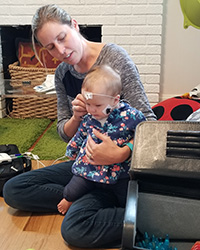
Palmer has trained many of the midwives, said Nan Asher, a contractor for the Michigan Department of Health and Human Services. She also gathered and analyzed data to help understand the value of the program.
Screenings for hearing loss are routine in a hospital setting, making infants born to midwives at higher risk of not having it detected until the child is a few years old.
Approximately 90 midwives have received training provided by a partnership of which the audiology program was an original participant. Palmer credits the program’s success to Asher.
They have identified approximately 20 newborns who require further testing to diagnose hearing loss since the program started in 2014, Palmer said. Between 2020-21, they screened 1,566 of the 2,711 babies delivered by midwives.
Midwives trained through the program can use non-invasive equipment to detect hearing loss, said Asher, a board member of the Michigan Coalition for Deaf, Hard of Hearing & Deafblind People. The equipment was originally purchased through a grant from The Carls Foundation, which also provided the seed money for CMU’s Carls Center for Clinical Care and Education.
Midwives provide birthing services for a variety of reasons, Asher said. Amish families won’t deliver in health care facilities unless medically necessary, and some families who’ve had previous negative experiences at hospitals also prefer births either at home or in specialized birthing centers.
Michigan is a leader among states in providing midwives with the tools to provide hearing screenings for infants born outside a hospital setting, Palmer said. That means an opportunity to grow the program by seeding in other states.
To support that, Palmer published a paper earlier this year on how other states can follow Michigan’s example.
Related News
View News HomeTurning up the volume on patient-centered hearing care

What does a healthy relationship look like?
The week in photos: March 16-22