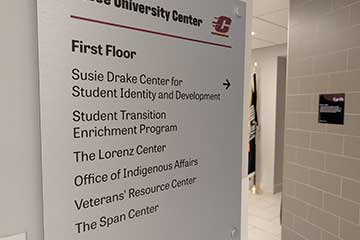
CMU named Gold-Level Veteran-Friendly School
October 15, 2026
Now through October 31, we're waiving application fees for all freshman and transfer applicants!
*Common app code: Central27
CMU audiology students explore how hearing aid settings shape real-world listening
When it comes to hearing aids, louder isn’t always better. In fact, the “right” setting can look different for every individual.
That question is at the heart of two related research projects being conducted by Central Michigan University Doctor of Audiology students Addy Kolb and Sam Bujak under the supervision of Dr. Yunfang Zheng.
Bujak’s project, Loudness Perception and Aided Outcome Correlations Across Varying Degrees of Hearing Loss, has been in development for over a year and focuses on how loudness perception relates to aided outcomes across degrees of hearing loss. As that work progressed and protocols were developed, new clinical questions emerged. These questions lead to a separate, complementary study in which Kolb was recruited for.
Kolb’s project, Fitting Formula Effect and Aided Outcome Correlation for Listeners with Different Degrees of Hearing Loss, builds on those questions by examining how different hearing aid fitting formulas influence performance and patient preference. Together, the two projects explore how hearing aid fitting strategies affect both objective outcomes and the patient experience.
Both students are part of CMU’s Audiology program and work closely with individuals receiving services through the Carls Center for Clinical Care and Education. Their research focuses on adults with mild to profound hearing loss and explores how people perceive and perform with different hearing aid fitting formulas and volume levels.
In simple terms, participants are fitted with hearing aids using three commonly used fitting formulas and tested at three different gain levels: their prescribed target setting, 10 decibels above target, and 10 decibels below target. Participants then complete listening tasks and rating scales that measure speech understanding, loudness perception, comfort, clarity, and how natural their own voice sounds.
“Rather than assuming one setting works best for everyone, we’re asking participants directly how these different configurations feel and perform for them,” Kolb said.
There is still limited research on how different fitting strategies affect loudness perception and overall aided outcomes in adults despite hearing aid technology advancements. Understanding these preferences is critical for audiologists working to provide personalized care.
“Our goal is to better understand how individuals with different degrees of hearing loss respond to these settings,” Bujak said. “That knowledge can help clinicians make more informed, patient-centered decisions.”
Both students credit CMU’s Audiology program for its strong clinical focus and early hands-on experiences. From their first week in the program, Kolb and Bujak were observing and assisting in clinic, applying classroom concepts to real patient care.
“This program really emphasizes working with each individual patient and supporting their hearing journey,” they said. “Our research aligns perfectly with that philosophy.”
As they look toward their future careers, both students plan to carry these findings forward—using research-backed insights to better serve patients and tailor hearing aid fittings to individual needs.
Kolb and Bujak will present their work during the 8th Annual Research Symposium, an event that highlights the innovative research happening across The Herbert H. & Grace A. Dow College of Health Professions. Attendees will have the opportunity to engage with research from audiology, physical therapy, physician assistant studies, public health, athletic training, and more.
The Herbert H. & Grace A. Dow College of Health Professions is sponsored by Gary and Barb Russell who have sponsored this event since 2021. The symposium is free and open to the community. All are welcome to attend and explore how CMU researchers are advancing health care through discovery, innovation, and patient-centered practice.