Capstone team competes to keep astronauts fed
Students built boxes to keep supplies viable in alien landscape
More than 18 million Americans are estimated to have watched Artemis 2 launch on April 1. Among them was a group of Central Michigan University seniors for whom the day had extra meaning.
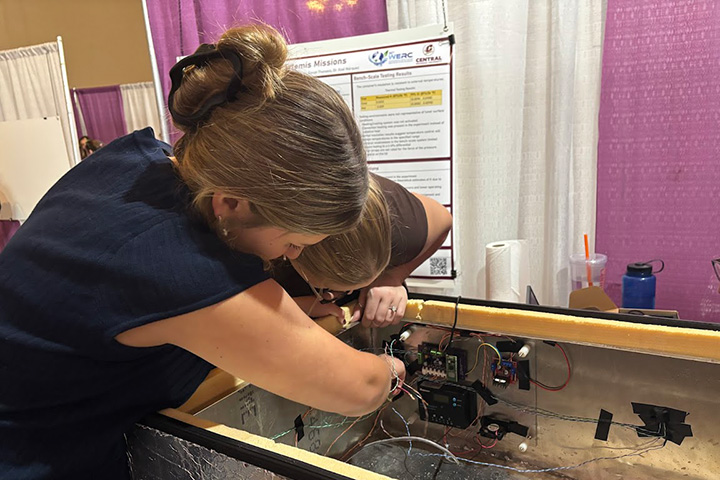
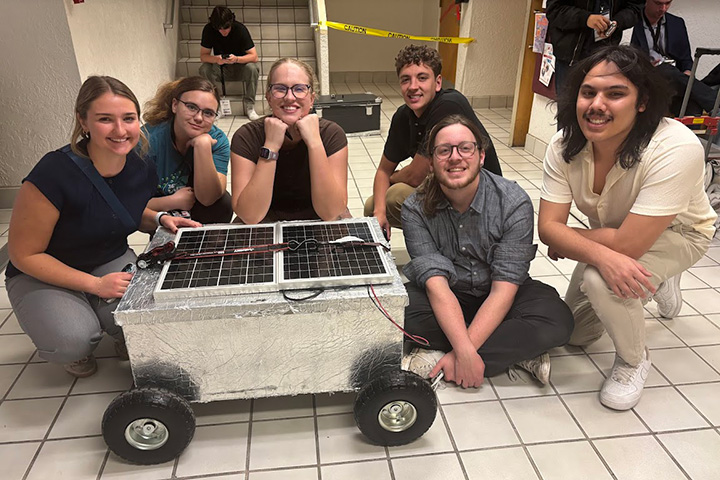
Six students across the College of Science and Engineering watched it while finishing their capstone project, a box designed to keep food and tools viable in the hostile environment that Artemis 3 will face during a planned 30-day trip to the moon’s surface.
Ten days later, they unveiled their prototype at WERC, a national competition in New Mexico sponsored by NASA, involving 21 teams from across the United States.
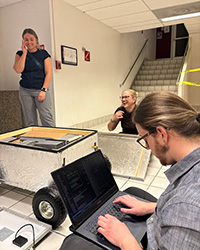
None of CMU’s team majored in aeronautical engineering, although five were pursuing InSciTE certificates.
“I never would have thought of working with NASA as an environmental engineer,” said Kayla Florian, one of the five team members and an environmental engineering major.
The stakes behind the challenge are high. The lunar modules must preserve food and tools by self-regulating the internal environment for up to 70 days while keeping in communication with Mission Control. The underlying questions are still Earthly.
“They’re still environmental problems,” said Itzel Marquez, a member of the School of Engineering and Technology’s faculty and the team’s adviser. “It’s still temperature and pressure. It’s just taking it to the moon.”
Everything about the design was a problem to solve. The shape. They also had to decide if they wanted one box or more. They needed to find a design that was complex enough to work remotely in hostile conditions but simple enough not to be a liability.
The hostile conditions involved rapid temperature swings from -250 degrees Fahrenheit to more than 300 degrees Fahrenheit, lower gravity, no ambient air pressure and moondust. Moondust is abrasive. The problem vexed the team for weeks.
The team approached their design like a subcontractor selling a design to NASA. That yielded positive momentum forward.
“We felt a lot more confident after we got some good feedback,” said Maxwell Hornak, an environmental engineering major.
Ultimately, they chose multiple, smaller boxes, said Daniel Thanasiu, a computer engineering and math major.
They proved more portable and required fewer astronauts to move them. Multiple boxes also offered redundancy if one of the boxes failed, said Anna Grace Lubbers, an environmental studies major.
They designed and built most of the components on campus. Lubbers learned to weld and put the boxes together.
The electronics included internal thermometers plus sinks to shunt heat to outside the box to cool it down. Electronic release valves help regulate internal air pressure. An onboard Wifi network would provide communications with Mission Control.
Thanasiu said the work was challenging but it drew on his personal interest in space. That connection helped him find joy in problem-solving.
“It was a real problem from a real thing I was really interested in,” he said.
They got help from unexpected corners of campus. One of the competitions was to fast pitch the project. Team members got training through the College of Business Administration to do that.
The fashion and merchandising lab in the Engineering Technology building let them test the boxes in different environmental conditions. The Office of Research and Graduate Students provided money to help cover travel expenses.
The competition started on April 11, the day after Artemis 2 touched down, at New Mexico State University. They showed off their boxes, got valuable feedback and returned to Mount Pleasant with some awards.
Two team members made the most of CBA’s training and took home first prize in the fast pitch competition among the 21 entries. Of the schools that took up the supplies box challenge, CMU’s prototype finished second. Florian won a CMU Outstanding Student Award.
Next year’s WERC will feature another problem that Artemis 3 will likely face, Marquez said. They are hoping to field another cross-disciplinary team to tackle the new challenge.
Related News
Highlight of time at CMU helps student shape future
Students showcase new games