Now through October 31, we're waiving application fees for all freshman and transfer applicants!
*Common app code: Central27
The Achilles’ heel of tuberculosis: CMU chemist targets bacteria’s protective shield
For Dr. Ben Swarts, the next breakthrough in the fight against tuberculosis could begin with something most people never see: the microscopic outer layer of a bacterium.
Swarts, a faculty member in Central Michigan University’s Department of Chemistry and Biochemistry, and his research group use chemistry to develop new ways to study mycobacteria, the single-cell organisms responsible for tuberculosis and several other infectious diseases.
The group’s work focuses on the complex cell envelope that surrounds and protects mycobacteria, a structure that helps the organisms survive the human immune system and withstand antibiotic treatment.
“We’re trying to create and use new approaches understand what the envelope is made of, how it’s constructed and organized, and how it changes during infection,” Swarts said. “Then we can ask how we might exploit that information to create better ways to prevent, diagnose and treat tuberculosis.”
That work carries significant implications. Tuberculosis kills more than 1 million people worldwide each year, and drug-resistant forms of the disease remain difficult to treat.
Swarts describes the mycobacterial cell envelope as an Achilles’ heel, a potential vulnerability that could be targeted as researchers develop new approaches to combating the disease.
Using chemistry to solve a biological problem
Mycobacteria present a unique challenge for researchers because many of the molecules that make up their cell envelope are highly complex carbohydrates and lipids.
Researchers who study mycobacteria often come from fields such as microbiology, genetics and immunology. Swarts’ group brings another perspective to the problem: chemistry.
“Chemistry offers ways to investigate complex and important carbohydrate and lipid molecules in the mycobacterial envelope that are outside the reach of traditional microbiology or genetic approaches,” Swarts said.
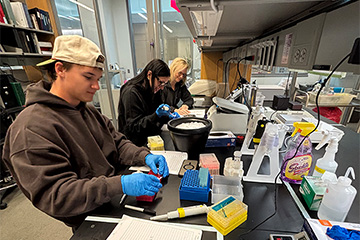
The interdisciplinary nature of the research gives students the opportunity to work across traditional scientific boundaries. Depending on their interests and career goals, students may work in synthetic organic chemistry, biochemistry, microbiology or a combination of all three. They may synthesize and characterize novel molecules, then test those molecules in biochemical assays or in live bacterial cells.
That experience goes beyond learning techniques in a laboratory.
“Research develops so many transferable skills,” Swarts said, including critical thinking, complex problem solving, project planning, data analysis, scientific communication, teamwork and the ability to learn independently.
A global research network
The Swarts research group’s work is also highly collaborative.
The lab recently received grants supporting projects with researchers at the University of Washington on tuberculosis vaccine design, the University of Massachusetts-Amherst on mycobacterial membranes and the University of California, Los Angeles on diagnostic development.
The group also has worked with industry partners, including SOFIE Biosciences to develop a PET imaging agent for mycobacterial infections and Biotechne to develop and characterize fluorescent probes used to image mycobacteria.
Multiple National Institutes of Health research grants and National Science Foundation research and instrumentation grants support the lab’s work.
Together, the grants support a team of about 15 researchers, including undergraduate students, graduate students, postdoctoral researchers and technicians. They also provide funding for the equipment, advanced instrumentation and laboratory supplies necessary to conduct the research.
Training the next generation of scientists
Students are central to the Swarts research group.
The lab includes postdoctoral researchers, Biochemistry, Cell and Molecular Biology Ph.D. students, undergraduate chemistry and biochemistry majors and laboratory technicians. Students work individually and in teams on research projects while contributing to the day-to-day operation, organization and safety of the laboratory.
Swarts said the group is particularly passionate about working with students through the Department of Chemistry and Biochemistry’s undergraduate capstone program.
Over the 13-year history of the lab, more than 100 trainees have participated in its research, including CMU students as well as visiting students and scholars.
After CMU, undergraduate researchers have gone on to careers in the chemical, pharmaceutical and biotechnology industries, including positions with companies such as Pfizer, AstraZeneca and Dow. Others have pursued graduate or professional degrees, including medical and pharmacy school.
Graduate students have continued into postdoctoral research at institutions such as the University of Chicago and University of Missouri or moved into industry, including positions with Eli Lilly and Chem-Trend.
A retreat marks a new chapter
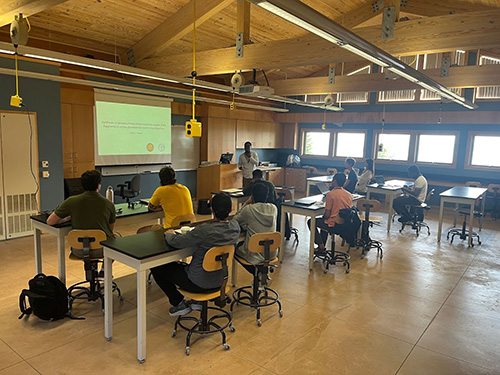
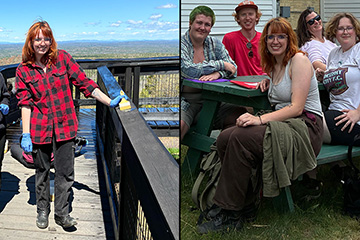
That history was one reason Swarts recently brought his research group to the CMU Biological Station on Beaver Island.
The lab is entering a period of transition. Many longtime members have recently graduated or are preparing to graduate, while a new cohort, including about a half-dozen Ph.D. students, two postdoctoral researchers and several undergraduates, has joined the group.
At the same time, new grants have opened the door to additional research directions.
The group spent three nights and two days at the Biological Station, using the retreat to reflect on the lab’s history, discuss its current research and operations, and map out its future.
The sessions took place both inside the Station’s facilities and on the beach. Afternoons included team-building activities, with members competing in beach volleyball, soccer, horseshoes and Euchre. Evenings brought the group together around beach fires.
The retreat also gave the researchers an opportunity to experience another part of the Station’s scientific community, including an evening public lecture by CMU Professor of Biology Peter Dijkstra.
Swarts said Station Director Dr. Kevin Pangle and Associate Director Alex Searfoss helped make the retreat possible.
From basic science to potential clinical impact
The retreat produced practical changes for the growing research group.
As the lab has expanded into multiple research spaces in the Biosciences Building and Dow Science Complex, the group identified ways to improve student onboarding and training, group meetings, laboratory organization and safety, and team building.
Those plans are now being implemented.
But perhaps the biggest theme to emerge from the retreat was the direction of the science itself.
The lab is increasingly moving toward translational research, building on fundamental discoveries with the eventual goal of creating applications that could have clinical impact.
For students, that creates an opportunity to see how a question that begins at the molecular level can eventually connect to problems facing patients.
As the Swarts research group begins its next chapter, the goal remains rooted in the same fundamental question: How can chemistry help researchers better understand one of the world’s most persistent infectious diseases?
The answer may ultimately lead not only to a better understanding of mycobacteria, but to new tools for preventing, diagnosing and treating tuberculosis.