Workshops & Events
Connect with mentors and faculty who know what it takes to succeed.
Explore events
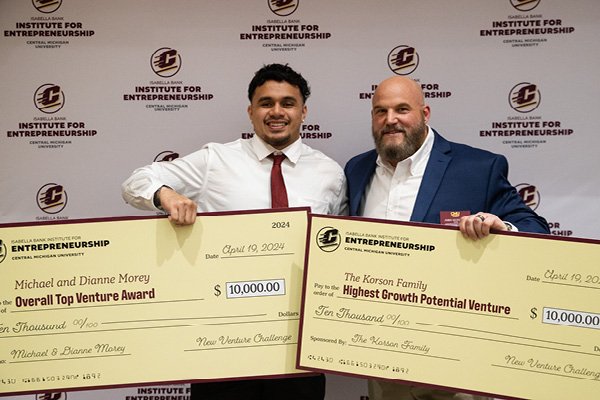
At Central Michigan University, the Isabella Bank Institute for Entrepreneurship is more than a program—it’s where students from every major turn ideas into real impact. As Michigan’s first Department of Entrepreneurship, we’re a hub for hands-on learning, innovation, and mentorship.
Here, you’ll:
Whether you want to start something new or transform what already exists, the Institute is your launchpad.
When you’re ready to get started, stop by Grawn 164 to join the team or visit the Idea Den in Grawn 166—your space to brainstorm, build, and take the next step.

Kaitlyn Whitefoot-Keliin, a graduate student studying biochemistry, studied neutrophils (one of the types of white blood cells), which, when mixed with bacteria, release extracellular vesicles (EVs; a class of particles often used in transport inside and outside of cells); the EVs then interact with DNA and contribute to blood clotting (coagulation). Whitefoot-Keliin showed that the improved coagulation was dependent upon the interaction of the DNA and the EVs, as clotting was less effective if either the DNA or the EVs were absent.
Her research was conducted by separating neutrophils from blood and mixing them with bacteria, specifically S. aureus, S. epidermidis, E. coli, or P. aeruginosa. Then, the EVs which were produced were isolated using centrifuges. After isolation, the EVs were treated with and without an enzyme that degrades DNA, allowing her to examine EVs with DNA, EVs with no DNA, and DNA without EVs. The coagulation ability of the EV-DNA was measured by adding EVs to human plasma. Whitefoot-Keliin's work has the potential to correct improper coagulation, a frequent complication of bacterial infections.
The project won the biology department’s Two Minute Research Talk competition in April 2022. Whitefoot-Keliin was also selected to present her work at the Gordon Research Seminar on Extracellular Vesicles in July 2022. Whitefoot-Keliin's interest in biology developed at a young age. She attributes going into microbiology to reading Ed Yong’s book, “I Contain Multitudes: The Microbes Within Us and a Grander View of Life”.
This story is brought to you by the Office of Research and Graduate Studies.