
Workshops & Events
Connect with mentors and faculty who know what it takes to succeed.
Explore events
At Central Michigan University, the Isabella Bank Institute for Entrepreneurship is more than a program—it’s where students from every major turn ideas into real impact. As Michigan’s first Department of Entrepreneurship, we’re a hub for hands-on learning, innovation, and mentorship.
Here, you’ll:
Whether you want to start something new or transform what already exists, the Institute is your launchpad.
When you’re ready to get started, stop by Grawn 164 to join the team or visit the Idea Den in Grawn 166—your space to brainstorm, build, and take the next step.

As AI-generated content becomes more sophisticated, so do the challenges of ensuring it is ethical and inclusive. Aiden Kosciesza, a professor at Central Michigan University, is leading a critical discussion on how artificial intelligence is reshaping communication and media. Through both his teaching and research, Kosciesza aims to equip students with the critical tools to navigate an AI-driven world while advocating for a more inclusive and responsible digital landscape.
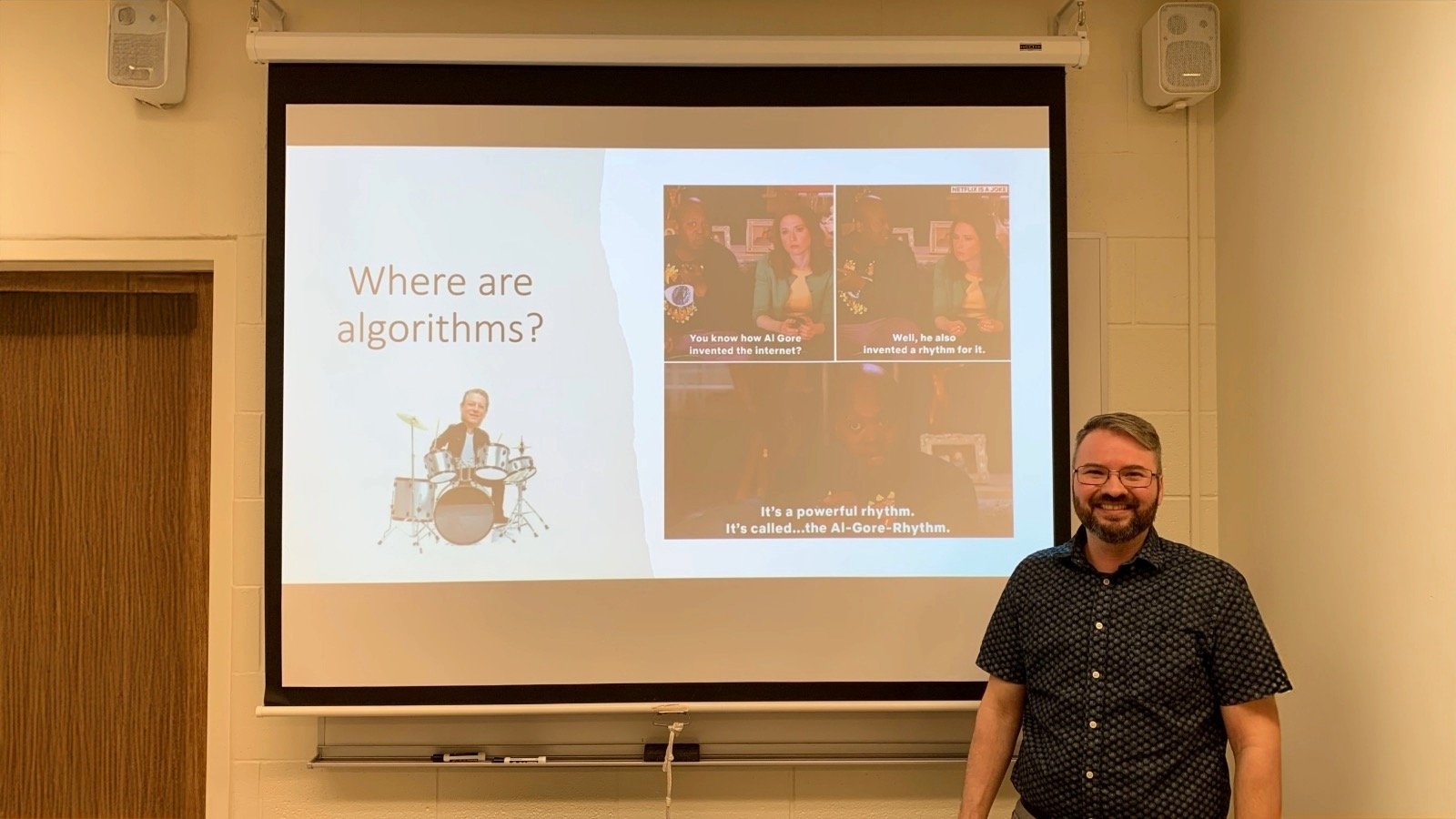
In his course, Algorithms, AI, and Systemic Bias, Kosciesza challenges students to dissect the narratives surrounding AI and evaluate its capabilities. His goal is for students to become more critical consumers and creators of digital content. Students explore how AI models are developed, the biases inherent in their training data, and the ethical implications of their use. Kosciesza emphasizes that AI-generated content tends to amplify dominant perspectives, often at the expense of marginalized communities. As a trans scholar, he is particularly concerned about how trans perspectives are excluded from AI training datasets, leading to digital erasure. A recent classroom exercise revealed some of ChatGPT’s biases to students, such as misidentifying singular ‘they’ as incorrect grammar.
Beyond the classroom, Kosciesza’s research delves into the deep connection of AI with Search Engine Optimization (SEO). His upcoming research paper, which he will present at the International Communication Association conference in June, examines how AI relies on internet-scraped content shaped by commercial incentives. He argues that AI-generated text reflects the profit-driven structure of digital media, reinforcing existing power dynamics while narrowing creative and diverse perspectives. Kosciesza will also be one of several presenters at the upcoming CMU Symposium, The Future of AI in Graduate Education and Higher Ed.
Ultimately, Kosciesza advocates for a more thoughtful approach to AI integration, encouraging users to question the assumptions behind its perceived usefulness. “There’s a huge financial incentive to convince us AI is competent,” he said. “But we need to ask, is it truly competent, or just following patterns that look convincing?”