Workshops & Events
Connect with mentors and faculty who know what it takes to succeed.
Explore events
At Central Michigan University, the Isabella Bank Institute for Entrepreneurship is more than a program—it’s where students from every major turn ideas into real impact. As Michigan’s first Department of Entrepreneurship, we’re a hub for hands-on learning, innovation, and mentorship.
Here, you’ll:
Whether you want to start something new or transform what already exists, the Institute is your launchpad.
When you’re ready to get started, stop by Grawn 164 to join the team or visit the Idea Den in Grawn 166—your space to brainstorm, build, and take the next step.

Before high-tech flight simulators teach pilots how to fly, someone has to teach the simulators how to simulate.
That's a skill computer science faculty member Alex Redei is sharing with Central Michigan University students who will be the computer professionals of the future.
"We're using all the same tools used in industry," Redei said. "We're doing interesting research that solves real problems and contributes positively to society."
The action plays out in a large open lab in the Engineering Technology Building. Powerful motors drive two life-size simulators through climbs, turns, dives and even barrel rolls. Video screens surround "pilots" enclosed in the windowless cockpits and show the results of their actions at the controls.
Redei and his team of one graduate and four undergraduate students develop software that sends pilots-in-training soaring on virtual flights.
Prepare for takeoff
Alex Redei said he is always looking for talented students to join his simulator lab: computer science majors, electrical or mechanical engineering majors, even artists. To learn about opportunities, contact him at redei1a@cmich.edu.
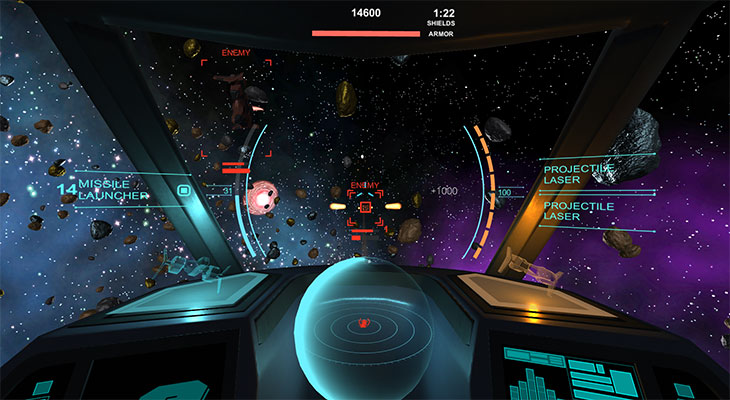
The team recently visited the University of Nevada, Reno, to introduce their Paragalactic space flight experience at the Fleischmann Planetarium. Redei said the team designed Paragalactic as an "edu-tainment" game to appeal to its middle school target audience. It meets science education standards while providing three levels of action:
Participants receive an "astronaut ID card" that tracks their progress through the simulation. Registering their ID with an online profile opens the ability to keep track of their scores, earn badges and compete with their friends.
"It's a really incredible opportunity, working on something as cool as this," said computer science senior Collin Van Brabant, who helped program the Paragalactic software and who designed the badge artwork.
Computer science senior John Apo joined Redei's team this semester as part of his Honors Program capstone project.
"This is giving us real-world experience in something we'll be using on the job someday," Apo said. "Also, it's really fun to play at the end of the day."
As the Paragalactic project wraps up, Redei and his students have new challenges in their sights:
"I'm proud to be a part of a research-intensive university," said Redei, who joined CMU in July 2019. He noted that CMU's Carnegie Foundation R2 classification puts it in the top 6% of all universities in terms of research output.
"Another benefit to CMU is the small class sizes," he said. "I enjoy getting to meet and work with the students. This blend of solid research and a supportive student-oriented culture sold me on coming to Central."