Now through October 31, we're waiving application fees for all freshman and transfer applicants!
*Common app code: Central27
Rosca Research
Mariana Rosca, M.D.'s lab studies mitochondria in organs and cultured cells, and develops novel approaches to alleviate organ damage induced by defects in mitochondrial bioenergetics.
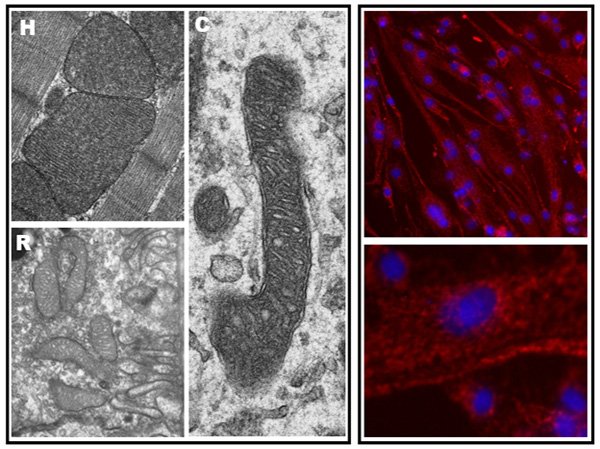
H: Electron microscopy of heart tissue showing interfibrillar mitochondria with double membranes and multiple folding of the inner membrane called cristae. R: Electron microscopy of the retinal pigment epithelium showing multiple mitochondria. C: Electron microscopy of the Purkinje layer of the cerebellum showing one large mitochondrion in the center and one small round mitochondrion on the left. On the right there are fluorescence microscopy images with a lower (up) and higher magnification of cultured cardiomyocytes stained with 4',6-diamidino-2-phenylindole (DAPI) for nuclei (blue) and Mito Tracker red for mitochondria (red).
The research in her laboratory is focused on mitochondrial defects (either inherited or acquired) that cause organ diseases. Specifically, her research team is investigating the pathophysiology of organ diseases induced by mitochondrial defects and novel strategies to correct the consequences of mitochondrial defects and alleviate the organ damage. In this regard, she is studying the heart, kidney, skeletal muscle and retina. The clinical context includes cardiac disease, chronic diabetic complications and metabolic disease.
Current research
 The lab is currently focused on
Mitochondrial redox imbalance in the heart upon metabolic challenges and
electron transport chain defects, d has received an NIH R15 grant
HL157838 for this.
The lab is currently focused on
Mitochondrial redox imbalance in the heart upon metabolic challenges and
electron transport chain defects, d has received an NIH R15 grant
HL157838 for this.
Funding
The research is currently funded by an R15 award from the National Institutes of Health for the project entitled "Nicotinamide Nucleotide Transhydrogenase (NNT) and bioenergetic metabolism in complex I defective cardiac mitochondria". To fulfill the specific aims for this project we use mice systemically and cardiac-specific deficient in NNT and investigate the role of NNT in supporting oxidative metabolism and cardiac function while maintaining the mitochondrial and cardiac redox balance. We use isolated cardiac mitochondria and tissue homogenate to perform respiratory and biochemical studies, protein and mRNA quantitation and various molecular biology techniques. The involvement of NNT is driving the differences in the severity of mitochondrial cytopathies in males and females is a major focus of our research.
Potential additional projects
- Involvement of mitochondrial abnormalities in the retinal photoreceptor damage.
- MicroRNAs as regulators of mitochondrial and cardiac health.
View Mariana Rosca's recent publications
Interested in joining?
If you are interested in joining or inquiring about the Rosca lab, please contact Dr. Mariana Rosca.
Rosca lab staff and volunteers
Rosca’s lab is supported by two first-year medical students who volunteer their time.
Rosca lab location
Rosca's lab is housed in the Research Laboratory building at 2630 Denison Drive, south of the main campus.