Now through October 31, we're waiving application fees for all freshman and transfer applicants!
*Common app code: Central27
RN-to-BSN Program Details
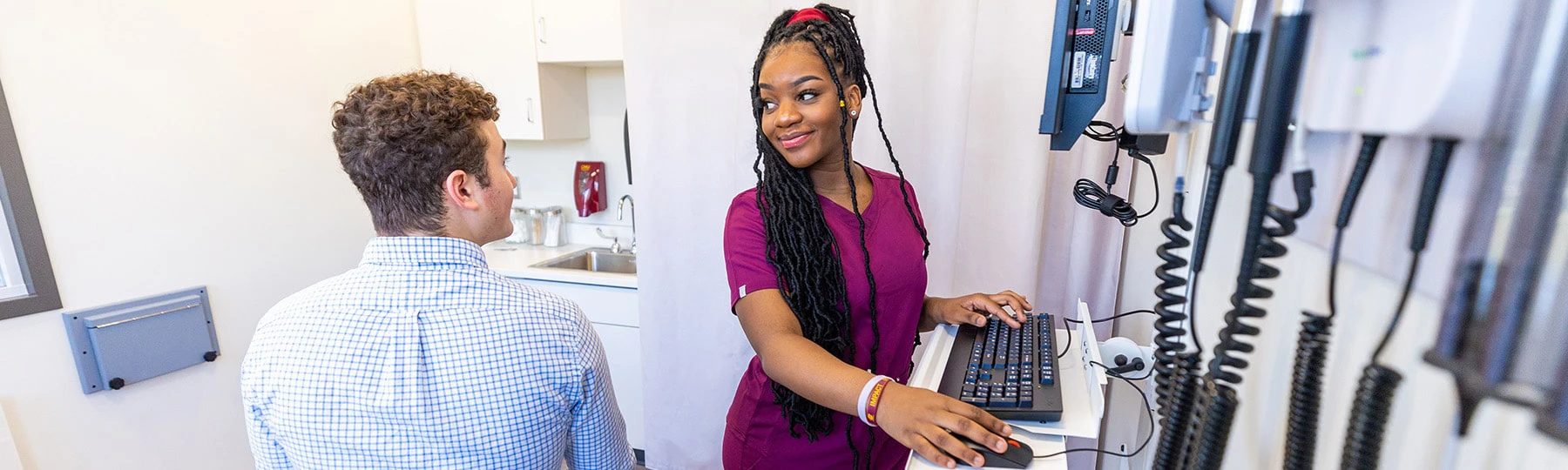
We're proud to offer an online RN-to-BSN program to Registered Nurses. The program is designed for working nurses to complete their BSN in less than 12 months. The RN-to-BSN program is aligned with the American Association of Colleges of Nursing Essentials for Baccalaureate Professional Nursing Practice and the national Quality and Safety Education for Nurses' Competencies.
To earn the Bachelor of Science in Nursing degree, CMU students must satisfy both the nursing major curriculum and the CMU general education program requirements. The nursing degree requires 120 semester credit hours, up to 90 hours can be transferred to this program. Review the transfer guides and articulation agreements from the Community College or University you attended to see how your credits will transfer to CMU. Your advisor will help determine if you need to take any courses at CMU beyond the 30 credit hours of the nursing major.
Application and admission
To be admitted into the online RN-to-BSN program you must meet the following criteria:
- Registered Nurse (RN) - An active, unencumbered RN license within your state of residence.
- Applicants without a registered nurse license may apply to the program, receive provisional admission and take up to 12 credits while preparing for the NCLEX-RN examination. Contact the program director for additional information.
- Applicants without a registered nurse license may apply to the program, receive provisional admission and take up to 12 credits while preparing for the NCLEX-RN examination. Contact the program director for additional information.
- A GPA of 2.5 or higher.
Students are admitted twice a year in the spring and fall semesters. You may apply to the program at any time during the last semester of your Associate's degree or diploma program or after completing your program. You must complete the online application and pay the application fee. You must also submit your official transcripts from previous colleges or universities via email or mail to:
Central Michigan University
Attn: Transcript Department
802 Industrial Drive
Mount Pleasant, MI 48858
Mission
The mission of the RN-to-BSN program is to create a culture of excellence that promotes the personal and professional growth of students to become nursing leaders through systems thinking, research, and service.
The RN-to-BSN program recognizes the unique characteristics and needs of our diverse, primarily rural setting, preparing graduates to provide nursing care to individuals, families, groups, communities, and populations in a variety of settings.
Program graduates demonstrate competence in clinical judgment, collaborate as members and leaders of interprofessional healthcare teams, and utilize evidence-based interventions to manage illness; promote, maintain, and restore health across the lifespan.
Goals
- Provide graduates with a strong foundation in nursing leadership, evidence-based practice, systems thinking, and population health to meet the demands of health care employers.
- Build upon a foundation of the arts, sciences, and humanities and professional nursing education that provide a base for our graduates' eligibility for graduate degree education to prepare for advanced nursing practice roles.
- Implement innovative and accessible models of nursing education to meet the personal and professional needs of an increasingly diverse student body.
- Recruit and retain qualified and diverse students committed to academic excellence, professional development, and lifelong learning.
- Recruit and retain qualified faculty who contribute to the university, the profession, and service and scholarly endeavors.
Student learning objectives
By the end of the BSN Completion Program, the graduate will:
- Integrate knowledge from the liberal arts, sciences, and nursing courses to provide culturally competent nursing care for diverse populations.
- Demonstrate nursing leadership principles to plan and implement patient safety and quality improvement initiatives within the context of a dynamic complex health care system and interprofessional care.
- Apply concepts of global health to plan appropriate culturally safe care and health promotion for vulnerable populations.
- Utilize best current evidence and systems thinking to improve nursing and health care practices for groups or populations.
- Incorporate concepts of interprofessional collaborations and communication, health policy, finance, and regulatory environments as leaders in nursing practice.
Alignment of RN-to-BSN student learning objectives with AACN domains and QSEN competencies
Our RN-to-BSN program builds an intellectual framework that reflects two major bodies of knowledge and scholarship: the American Association of Critical-Care Nurses (AACN) 2021 Domains and the Quality and Safety Education for Nurses (QSEN) Competencies. The table below illustrates the alignment of the program's student learning objectives (SLO) with the AACN 2021 Domains and QSEN Competencies.
| Program SLO | AACN 2021 Domains | QSEN Competencies |
|---|---|---|
| 1. Integrate knowledge from the liberal arts, sciences, and nursing to provide culturally competent nursing care for diverse populations. |
|
|
| 2. Demonstrate nursing leadership principles to plan and implement patient safety and quality improvement initiatives within the context of a dynamic complex health care system and inter-professional care. |
|
|
| 3. Apply concepts of global health to plan appropriate culturally-safe care and health promotion for vulnerable populations. |
|
|
| 4. Utilize best current evidence and systems thinking to improve nursing and health care practices for groups or populations. |
|
|
| 5. Incorporate concepts of inter-professional collaboration and communication, health policy, finance, and regulatory environments as leaders in nursing practice. |
|
|
Accreditation
Our RN-to-BSN Program is Accredited by the Commission on Collegiate Nursing Education (CCNE). We are also accredited by the Higher Learning Commission (HLC). Inquiries regarding the accreditation status by the HLC should be directed to our administrative staff. You may also contact:
Higher Learning Commission
230 South LaSalle Street, Suite 7-500
Chicago, IL 60604
Email: info@hlcommission.org
Phone: 800-621-7440 or 312-263-0456
Nursing Programs
Health Professions Building 2212
Central Michigan University
Mount Pleasant, MI 48859
Phone: 989-774-3768
The baccalaureate degree program in nursing at Central Michigan University is accredited by the Commission on Collegiate Nursing Education, 655 K Street NW, Suite 750, Washington, DC 20001, 202-887-6791.