Now through October 31, we're waiving application fees for all freshman and transfer applicants!
*Common app code: Central27
Aquatic Vivarium
Get hands-on with aquatic research at CMU
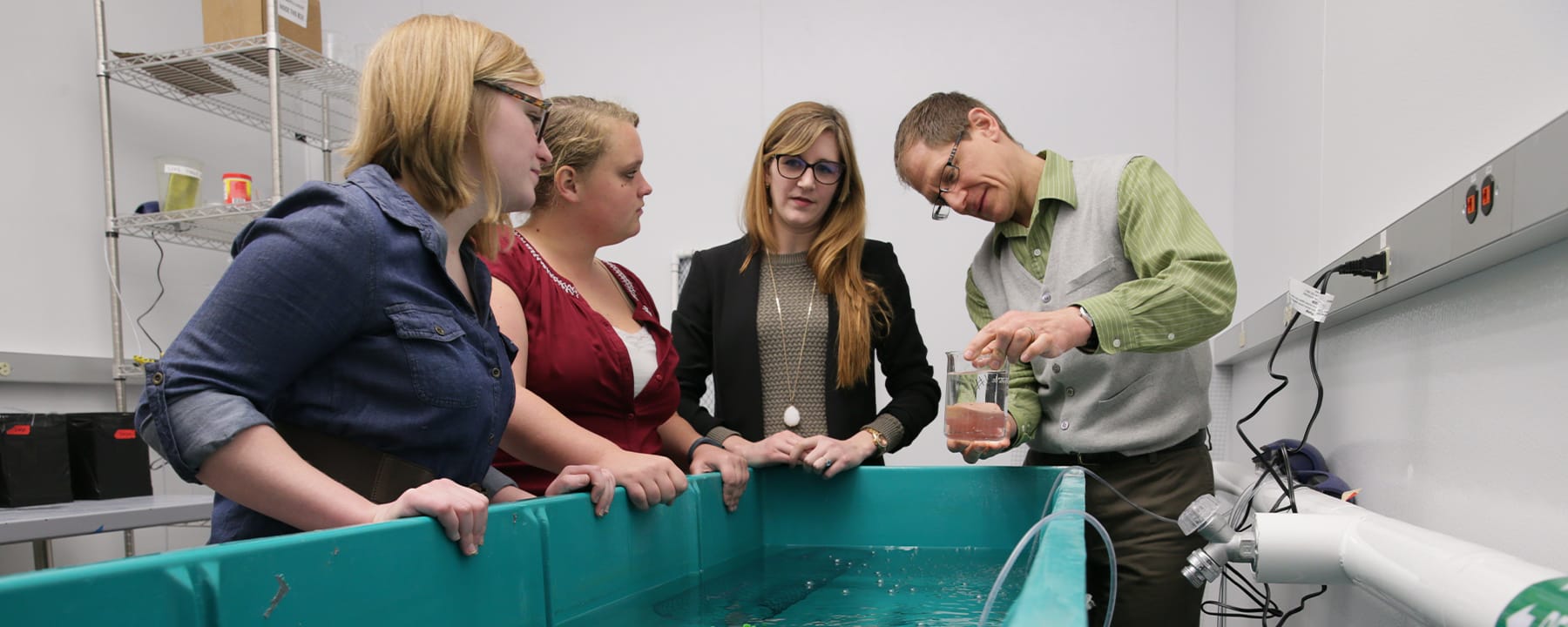
Study living organisms. Ask your own questions. Do real science.
What happens when you give a biology student the opportunity to work with living organisms in a research facility built for discovery? They start asking bigger questions.
At Central Michigan University, students use our nearly 5,000-square-foot Aquatic Vivarium in the Biosciences Building to explore aquatic life, conduct experiments and work alongside faculty on research. The vivarium provides a controlled environment where you can study organisms and ecosystems while developing the skills you’ll use in graduate school, research and careers in the biological sciences.
This isn't just a place where research happens. It's a place where you can become a researcher.
See your biology come to life
The Aquatic Vivarium gives you opportunities to work directly with living organisms in a carefully controlled environment. Depending on your research interests, you could explore questions involving:
- Aquatic ecology
- Animal behavior
- Physiology
- Development and growth
- Ecosystem interactions
- Plant biology and biotechnology
- Environmental conditions and their effects on living organisms
You’ll learn how scientists turn questions into experiments, collect meaningful data and use evidence to understand the world around you.
Research isn't just for graduate students
At CMU, undergraduate students have opportunities to get involved in research and build experience that goes beyond the classroom.
The Aquatic Vivarium is designed to support both short-term projects and long-term experiments, giving students and faculty the flexibility to investigate different questions and approaches.
That means you can move from learning scientific concepts in class to using those concepts to investigate something that hasn't been answered yet.
Work with modern research equipment
The vivarium gives yous access to specialized spaces and environmental controls designed for aquatic research.
Research rooms provide flexible space for experiments, specimen preparation, microscopy and other procedures. Environmental chambers allow researchers to precisely control conditions such as temperature, humidity and lighting.
That level of control lets you investigate how organisms respond to different environments, and gives you experience with the kinds of research methods used by professional scientists.
Build experience that goes beyond your résumé
Research experience can help you develop skills you'll carry into whatever comes next. In the Aquatic Vivarium, you can gain experience with:
- Designing and conducting experiments
- Working with living organisms
- Collecting and analyzing data
- Using scientific equipment
- Following research protocols
- Solving problems when experiments don't go as planned
- Working collaboratively with faculty and other students
- Communicating scientific findings
Those experiences can help prepare you for graduate and professional programs, research careers and jobs across the biological and environmental sciences.
Your classroom doesn't have to have four walls
The Aquatic Vivarium is part of a much larger network of hands-on learning opportunities available to CMU biology students.
Across campus and beyond, students can study biology at specialized facilities including the CMU Biological Station on Beaver Island, the Greenhouse, Herbarium, Flow Cytometry Facility and Microscopy Facility.
Together, these spaces give you opportunities to explore biology from multiple perspectives, from molecules and cells to organisms and entire ecosystems.
A research experience built around you
Located inside CMU's Biosciences Building, the Aquatic Vivarium gives students access to a professional research environment while they're still earning their degrees.
The facility includes flexible research rooms, holding areas, a procedure room and environmental chambers with precise temperature, humidity and lighting controls. The facility also has backup power to help protect ongoing experiments and maintain stable conditions.
But the most important resource isn't the equipment.
It's the opportunity to use it.
Ready to dive into research?
Whether you're interested in ecology, animal behavior, physiology, biotechnology or another area of biology, CMU gives you opportunities to turn your curiosity into hands-on experience.
Explore Biology at CMU and discover where your questions can take you.
Built for serious research
Research room features
- Epoxy-coated walls and floors for durability and cleanliness
- 8” sand-filled insulated walls to reduce noise and vibration
- Temperature control ranging from ~67°F to 82°F
- Side-wall trench floor drains for efficient cleaning
- Dimmable lighting to simulate dawn and dusk cycles
- Programmable lighting to reflect different geographic conditions
- Dechlorinated and RO water access at multiple points
- Compressed air line for oxygen delivery
- Twelve GFI-protected 110v electrical outlets for equipment needs
Environmental chambers
- Insulated fiberglass walls with epoxy concrete floors
- Precision temperature control from 34°F to 104°F (±0.3°F)
- Relative humidity control from 10% to 95% (±2%)
- Continuous monitoring with alarm notifications for parameter deviations
- Dechlorinated and RO water spigots
- Compressed airline for oxygen supplementation
- Adjustable T5 light canopy with wall-mount options and independent controls (2 chambers)