Priority two
Engage Communities — Cultivate and enrich reciprocal partnerships with university stakeholders to ensure a lasting impact in the communities we serve.
Objectives
- Champion the interests of rural and under-resourced populations through collaborations.
- Embrace and enhance the historic connection between the university and the Saginaw Chippewa Indian Tribe through active listening, cooperative partnering, and reciprocal learning to build on longstanding local connections and establish networks for broader collaboration with tribes across the Great Lakes region.
- Engage alumni, donors, community and business leaders, among others, to provide mutually beneficial real-world and hands-on experiences for students through curricular and co-curricular partnerships.
- Leverage and develop strengths of CMU with the needs and interests of our communities to build and sustain dynamic relationships.
- Engage with local leaders to further a welcoming community on- and off-campus for all students, faculty and staff.
2025-2026 SMART goals
Updated and approved by the CMU Board of Trustees September 18, 2025
- Develop strategies to identify and enhance relationships to meet community needs, beginning with healthcare and wellbeing in the mid-Michigan area, Great Lakes Bay Region, western and northern Michigan.
- Measure: Develop the plan with annual goals by January 2026 and create an internal university structure to respond to community needs by April 2026.
- Measure: The Community Relations Committee will assess the “Paint the Town Maroon” initiative, develop and measure progress on annual goals (including specific community-centered projects that broaden opportunity), and complete identified signature events for the year by June 2026.
- Increase the number of students engaging in curricular and co-curricular real-world experiences with external stakeholders to achieve a long-term goal of 80% of undergraduate students.
- Measure: Identify an initial list of the experiences, partners for engagement, a transcript-based tracking mechanism, and communication plan to students and faculty by December 2025 for a Fall 2026 rollout.
- Measure: Complete a data look back for the past two years, based on data available, to measure baseline information and to develop goals for annual increases by August 2026.
Update on 2024-2025 Progress
- Lambert, an external public relations firm, conducted in-depth stakeholder surveys and focus groups in four key Michigan regions: mid-Michigan, northern Michigan, western Michigan and the Great Lakes Bay Region. Their findings provided a baseline assessment of current relationships and regional needs.
- Collaborative efforts university-wide advanced the development of a shared definition of “real-world learning experience” and a pilot program to track these experiences in a comprehensive learner record platform.
2023-2024 Progress
By the end of 2024, CMU had opened both a physical location for CMU Innovation and Online and a site for the CMU Rural Health Excellence Institute in Traverse City, Michigan. In addition, CMURC expanded its reach with the Great Lakes Bay Small Business Hub, and CMU increased access to teacher education in rural communities through the MiCAREER Resource Hub.
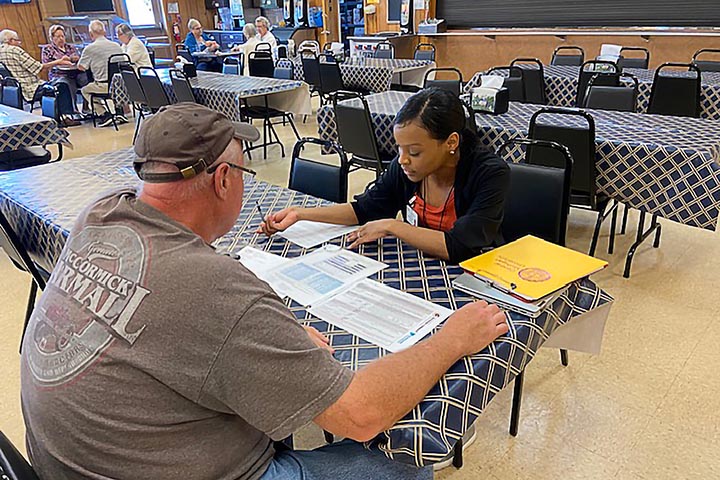
A better life is possible for people with Parkinson’s Disease, according to a Central Michigan University faculty member. One of the biggest obstacles is arming patients with the information about how to make it happen.
Strengthening ties between patients and support networks is critical, said Jamie Haines, an associate professor in the Physical Therapy Program.
“Making relationships, that’s what this really is about,” Haines said. Relationships lead to trust. Trust can build a bridge to a better life where resources are otherwise lacking.
Haines and four graduate students are wrapping up a year-long project to determine if creating support networks in rural communities boosts the confidence of patients in their ability to manage symptoms. The more rural a community, the more likely that it suffers from a lack of resources.
“The access to experts is very challenging,” she said.
Most people with Parkinson’s Disease who live in rural communities get their care for the disease from their general provider. Those providers are easier to access, but they also provide care for a diverse range of health issues in their communities, Haines said.
People with Parkinson’s need more. They need a team including physical, speech and occupational therapists and movement disorder specialists
“Research tells us people with Parkinson’s need a team,” she said. Those teams just don’t exist in rural areas.
They’ve worked with patients in Mount Pleasant, Alpena and Houghton to determine whether a support network from outside the area can develop trust to help patients do things that will lead to better lives.
The first piece is providing information on the best ways to slow the disease, she said. One of the most effective is exercising regularly.
“Exercise is one of the best thing for Parkinson’s patients,” said Lachane’ Ballard, one of Haines’ students. Getting medications and dosages right is also critical.
Haines’ team met with the patients three times over the year. During those meetings, they assessed patients’ balance, ability to walk and strength. They provided patients with assessment reports and strategies about how to improve.
It’s a bit early to draw any broad conclusions from the research, Haines said. Because Parkinson’s Disease is progressive, people’s conditions deteriorate over time.
For Ballard, the work has offered her invaluable experience working with people with Parkinson’s. She hopes to incorporate that into her work after she graduates next May.
That fulfills one of Haines’ side goals of increasing resources in rural communities by encouraging young healthcare providers to work in them.
Even if it’s too early to draw conclusions about what a good support network should look like or how to resource it, Ballard said there was one benefit to the researchers.
“It’s nice to be able to see our positive impact with them,” she said.