
CMU Libraries: Over One Hundred Years of Evolution
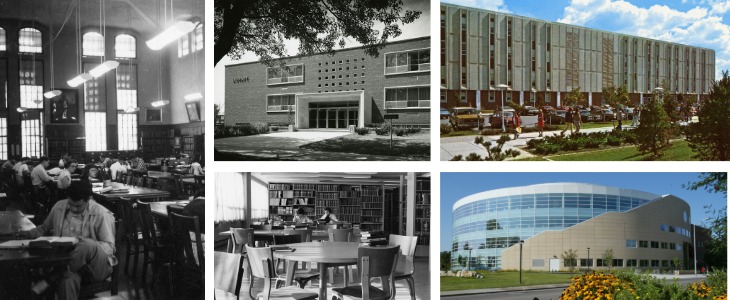
From the beginning, a library—a repository of books and documents containing boundless knowledge to be shared with students—was part of Central Michigan University’s infrastructure. The first library was part of the old Administration Building (known affectionately as Old Main), which opened in 1893. In 1900, it was touted as a great boon to students, most all of whom were teachers in training, “for no teacher can be a success who has not learned the supreme value of books” (State Normal Bulletin 1900). In that one year, the holdings doubled, from about 1,800 to 3,656 volumes.
As the student body grew, and the needs of the campus increased, the library evolved to keep pace, both in terms of the number of items held by the library and the number of staffers. By 1925, there were two librarians on staff managing over 26,000 volumes in “the center of the life of the school,” as the Bulletin referred to the space. In fact, in 1925, campus leaders began making plans to construct a new purpose-built library building.
However, tragedy struck the central campus on December 7, 1925, when fire tore through Old Main, and destroyed everything, including the library and all the books. A line from the student newspaper of December 9, 1925, soberly explains the destruction: “All that is left of our library of 30,000 volumes is placed on one small table in the Men’s Union.” Immediately after the fire, Central staff requested emergency funds from the State of Michigan to rebuild. As part of the $40,000 package of appropriations for temporary buildings, furniture, and equipment, $25,000 of it—or 63 percent—was for purchasing new library materials.
Rebuilding after the Old Main fire altered the plans for a stand-alone library building. Instead, in the new building that was built to replace Old Main, a new library was a top priority, along with creating new classrooms, offices, and an auditorium. Completed in 1927, Warriner Hall (then known as the Administration Building) included a spacious and well-appointed library in the east wing of the building. The two-story space could accommodate 250 students (nearly half of the 600-strong student body!) and had 10,000 volumes, with space for additional thousands of volumes in an adjoining room. But this space quickly became insufficient.
Following the Second World War, Central welcomed an influx of students. And these students were studying more diverse subjects in fields other than teaching. By 1950, to help the nearly 2,500 students with their studies, the library had almost 60,000 volumes—the maximum limit of what the space in Warriner Hall could hold. The 250 seats and cramped stacks weren’t going to cut it anymore, especially as Central moved from being a teaching college to a comprehensive college, and eventually a university.
A twenty-year building boom at Central started with a new gymnasium (Finch Fieldhouse—1951), a new dormitory (the now-demolished Barnes Hall—1951), and a new library (1955). The new library building had three floors of space for nearly 200,000 volumes, in addition to copious study spaces—enough for 750 students, classrooms, and a dedicated audio/visual services desk. The library also included a dedicated rare books library and archives—the Clarke Historical Library. To help the CMU community make use of this bounty of resources, there were ten staff members who worked in the library, including the long-time Head Librarian, Charles V. Park.
In 1965, the building was dedicated as the Charles V. Park Library. By that time, it was clear that the “new library”—only ten-years old—could not meet the increasing demands of the CMU community. When it was built, the 750 seats available to students for studying could accommodate over one-quarter of the student body. In 1965, 750 seats barely accommodated ten percent of students. Add to that the increases in the numbers of materials (over 300,000 by 1968), the increase in the number of staff (28 by 1968), and the emergence of new technologies that libraries embraced in the second half of the twentieth century, and the sentiment from the Centralight alumni magazine in 1968 sums it up: For several years, students did not have “adequate library facilities.”
As in the 1950s, CMU planned for another new library, this time at the end of CMU’s twenty-year building boom. In 1969, the Charles V. Park Library on the corner of Franklin and Preston Streets opened to students. The new four-million-dollar facility, spanning four floors, had over 170,000 square feet of space and could easily welcome 2,300 students. The 600,000 items moved from the previous library building, fit comfortably within the new walls, which offered students the latest in information resources – audio/visual materials and microfilm, and everything was classified in a new way—the Dewey Decimal System made way for Library of Congress call numbers. As for the old facility, those familiar with the CMU campus since 1970 would know that building as Ronan Hall!
Even as construction on the new facility was happening in 1968, then-Head Librarian Orville Eaton noted that it might not be big enough considering CMU’s rapid growth. And he wasn’t wrong. Just ten years later, in 1979, the student newspaper reported plans for an addition to the Park Library that would double the size of the building. Because of the expanding collections to serve an ever-more diverse array of subjects, shelf space was threatening to encroach on student seating. And the needs of students were evolving. By the early 1980s, students were making over one million pages of photocopies, which was not part of a student’s arsenal of resources two decades prior. There was also an electronic information revolution, which made searching of electronic databases accessible. In 1990, CMU switched from a paper-based catalog to an online catalog, with over 1.7 million entries. To give students access to this new catalog, the library brought in fifty dedicated computer terminals, which also encroached on available space.
Although talk of an addition started in the late 1970s, it would be twenty years before any additions to the building would come to fruition. Planning for a major renovation of the Park Library began in earnest in the mid-1990s, and an addition to the library was the number one infrastructure priority of CMU in 1995. With $50 million in state appropriations tapped for the project, workers broke ground on a new 120,000-square-foot addition in 1999.
The project was massive, totally gutting and renovating the existing building as well as constructing new space. Renovating a university library does not put the information needs of a campus on hold. The books and staff that remained in the library building were separated from construction zones via temporary walls. Because of safety concerns with the construction, the shelves were not open for students and faculty to browse them. Rather, people could request materials and library staff would retrieve them. Other library operations were moved to temporary locations on campus. Students made use of reference materials and consulted with Reference Librarians in Finch Fieldhouse. This was also where people could find periodicals, study spaces, and computerized catalog terminals. The Clarke Historical Library temporarily moved to the Rose/SAC complex, the home of CMU athletics and campus recreation.
After two-and-a-half years, in January 2002, the newly renovated Charles V. Park Library opened. The 307,000-square-foot space was no longer a repository for information and study spaces. It was a state-of-the-art facility that “lifts people’s spirits,” as the architect Evans Woollen noted. Thomas Moore, the dean of the University Libraries said, “I like the generous exposure to natural light. […] It is a marvelous change from the dim, rectangular previous building.” To keep up with the information age, the Libraries offered the latest in library services, including live chat for off-campus students: “There are universities that have been doing it for a year or so, but it’s not common by any means,” said Anne Marie Casey who was director of Off-Campus Library Services. Technology resources did not stop with the library services—other campus units who call the Park Library building home, including the Help Desk of the Office of Information Technology, Student Disability Services, and the unit that is now known as Curriculum and Instructional Support, offered the CMU community access to the latest in software, networking, accessibility, and classroom technology, like the new “Blackboard” course system.
In 2026, the evolution of library spaces and services has continued to change to keep pace with, and lead, the needs of the CMU community—from best practices in digitally preserving records to 24-hour study spaces. However, these changes to services and spaces are effectively details of a façade covering a core that remains essentially the same since 1893, when Central’s first library was established in the first building: the library is important because academic success depends on fully understanding the supreme value of information.
Information from the CMU Bulletins, the Central Normal Life/Central State Life/Central Michigan Life student newspapers, the CMU Yearbooks, the Centralight alumni magazine, and the Clarke Historical Library’s “Existing Buildings: Park Library” and “CMU Libraries History.”