Chemistry: Materials Chemistry
Major
Materials chemistry concentration overview
Materials chemistry focuses on the design, synthesis, characterization, and application of materials that shape modern technology, from polymers and pharmaceuticals to energy materials, electronics and advanced composites. Materials chemistry majors develop strong laboratory, analytical, research, teamwork and communication skills while solving real-world problems at the intersection of chemistry, physics, and engineering.
Our chemistry program is approved by the American Chemical Society and the materials chemistry concentration features a faculty-mentored capstone research experience for all students, and provides a strong foundation for graduate study or careers in industry, research and technology-driven fields.
AT A GLANCE
What will you learn as a materials chemistry major?
As a materials chemistry major, you’ll build on a strong foundation in chemistry while exploring how the composition, structure and processing of materials influence their properties and performance in real‑world applications—from energy and electronics to health and sustainability.
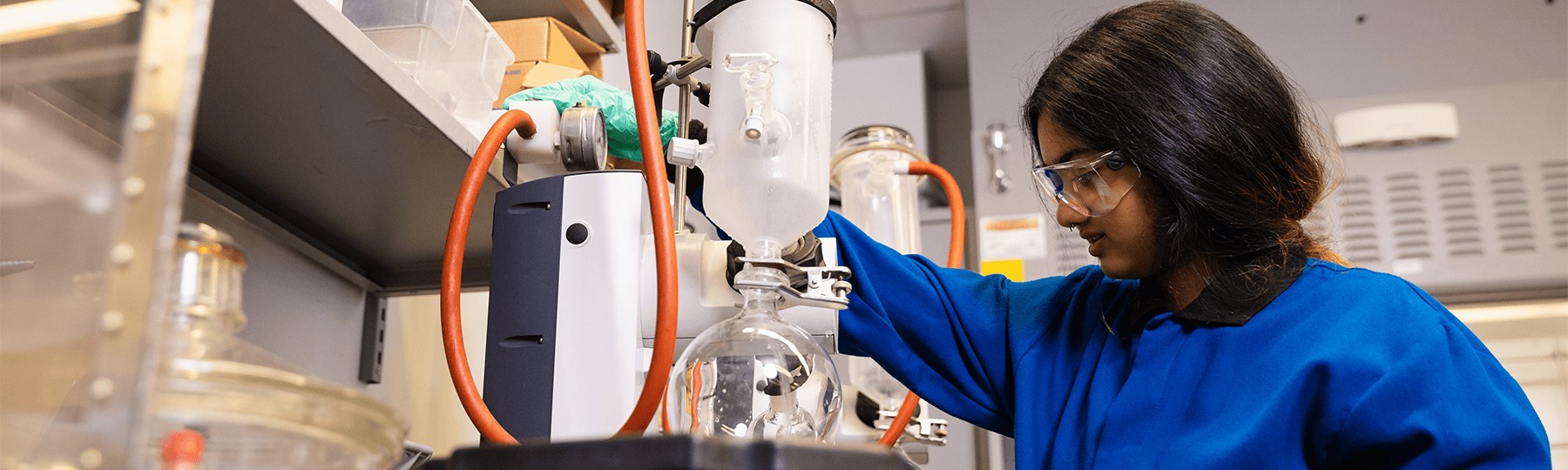
All students in our program participate in a faculty-mentored research capstone that integrates classroom learning with hands-on discovery. In this immersive experience, you’ll design experiments, synthesize and characterize materials, analyze data and engage in authentic scientific inquiry while strengthening laboratory skills, safety practices and ethical research conduct.
Throughout the program, and especially during the capstone, you’ll develop strong communication and teamwork skills essential for professional success. You’ll write and present scientific work, collaborate closely with peers and faculty, and graduate prepared for graduate school or careers in materials science, chemistry, engineering and related fields.
Materials chemistry program highlights
As a materials chemistry major, you will:
- Learn in an ACS-approved chemistry program: Build a strong foundation in chemistry and materials science through a curriculum that emphasizes hands-on laboratories, quantitative reasoning and professional scientific practice, meeting national standards set by the American Chemical Society.
- Take part in a distinctive faculty-mentored research capstone: Work closely with faculty on a research project where you design experiments, synthesize and analyze materials and explore real scientific challenges in areas such as polymers, pharmaceuticals, energy storage, biomaterials and nanotechnology. CMU is the only public university in Michigan where 100% of chemistry and biochemistry majors complete a capstone research project and thesis.
- Share your discoveries beyond the classroom: Present your research at regional or national scientific meetings and, in many cases, contribute to peer-reviewed publications. All CMU materials chemistry majors present their research, with many doing so at professional conferences, including national scientific conferences.
- Gain real-world experience through internships: Apply your skills in professional settings through internships or summer research opportunities in industry, government, healthcare, or academic laboratories. Students have interned at companies such as Dow, Corteva, DuPont, Zoetis, Montrose, and others, and may earn academic credit through the chemistry and biochemistry internship course.
- Connect, collaborate, and build your future: Work in interdisciplinary teams across CMU departments and colleges, join student organizations, and form mentoring relationships that prepare you for graduate school and science-based careers. CMU is home to a dynamic, nationally recognized American Chemical Society Student Members chapter.
Accelerated master's in chemistry
Work toward your bachelor’s and master’s at the same time with an accelerated master’s in chemistry.
View all accelerated master's programs
Careers with a materials chemistry degree
Materials chemistry prepares you for careers in chemistry, advanced manufacturing, materials development, pharmaceuticals, energy, environmental science and research, as well as for graduate and professional programs. Below are common career paths for materials chemistry graduates with median salaries.
| Career | Projected Salary |
|---|---|
| Manufacturing Chemist | $57,790 |
| Chemical Technician | $57,790 |
| Research Assistant | $62,370 |
| Polymer Chemist | $86,620 |
| Chemist | $86,620 |
| Materials Scientist | $86,620 |
| Research & Development Chemist | $90,530 |

Chemistry scholarships
Chemistry students at CMU have access to a wide range of scholarships that recognize academic achievement, leadership, research involvement, and service—helping make your degree more affordable. Scholarships are available for first-year students, students excelling in foundational courses, and upper-level majors active in the department, with many awards renewable. From merit-based awards for early undergraduates to endowed scholarships supporting continued excellence, CMU offers funding opportunities throughout your academic journey, all accessible through the Scholarship Universe matching tool.
Request Information about CMU
By submitting this form, I agree to receive calls, emails and/or text messages from Central Michigan University to discuss furthering my education.