Now through October 31, we're waiving application fees for all freshman and transfer applicants!
*Common app code: Central27


Communication
MA
Be a master of communication
Our master's in communication is not just a degree; it's a stepping stone to diverse opportunities and an enhanced understanding of human communication. Whether you're aiming for a Ph.D., teaching positions or roles in government or corporate communications, you'll gain the skills and insights to navigate and excel in your chosen path.
AT A GLANCE
Degree Type
Master of Art (M.A.)
Format
On Campus
Credit Hours
30 Credit Hours
Prepare for what's next with our master's in communication
Enter the world of advanced communication learning. Our master's in communication introduces graduate students to robust theoretical frameworks for understanding important themes and topics in communication studies. You'll immerse in experiential learning environments where those frameworks are challenged and tested using the latest communication research techniques and methods.
Our master of communication program is fertile ground for independent research, professional collaboration and intellectual curiosity. In recent years, more than 75% of our faculty have showcased their academic prowess, publishing significant works of scholarship. You'll work alongside these accomplished professors, partnering on unique research projects ranging from socio-political movements to crisis communication.
As part of our dynamic academic culture, you'll have the opportunity to co-author research projects, present at conferences and even gain teaching experience as a graduate teaching assistant—an invaluable asset for those considering a Ph.D. program. A quarter of our graduates have gone on to nationally recognized doctoral programs, while others have found successful careers in business, non-profit work, marketing, higher education administration and more.
Highlights of our Master of Arts in Communication
As a CMU communication graduate student, you will:
- Collaborate on cutting-edge research projects: Partner with renowned faculty and scholars, using modern research methods like harnessing the power of social media to analyze digital communication trends.
- Benefit from individualized attention: With a student-to-faculty ratio that's better than 1:1, you receive personalized guidance and mentorship.
- Gain invaluable teaching experience: Graduate teaching assistants receive a generous stipend and full tuition waiver to support their academic pursuits.
- Explore internship opportunities: Bridge the gap between theory and practice, develop essential career skills and build professional networks.
- Present your research at prestigious conferences: Our students have shared research results at the National Communication Association Annual Conference and the Central States Communication Association Annual Conference.
- Prepare for academic excellence: Hone your teaching and research skills to position yourself for admission to top-tier PhD programs in communication.
Accelerated master's in communication
Accelerated master’s programs help you count classes that you take as an undergraduate toward your master’s in communication, saving you time AND money. You may be able to double-count 12 credits.
By double-counting all 12 credits, domestic students save up to $3,324 and international students save up to $1,248.
Careers for master's in communication graduates
A master’s in communication can prepare you for graduate study at the doctorate level, as well as for careers in business, teaching, government and more. With experience in research, writing and teaching, you’ll be equipped for success in any role.
| Career | Projected Salary |
|---|---|
| College Professor/Instructor | $83,980 |
| Communications Director | $69,780 |
| Director of Government Affairs | $69,780 |
| Global Communications Manager | $81,205 |

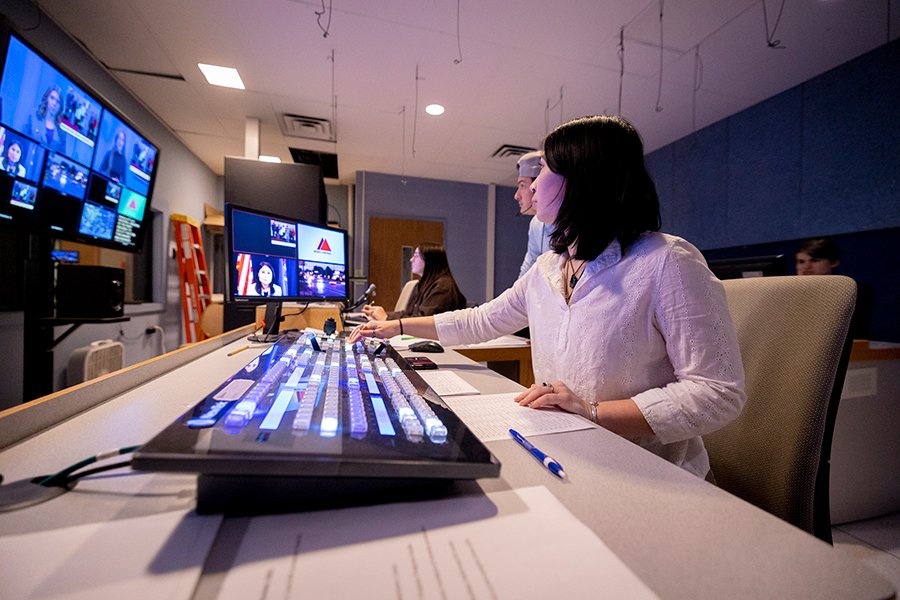
Experiential learning in the School of Communication, Journalism and Media
Learning-by-doing is at the core of the CMU educational experience. In the College of the Arts and Media, this truth comes to life in the research of faculty and students, opportunities for media production and in the planning of cultural events.
Request Information about CMU
Loading...
By submitting this form, I agree to receive calls, emails and/or text messages from Central Michigan University to discuss furthering my education.