Now through October 31, we're waiving application fees for all freshman and transfer applicants!
*Common app code: Central27

Earth and Ecosystem Science
M.S.
Earth and ecosystem science overview
The Earth and Ecosystem Science master's degree takes a systems-level approach to studying how natural environments work. Drawing from atmospheric science, geology, biology, chemistry and mathematics, this multidisciplinary program prepares you to analyze, manage and solve real-world environmental challenges—whether you're pursuing a career as an environmental engineer, research scientist or resource manager.
AT A GLANCE
Degree Type
Master of Science (M.S.)
Format
On Campus
Credit Hours
30 Credit Hours
Why choose a master’s in earth and ecosystem science?
If you're passionate about research-driven science, the earth and ecosystem science master's degree is built for you. You'll pursue hypothesis-driven and discovery-driven research alongside experienced faculty—whether your goal is to work as an environmental engineer, a research scientist or a policy advisor.
Current projects include:
- Studying invasive species in the Great Lakes.
- Building and monitoring regional storm warning systems.
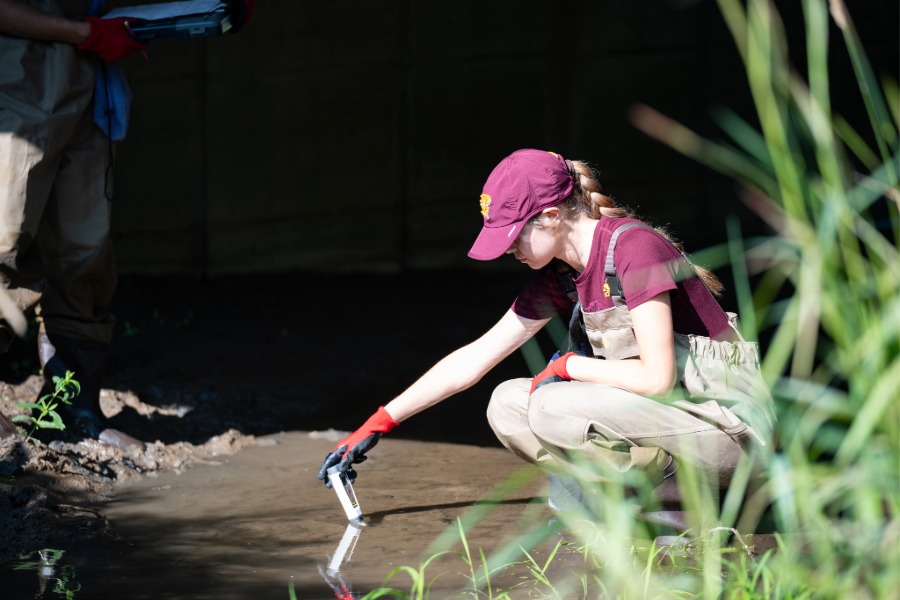
- Tracking contaminant transport in groundwater, air and soil, with applications relevant to environmental engineers and resource managers.
- Advancing carbon capture, renewable energy and critical mineral research.
Through the earth and ecosystem science master's degree, you'll develop the skills to investigate ecosystem behavior, understand environmental change and apply solutions across a range of spatial and temporal scales—capabilities that are highly valued across private and public sector professions.
Earth and ecosystem science graduate degree coursework
You’ll work with your faculty advisor to choose courses that support your research in the earth and ecosystem science master’s degree, which may include: ecosystem science, environmental data analysis, hydrology, biogeochemistry, atmospheric processes, GIS and remote sensing and quantitative modeling. Electives may include environmental policy, ecological risk assessment and sustainability systems—topics that directly support careers as an environmental engineer or research scientist. Throughout the program, you'll gain hands-on experience through field, laboratory and computational work tailored to your interests and career goals.
As a student in the earth and ecosystem science master's degree, you'll also receive:
- Training in professional scientific communication.
- Foundational instruction in research ethics.
- Research internship opportunities that prepare you for roles as an environmental engineer, research scientist or policy professional.
- Directed research with faculty mentors, a defining feature of the earth and ecosystem science master's degree experience.
Tailor your earth and ecosystem science master's degree to your career goals. The thesis track requires original research and a formal defense, while the non-thesis track focuses on advanced coursework and a capstone project. Both options build your skills in scientific communication, ethics and analysis—preparing you for technical roles such as environmental engineer or research scientist or for further graduate study.
Highlights of the earth and ecosystem science master’s degree
As a student in the earth and ecosystem science master's degree, you will:
- Get personalized mentorship: Work closely with faculty who guide your earth and ecosystem science master's degree research one-on-one.
- Tackle real-world problems: Engage in interdisciplinary projects on climate change, severe weather and critical mineral resources
- Build technical skills: Strengthen the analytical, critical thinking and communication abilities across field, lab and computational settings—skills highly valued by employers hiring environmental engineers and research scientists.
- Grow professionally: Present at national and international conferences, expand your network and build a strong résumé that sets you apart—whether your goal is to become an environmental engineer, a research scientist or to advance to a doctoral program.
Careers in earth and ecosystem science
This degree prepares you for roles in government, non-profits and private firms or for doctoral study. Graduates work as environmental engineers, research scientists, resource managers and policy advisors, equipped to assess environmental challenges, guide decisions and manage natural resources.
| Career | Projected Salary |
|---|---|
| Environmental Scientist | $80,060 |
| Environmental Specialist | $80,060 |
| Environmental Engineer | $104,170 |
| Conservation Scientist/Forester | $69,060 |
| Meteorologist | $97,450 |
| College Professor/Instructor | $83,980 |
| Zoologist and Wildlife Biologist | $72,860 |
Request Information about CMU
Loading...
By submitting this form, I agree to receive calls, emails and/or text messages from Central Michigan University to discuss furthering my education.